

Editorial Disclaimer: Smart Update24 verifies information through official websites, government notifications, and trusted sources before publication. Our team also conducts independent research and analysis to provide accurate information to readers; however, users are advised to verify important details from the respective official websites for final confirmation.
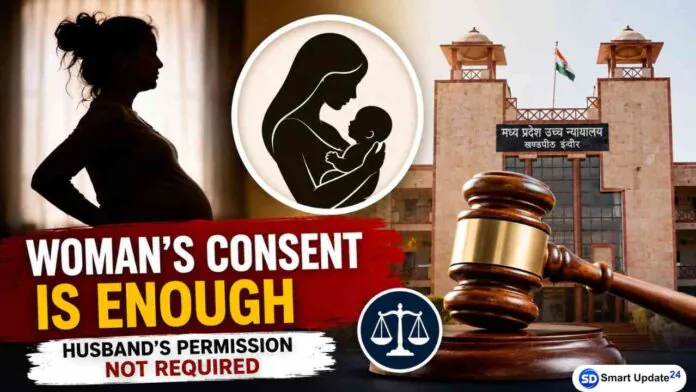
Madhya Pradesh High Court Women’s Rights: The Madhya Pradesh High Court has granted a woman permission to terminate her 13-week pregnancy, ruling that, in the eyes of the law, her consent alone is sufficient. The Court noted that there is no legal requirement for the consent of her estranged husband or for prior judicial approval.
The woman had approached the Court citing mental trauma and a sense of insecurity after her husband backed out of a mutual consent divorce agreement. Citing various Supreme Court judgments regarding reproductive autonomy, the State also raised no objection to the matter. The High Court reaffirmed that the woman holds the sole right to make decisions regarding her pregnancy.
In a significant observation reinforcing a woman’s reproductive autonomy, the Madhya Pradesh High Court has stated that a married woman does not require her husband’s permission to become a mother. The court emphasized that decisions regarding pregnancy and childbirth rest primarily with the woman, as they directly affect her body, health, and personal liberty.

The ruling has sparked widespread discussion on women’s reproductive rights and constitutional freedoms across the country.
Madhya Pradesh High Court Women’s Rights: What Did the Court Say?
According to the court’s observation, a woman’s decision to conceive or continue a pregnancy is a deeply personal choice. Since pregnancy involves physical, emotional, and medical consequences that are borne by the woman, her consent is the deciding factor.
The court observed that a husband’s consent is not legally mandatory for a woman to give birth to a child.
The observation highlights the importance of protecting a woman’s dignity, bodily autonomy, and right to make reproductive decisions independently.
Why Is This Judgment Important?
The ruling is being seen as a major step toward strengthening women’s rights in India. It reiterates that reproductive choices are closely linked to fundamental rights guaranteed under the Constitution, including the right to life, privacy, dignity, and personal liberty.
Legal experts believe that the observation reinforces the principle that women should have control over decisions related to their own bodies.
Focus on Women’s Reproductive Rights
Over the years, Indian courts have repeatedly recognized that reproductive decisions belong primarily to women. These rights include:
- The right to decide whether to become a mother.
- The right to make informed reproductive choices.
- The right to bodily autonomy and privacy.
- Protection of personal liberty under constitutional principles.
The latest observation by the Madhya Pradesh High Court further strengthens this legal approach.
What Does It Mean for Married Women?
The observation suggests that a married woman’s choice regarding pregnancy cannot be made conditional on her husband’s approval. Instead, her independent consent carries legal significance in matters concerning childbirth.
While family discussions and mutual understanding remain important in personal relationships, the court has underlined that the legal right over reproductive decisions ultimately belongs to the woman.
Also Read: UPI Goes Global | Full List of Countries Accepting India’s UPI Payments in 2026
Madhya Pradesh High Court Women’s Rights: Why This Decision Is Being Widely Discussed
The judgment has attracted national attention because it addresses an issue that affects many families. Women’s rights groups have welcomed the emphasis on bodily autonomy, while legal experts say the observation aligns with constitutional values and previous Supreme Court principles on reproductive freedom.
The ruling has also generated debate on social media regarding gender equality, family law, and individual rights.
The Madhya Pradesh High Court’s observation marks another important moment in the ongoing discussion about women’s reproductive rights in India. By recognizing that a woman’s consent is sufficient in decisions related to childbirth, the court has reaffirmed the importance of personal liberty, dignity, and bodily autonomy.
As discussions continue, the judgment is expected to contribute to a broader understanding of reproductive rights and gender equality in the country’s legal framework.
Know More: https://www.instagram.com/reel/Daf8NGhDFwa/
