

Editorial Disclaimer: Smart Update24 verifies information through official websites, government notifications, and trusted sources before publication. Our team also conducts independent research and analysis to provide accurate information to readers; however, users are advised to verify important details from the respective official websites for final confirmation.
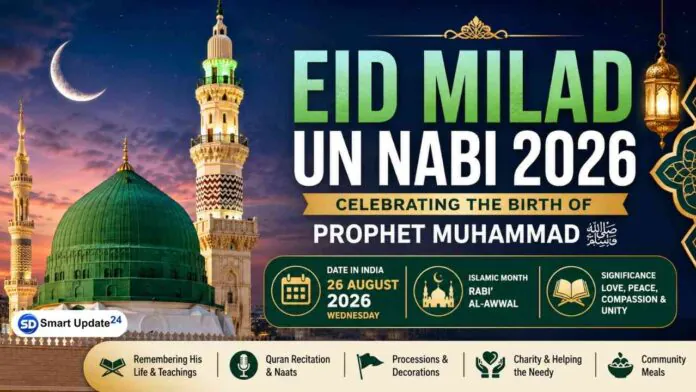
Eid Milad un Nabi 2026 will be observed in India on Wednesday, August 26, 2026, according to the Central Government holiday calendar. Also known as Milad-un-Nabi, Mawlid al-Nabi or Eid-e-Milad, the occasion commemorates the birth of Prophet Muhammad, regarded by Muslims as the final prophet and messenger of God.
The observance falls in Rabi’ al-Awwal, the third month of the Islamic lunar calendar. Because the Islamic calendar is based on the lunar cycle and religious dates can depend on local moon sighting, the observance may vary by a day in some regions. For India, however, August 26, 2026 is listed as the official holiday date.
Eid Milad un Nabi is not simply about a date on the calendar. For Muslims who observe Mawlid, it is an opportunity to remember the life, character, teachings and message of Prophet Muhammad and to reflect on values such as compassion, kindness, justice, patience and generosity.

When Is Eid Milad un Nabi 2026?
In India, Eid Milad un Nabi will be observed on August 26, 2026, Wednesday.
The Government of India’s holiday information lists Milad-un-Nabi on August 26, while India’s official tourism portal describes the celebration period as beginning on the evening of August 25 and continuing through August 26.
Related Article: Kingston Law College Recruitment 2026 | Teaching and Administrative Posts, Eligibility and How to Apply
Eid Milad un Nabi 2026 at a glance
- Festival: Eid Milad un Nabi / Milad-un-Nabi / Mawlid
- Year: 2026
- Date in India: Wednesday, August 26, 2026
- Islamic month: Rabi’ al-Awwal
- Significance: Commemoration of the birth of Prophet Muhammad
- Celebrated by: Muslim communities in India and around the world
- Holiday status in India: August 26 is listed as a gazetted Central Government holiday, although state and institutional holiday arrangements can differ.
What Is Eid Milad un Nabi?
Eid Milad un Nabi literally refers to the commemoration of the birth of Prophet Muhammad. The celebration is also widely known as Mawlid al-Nabi or simply Mawlid.
The occasion is associated with the 12th day of Rabi’ al-Awwal in many Muslim traditions. However, there are differences among Muslim scholars and communities regarding the exact historical date of the Prophet’s birth and whether Mawlid should be formally celebrated.
The Islamic Society of North America notes that many Muslim communities commemorate the occasion through Quran recitation, gatherings, charity, and discussions about the Prophet’s life, while some Muslims do not observe Mawlid because they believe it was not practiced by the Prophet or his companions.
Therefore, Eid Milad un Nabi is observed differently across Muslim communities. Some celebrate it publicly with large gatherings and processions, while others mark the occasion more privately through prayer, religious study and reflection.
Who Was Prophet Muhammad?
Prophet Muhammad was born in Mecca in approximately 570 CE, according to the traditional historical account. He belonged to the Quraysh tribe and the Banu Hashim clan.
His father, Abdullah, died before or around the time of his birth, and his mother, Amina, died when he was still a child. He was subsequently cared for by his grandfather and later by his uncle, Abu Talib.
As a young man, Muhammad worked as a shepherd and later became a successful merchant. He became known for his honesty and trustworthy character. At the age of 25, he married Khadijah, a respected businesswoman.
His life changed profoundly when he was around 40 years old.
The First Revelation and the Beginning of Prophethood
According to Islamic tradition, Prophet Muhammad used to spend time in spiritual reflection in the Cave of Hira, near Mecca.
Around 610 CE, he received his first revelation through the angel Gabriel, beginning the revelation of the Quran. He subsequently began calling people towards the belief in one God and teaching principles of faith, morality, justice and social responsibility.
His message gradually attracted followers, but it also brought opposition and persecution in Mecca.
For many years, Muhammad and his followers faced serious difficulties. Despite this, the Muslim community continued to grow.
The Hijrah: Migration From Mecca to Medina
In 622 CE, Prophet Muhammad and his followers migrated from Mecca to the city of Yathrib, later known as Medina.
This migration, known as the Hijrah, became one of the most important events in Islamic history and marks the starting point of the Islamic calendar.
In Medina, Muhammad helped establish a growing Muslim community and became both a religious and community leader. The city became an important centre from which Islam spread across Arabia.
Prophet Muhammad’s Later Life
Over the following years, Islam spread considerably across the Arabian Peninsula. Prophet Muhammad eventually returned to Mecca, where he established the Muslim community’s control over the city.
He continued teaching his followers about faith, worship, morality, social justice, forgiveness and responsibility towards others.
His final years were spent in Medina. Prophet Muhammad died in 632 CE in Medina.
For Muslims, his life remains the central example of how Islamic teachings can be put into practice in everyday life.
Why Is Eid Milad un Nabi Celebrated?
For Muslims who observe Mawlid, the primary purpose is to remember the birth and life of Prophet Muhammad and to reflect on his teachings.
The occasion is associated with values such as:
- Compassion towards others
- Kindness and generosity
- Forgiveness
- Justice and fairness
- Patience during difficulties
- Respect for parents and family
- Helping people in need
- Peace and harmony
- Strong faith and devotion
The celebration therefore goes beyond remembering the historical event of the Prophet’s birth. It is also an opportunity for believers to learn more about his character and try to follow his example.
India’s official tourism portal describes Eid-e-Milad as a celebration that highlights love, compassion, unity and the continuing influence of the Prophet’s teachings.
How Is Eid Milad un Nabi Celebrated?
The way Eid Milad un Nabi is observed varies significantly from country to country and even between different Muslim communities.
In India, celebrations can include religious gatherings, Quran recitation, lectures, naats, prayers, charity and community meals.
1. Special Religious Gatherings
Many communities organise gatherings at mosques, Islamic centres and community halls.
Religious scholars and speakers may discuss the life of Prophet Muhammad, his teachings and important events from Islamic history.
2. Recitation of the Quran
Quran recitation and religious discussions are common parts of the observance in communities that celebrate Mawlid.
The focus is generally on remembering God and learning from the Prophet’s teachings.
3. Naats and Religious Poetry
Naats, or devotional poetry praising Prophet Muhammad, are performed or recited during many Milad gatherings.
These programmes can attract large audiences, particularly in South Asia.
4. Processions
In several parts of India, colourful processions are organised during Eid Milad un Nabi.
Participants may carry banners and religious symbols while reciting naats and prayers. Streets, mosques and homes may also be decorated with lights and banners.
5. Charity and Helping the Poor
Charity and helping people in need are important themes associated with the occasion.
Some communities distribute food, clothes and other necessities to people who need assistance.
This reflects the emphasis placed on generosity and compassion in Islamic teachings.
6. Community Meals
Community meals are another feature of Eid-e-Milad celebrations in many places.
Mosques and community organisations may arrange meals where people gather together and share food.
7. Decorations and Illuminations
Homes, mosques, streets and community buildings may be decorated with lights, banners and other festive arrangements.
In many Indian cities, the decorations create a distinctive festive atmosphere during the Milad period.
Eid Milad un Nabi in India
Eid-e-Milad has a significant cultural and religious presence in India.
From large cities to smaller towns, Muslim communities may observe the occasion through prayers, religious programmes, processions, charity and communal gatherings.
India’s official tourism portal highlights celebrations in different parts of the country, including colourful processions, illuminated streets, religious gatherings, naats and community meals.
The celebration also reflects India’s diverse cultural traditions, with local customs influencing the way communities observe the occasion.
Is Eid Milad un Nabi a Government Holiday in India in 2026?
Yes. August 26, 2026 is listed as a gazetted holiday for Milad-un-Nabi / Id-e-Milad in the Central Government holiday calendar.
However, holiday arrangements can differ for state government offices, schools, private companies and other institutions. Bank holidays are also determined according to the RBI’s location-specific holiday calendar.
For example, RBI holiday information reported for 2026 shows Milad-un-Nabi-related closures on August 25 in some centres and August 26 in several other cities and states.
Therefore, anyone planning official or banking work around Eid Milad un Nabi should check the holiday notification applicable to their state, district or institution.
Is Eid Milad un Nabi the Same as Eid al-Fitr or Eid al-Adha?
No.
Although all three occasions are important to many Muslims, they have different meanings.
Eid al-Fitr marks the end of Ramadan, the Islamic month of fasting.
Eid al-Adha is associated with the sacrifice and devotion of Prophet Ibrahim and is celebrated during the Islamic month of Dhu al-Hijjah.
Eid Milad un Nabi, meanwhile, commemorates the birth of Prophet Muhammad and focuses on remembering his life, character and teachings.
Why Does the Date Change Every Year?
The Islamic calendar is a lunar calendar, unlike the Gregorian calendar used for most official dates in India.
As a result, Islamic months move through the Gregorian calendar from year to year.
Eid Milad un Nabi is associated with Rabi’ al-Awwal, the third month of the Islamic calendar. The exact Gregorian date can therefore change each year.
In 2026, the Indian Central Government calendar lists Eid Milad un Nabi on August 26. Some religious communities may determine the observance according to local moon sighting, which can sometimes result in a difference of one day.
What Is the Main Message of Eid Milad un Nabi?
For those who observe it, the deeper message of Eid Milad un Nabi is not limited to celebration.
It is a time to remember a religious figure whose life is central to Islam and to reflect on qualities that Muslims associate with his example.
Compassion, patience, forgiveness, honesty, generosity and concern for others are among the values commonly emphasised during Milad gatherings.
The occasion can therefore become a moment of personal reflection: how can these qualities be brought into family life, society and relationships with other people?
Different Views About Mawlid
It is important to recognise that Muslims do not have a single universal view about Eid Milad un Nabi.
Many Muslims, particularly across South Asia and other parts of the world, observe Mawlid through religious gatherings, Quran recitation, naats, charity and lectures about the Prophet’s life.
At the same time, some Muslim scholars and communities do not celebrate Mawlid as a religious festival, arguing that the Prophet Muhammad and his companions did not establish such a celebration.
The diversity of views is well documented among Muslim communities. The Islamic Society of North America notes that both approaches exist among Muslims and that practices differ across regions and traditions.
Eid Milad un Nabi 2026: A Day of Remembrance and Reflection
As Eid Milad un Nabi 2026 approaches on August 26, millions of Muslims in India and around the world will remember Prophet Muhammad and reflect on his life and teachings.
For many communities, the day will bring together prayer, religious gatherings, naats, charity, food distribution, family gatherings and community celebrations.
The occasion also provides an opportunity to think beyond the festivities and focus on values such as compassion, kindness, justice, forgiveness and service to others.
Whether observed through a large public gathering or a quiet moment of personal reflection, Eid Milad un Nabi remains an important occasion for Muslims who commemorate the Prophet’s birth.
Eid Milad un Nabi 2026 will be observed in India on Wednesday, August 26, with the celebration period beginning in many communities from the evening of August 25. Because local religious observance can depend on moon sighting, people are advised to follow announcements from their local religious authorities as well as the applicable government holiday calendar.
Eid Mubarak to everyone observing Eid Milad un Nabi 2026.
