

Editorial Disclaimer: Smart Update24 verifies information through official websites, government notifications, and trusted sources before publication. Our team also conducts independent research and analysis to provide accurate information to readers; however, users are advised to verify important details from the respective official websites for final confirmation.
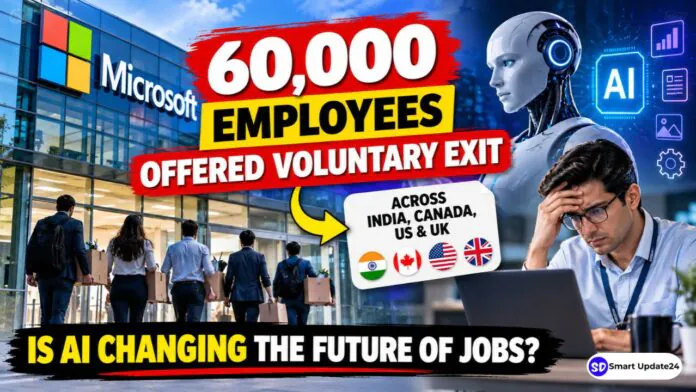
Microsoft Voluntary Exit Offer 2026: Microsoft has announced a new voluntary exit programme that could affect around 60,000 eligible employees across India, the United States, the United Kingdom, and Canada. The announcement, made on October 26, 2026, has renewed concerns about job security as major technology companies increase their investments in artificial intelligence (AI).
However, there is an important distinction: Microsoft has not announced the compulsory layoff of 60,000 employees. The company is offering eligible workers the option to leave voluntarily with financial support and career-planning resources. The actual number who accept the offer has not been announced.
The development raises a wider question for professionals around the world: as AI tools become more capable, how secure will traditional jobs remain, and what should workers do to prepare for a changing employment market?

What Is Microsoft’s Voluntary Exit Offer?
Microsoft’s new programme, officially called the Voluntary Exit Offer (VEO), is available to eligible employees in participating teams in India, the US, the UK and Canada. It covers employees at internal level 70 and below, although not every employee or department is included.
The programme offers financial support and career-transition resources to eligible staff who choose to leave. Microsoft has not announced a target number of departures, and the offer should not be interpreted as a decision to remove all 60,000 eligible employees.
The move comes after earlier workforce reductions and a voluntary retirement programme. At the same time, Microsoft is spending heavily on AI infrastructure and expanding its AI-related products and services. The company has not explicitly stated that replacing employees with AI is the reason for this latest offer.
Is Artificial Intelligence Making Traditional Jobs Less Secure?
The growing capabilities of AI tools are changing how companies approach hiring, productivity and staffing. Tasks that once required several employees can increasingly be completed with software assistance, particularly in areas involving routine writing, data processing, customer support and digital content production.
For workers, the concern is not limited to immediate job losses. Employers may also reduce recruitment for certain positions, reorganise teams or expect existing employees to handle more work using AI tools.
A Stanford Digital Economy Lab study, revised in August 2026, found that employment among workers aged 22 to 25 in AI-exposed occupations was 19% below the level expected if it had kept pace with less-exposed peers. The researchers linked this difference primarily to reduced hiring, while finding no evidence of widespread, economy-wide job displacement.
This suggests that the impact of AI may appear first in fewer entry-level opportunities in some occupations rather than in mass unemployment across the entire economy.
Microsoft Voluntary Exit Offer: Creative Industries Face a Period of Change
Creative and communication professionals are among those adapting to new AI-powered tools. Animation, graphic design, advertising, digital publishing and content production now have software capable of generating initial drafts, illustrations, layouts and other creative assets.
Businesses may use these tools to reduce production time and costs. As a result, some employers may need fewer people for repetitive production tasks, while demand may shift towards professionals who can supervise AI-generated work, maintain quality and develop original ideas.
However, it would be premature to conclude that creative jobs are disappearing altogether. Early research published by Gallup in May 2026 found no clear evidence of widespread AI-driven employment or earnings declines across artistic occupations in the United States. The evidence points towards changing workflows rather than the complete disappearance of creative work.
The practical challenge for designers, writers, animators and digital marketers is to combine technical skills with originality, critical thinking and an understanding of what audiences and clients actually need.
Are Education and Research Jobs Also at Risk?
The influence of AI extends beyond the technology industry. Educational institutions, research organisations and private colleges are exploring AI tools for administrative work, content development, data analysis and student support.
These applications may change staffing requirements for some routine tasks. Yet there is not enough evidence to claim that education and research have suffered the greatest AI-related job losses worldwide.
Teachers, researchers and academic professionals still perform work involving human judgement, mentoring, complex investigation and accountability. AI may assist with parts of these responsibilities, but the effect on employment will depend on how individual institutions adopt the technology and organise their workforce.
In India, professionals working in private education and training may benefit from learning to use AI tools while strengthening their subject knowledge, communication skills and practical expertise.
Microsoft Voluntary Exit Offer: Why Physical and Skilled Technical Work May Offer Different Opportunities
Jobs involving installation, maintenance, repair, construction and hands-on production can be more difficult to automate completely because they require physical interaction with equipment and unpredictable real-world environments.
Electricians, mechanics, technicians and other skilled tradespeople may therefore have different exposure to AI than workers whose responsibilities consist mainly of routine digital tasks.
That does not mean these occupations are completely protected. Robotics, automated machinery and AI-assisted diagnostic systems can also change technical work. However, combining practical skills with digital knowledge can help workers adapt as technology evolves.
For young people choosing a career, vocational education, apprenticeships and industry-recognised technical training are worth considering alongside conventional academic qualifications.
Should Students Rethink Their Career Plans?
The Microsoft announcement is a reminder that a degree or a prestigious employer alone cannot guarantee lifelong job security. At the same time, it does not mean that university education, an MBA or a conventional corporate career has become worthless.
Students and working professionals can take several practical steps to prepare for change:
- Learn to use AI effectively: Understand the tools relevant to your profession and where human review remains necessary.
- Build practical skills: Develop capabilities that can be demonstrated through projects, work experience or recognised qualifications.
- Strengthen human skills: Communication, leadership, problem-solving, negotiation and sound judgement remain important.
- Keep learning throughout your career: Update your knowledge as tools, industries and job requirements change.
- Develop financial resilience: Build savings where possible and avoid depending entirely on a single source of income.
- Explore business opportunities carefully: Entrepreneurship can offer another career path, but it involves financial risks and is not a guaranteed alternative to employment.
The goal should not be to abandon education or rush into starting a business. It should be to build a career that can adapt when the employment market changes.
The Future of Work: Adaptation Will Matter More Than Panic
Microsoft’s voluntary exit offer has brought job security back into the spotlight. For thousands of eligible employees, the decision to accept a financial package and leave a familiar workplace may involve difficult personal and professional considerations.
For everyone else, the larger lesson is about preparation. AI is changing how businesses operate, but the scale and speed of its effect on employment remain uncertain. Some tasks may disappear, some roles may evolve, and new opportunities may emerge.
Workers who combine professional expertise, practical experience, and the ability to use new technology will be better positioned to respond to these changes.
The important question is no longer simply whether AI will change your job. It is whether you are preparing for the changes that may come.
