

Editorial Disclaimer: Smart Update24 verifies information through official websites, government notifications, and trusted sources before publication. Our team also conducts independent research and analysis to provide accurate information to readers; however, users are advised to verify important details from the respective official websites for final confirmation.
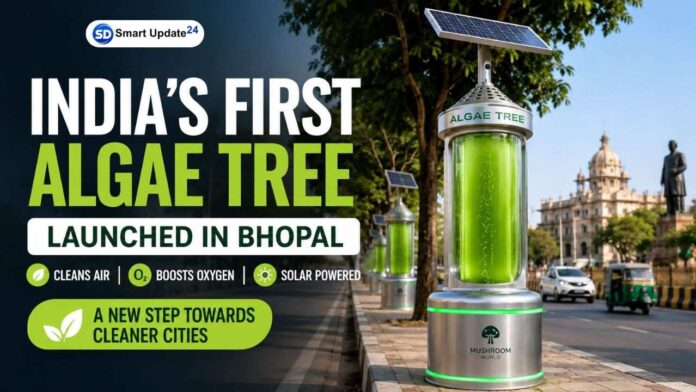
Algae Tree: India’s first ‘ALGAE TREE’ has been installed in Bhopal. This solar-power system absorbs CO2 from the air and releases oxygen. India has taken a step toward combining biotechnology and environmental innovation with the launch of its first “Algae Tree” in Bhopal, Madhya Pradesh.
It claims that one unit does the work of 20-25 trees and can reduce 1.5 tons of CO2 annually.
The newly introduced system was officially inaugurated on May 1, 2026, at Swami Vivekananda Park and is being seen as an experimental approach to tackling air pollution in crowded urban areas.

Designed as a modern air purification solution, the technology aims to support cities where space limitations often make traditional tree plantations difficult.
What Is an Algae Tree?
Unlike a conventional tree, an Algae Tree is a biotechnology-based structure designed to improve air quality through a specialized photo-bioreactor system. The unit uses algae, which naturally absorb carbon dioxide and release oxygen during photosynthesis.
Standing 3 meters tall, this solar-powered biotech structure functions as a highly efficient urban air purifier by utilizing a specialized ‘photo-bioreactor’ system. The result of two years of research by a team of over 50 experts, this innovative device—developed by the ‘Mushroom World Group’—targets those highly pollution-prone urban areas where traditional tree planting is rendered unfeasible due to narrow streets or concrete structures.
The structure installed in Bhopal stands around three metres tall and runs on solar energy, making it an environmentally friendly system with low external energy requirements.
Experts say algae can absorb carbon dioxide at a much faster rate than many conventional plants, which is why such systems are increasingly being explored worldwide for pollution management.
Algae Tree: Developed After Two Years of Research
The project was developed by Mushroom World Group after nearly two years of research and development. According to the information released, a team of more than 50 experts contributed to the project.
The objective behind the initiative was to create a solution for urban spaces where planting large numbers of trees may not be practical due to limited land availability, traffic congestion, narrow roads, and dense concrete infrastructure.
A Possible Solution for High-Pollution Urban Areas
Major cities across India continue to face increasing air pollution challenges. While tree plantation remains one of the most effective long-term environmental solutions, several urban areas struggle with space constraints.
The Algae Tree is designed to complement traditional greenery rather than replace it. Such systems could potentially be installed in busy traffic zones, commercial areas, public spaces, and locations with limited open land.
Supporters of the concept believe these structures may help improve urban air quality while creating awareness around sustainable technologies.
Also Read: Geo-Tag App Enabled | Kolkata Plans for Faster Garbage Clean-Up Across the City
Can Technology Replace Natural Trees?
The launch of the Algae Tree has also sparked discussions among people online. Many believe technology can support environmental protection efforts, but natural forests and tree plantations remain essential for ecological balance, biodiversity, and shade.
Environmental experts generally emphasize that technological innovations should work alongside nature-based solutions instead of replacing them.
A New Chapter in India’s Environmental Innovation
The launch of India’s first Algae Tree in Bhopal reflects a growing focus on smart environmental technologies. As cities continue to expand and pollution concerns rise, projects like these may become part of future urban sustainability strategies.
Whether the technology becomes widely adopted will depend on long-term performance, effectiveness, and how well it integrates into real-world city environments.
Know More: https://algaetree.in/
