

Editorial Disclaimer: Smart Update24 verifies information through official websites, government notifications, and trusted sources before publication. Our team also conducts independent research and analysis to provide accurate information to readers; however, users are advised to verify important details from the respective official websites for final confirmation.
Bharat NCAP 2.0: For years, Indian car buyers have mainly looked at price, mileage, design, features, and engine performance before buying a new car. But one factor has become increasingly important: safety.

Now, India’s vehicle safety assessment system is preparing for a major change.
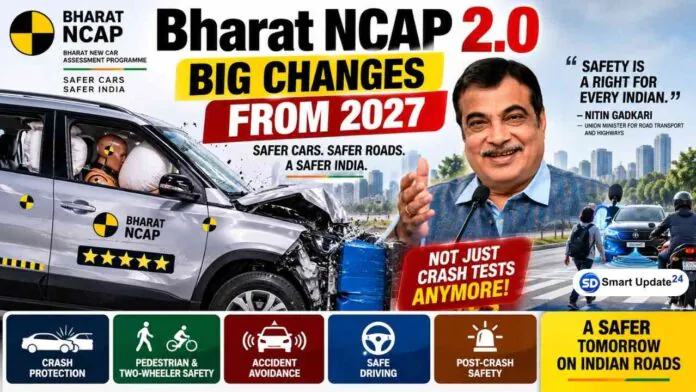
Union Road Transport and Highways Minister Nitin Gadkari has announced plans to introduce Bharat NCAP 2.0 from October 2027. The new system is expected to go beyond traditional crash testing. It will look not only at how well a car protects passengers during a crash, but also at whether the vehicle can help prevent accidents, protect pedestrians and two-wheeler users, and improve safety after a crash.

In other words, the definition of a “safe car” is about to become much broader.
Related Article: Seva Sampark Abhiyan 2026 | From September 17 to Mark PM Modi’s Birthday
What is Bharat NCAP?
Bharat NCAP stands for Bharat New Car Assessment Programme.
It is India’s own vehicle safety assessment programme under which eligible passenger vehicles are tested against specified safety criteria and awarded a star safety rating.
A higher star rating indicates stronger performance under the programme’s assessment criteria.
The programme was launched in 2023 to give Indian consumers better information about vehicle safety and to encourage automobile manufacturers to develop safer vehicles.
Instead of simply relying on a company’s list of safety features, buyers can look at independent crash-test performance when comparing cars.
Why was Bharat NCAP introduced?
Before Bharat NCAP, Indian consumers often had limited easy-to-understand information about how different cars performed in crashes.
A car could have airbags, ABS, seat belts and other safety equipment, but those features alone could not tell the complete story.
A crash-test rating makes comparison easier.
For example:
Car A: 5-Star Bharat NCAP
Car B: 2-Star Bharat NCAP
This immediately gives the buyer an indication that the two vehicles have performed differently under the assessment programme.
The broader objective is to encourage consumers to choose safer vehicles while pushing manufacturers to compete more strongly on safety.
So, what exactly is Bharat NCAP 2.0?
Bharat NCAP 2.0 is the proposed next generation of India’s vehicle safety assessment system.
The biggest change is that safety will no longer be viewed only from the perspective of what happens during a crash.
The new approach asks several additional questions:
- Can the vehicle help prevent a crash?
- How well does it protect pedestrians?
- How well does it protect cyclists and two-wheeler users?
- Does it have modern accident-avoidance technology?
- What happens to the occupants after a serious crash?
- Can people be rescued easily from the vehicle?
This is why Bharat NCAP 2.0 is being described as a broader assessment of the entire safety chain.
When will Bharat NCAP 2.0 start?
The proposed transition is targeted for October 2027.
The current Bharat NCAP framework is expected to remain relevant until the end of September 2027, with the new framework planned to take effect from October.
However, buyers should remember that some technical provisions can change before the final rules are officially implemented.
The New 100-Point Safety System
One of the most important proposed changes is a broader 100-point scoring system.
The proposed framework divides vehicle safety into five major areas:
| Safety Area | Points |
|---|---|
| Crash Protection | 55 |
| Vulnerable Road User Protection | 20 |
| Safe Driving | 10 |
| Accident Avoidance | 10 |
| Post-Crash Safety | 5 |
| Total | 100 |
This tells us something important.
A vehicle will no longer be judged only by how strong its body structure is in a crash.
Its ability to avoid crashes and protect people outside the vehicle will also matter.
1. Crash Protection: 55 Points
Crash protection remains the largest part of the assessment.
Under the proposed system, vehicles will face a wider range of crash scenarios, including:
- Frontal impact
- Full-width frontal impact
- Side impact
- Oblique pole impact
- Rear impact
Crash-test dummies are used to measure the potential injuries suffered by adults and children. This is important because real-world crashes can happen in many different ways. A vehicle that performs well in one type of crash may not necessarily perform equally well in another. Bharat NCAP 2.0 therefore aims to provide a more comprehensive picture of a vehicle’s crash protection.
2. Pedestrian and Two-Wheeler Safety: 20 Points
This could be one of the most important changes.
Indian roads are shared by:
- Cars
- Motorcycles
- Scooters
- Bicycles
- Pedestrians
- Other road users
Until now, vehicle safety discussions have often focused heavily on people sitting inside the car.
Bharat NCAP 2.0 gives much greater importance to people outside the vehicle.
The proposed assessment includes pedestrian protection tests involving areas such as:
- The front bumper
- Bonnet
- Windshield area
- Adult pedestrian head impact
- Child pedestrian head impact
The system also proposes evaluating accident-avoidance technologies in situations involving pedestrians and motorcyclists.
This means manufacturers will have to think more carefully about what happens when a car comes into contact with someone outside the vehicle.
3. Accident Avoidance: Can the Car Prevent a Crash?
This is where modern vehicle technology becomes particularly important. Imagine a situation where a pedestrian suddenly enters the road. The driver may not have enough time to react.
A modern safety system can detect the potential collision, warn the driver and, depending on the system and circumstances, automatically apply the brakes.
This technology is known as Autonomous Emergency Braking, or AEB.
Bharat NCAP 2.0 proposes giving greater importance to technologies such as AEB.
The idea is simple:
Don’t just make the car safer when a crash happens. Make the car better at avoiding the crash in the first place.
4. Safe Driving: Technology That Helps the Driver
Modern cars are increasingly equipped with electronic systems designed to support drivers. These technologies can help maintain vehicle stability and assist drivers in dangerous situations. One important example is Electronic Stability Control, or ESC. The proposed Bharat NCAP 2.0 framework gives greater importance to such active safety technologies. This represents a major change in how vehicle safety is evaluated.
5. Post-Crash Safety: What Happens After the Accident?
A crash does not necessarily end when the vehicle stops moving.
The situation immediately after a crash can also be dangerous.
For example:
- Doors may become difficult to open.
- Occupants may have difficulty escaping.
- Seat belts may become difficult to release.
- Fire hazards may develop.
- Electric vehicles may present electrical safety risks.
Bharat NCAP 2.0 therefore proposes a separate Post-Crash Safety category.
This looks at what happens after the collision and whether occupants can be safely rescued.
Will Getting a 5-Star Rating Become More Difficult?
Most likely, yes.
The proposed framework raises the bar for higher ratings.
The new system is designed so that a vehicle cannot depend on only one or two strong areas to achieve an excellent overall rating.
A vehicle will need to perform well across multiple aspects of safety.
That means manufacturers may have to improve:
- Structural strength
- Airbags
- Child protection
- Pedestrian protection
- Stability control
- Emergency braking
- Crash avoidance
- Post-crash safety
So a future 5-Star Bharat NCAP rating should represent a broader level of safety performance.
Will Airbags Still Matter?
Absolutely.
Airbags remain an important part of occupant protection. However, Bharat NCAP 2.0 is moving toward a more comprehensive approach.
The proposed framework includes stronger requirements around safety equipment such as curtain airbags and Electronic Stability Control for vehicles seeking a star rating. This means buyers should not simply count the number of airbags.
They should look at the complete safety package.
Does a 5-Star Car Mean It Is Accident-Proof?
No.
This is one of the most important things every car buyer should understand. A 5-Star rating does not mean that a vehicle can never crash or that occupants can never be injured. It means the vehicle has performed strongly under the specific tests and criteria used by the safety programme. Real-world accidents are unpredictable.
Even the most advanced safety technologies cannot prevent every accident.
Therefore:
5-Star Car ≠ Accident-Proof Car
Safe driving, seat-belt use, responsible speed, and following traffic rules remain essential.
What Does Bharat NCAP 2.0 Mean for Ordinary Car Buyers?
This could be the biggest benefit.
Suppose you are planning to spend ₹8 lakh, ₹10 lakh or ₹15 lakh on a new car.
You may compare:
- Price
- Mileage
- Engine
- Boot space
- Infotainment
- Sunroof
- Design
- Features
But there is another question that should be near the top of the list:
“How safe is this car?”
Bharat NCAP gives buyers a way to make that comparison using safety assessment results rather than relying only on advertisements or showroom claims.
With Bharat NCAP 2.0, buyers may get an even broader picture of safety.
What Should You Check Before Buying a Car?
When buying a new vehicle, don’t look only at the star number.
Check:
1. Does the specific model have a Bharat NCAP rating?
2. Which version of Bharat NCAP was used?
3. How did it perform in adult occupant protection?
4. How did it perform in child occupant protection?
5. Does it have ESC?
6. Does it have curtain airbags?
7. Does it have AEB or other active safety systems?
8. How does it perform in pedestrian protection?
9. How does it compare with other cars in the same price range?
This can help you make a more informed buying decision.
What Does Bharat NCAP 2.0 Mean for Car Manufacturers?
The new system could create significant pressure on manufacturers.
A company may have to improve not only the structural design of a vehicle but also its electronic safety systems.
Future vehicle development could increasingly focus on:
Strong body structure + airbags + stability control + pedestrian protection + accident avoidance + post-crash safety
This could ultimately push safety technology into more vehicles and more price segments.
Why Is India Making These Changes?
The biggest reason is road safety.
India has a very large road network and millions of vehicles. Reducing serious injuries and deaths caused by road crashes requires more than just better driving behaviour. Vehicle design and technology also matter.
The government’s broader objective is to create an environment where manufacturers have stronger incentives to build safer vehicles and consumers have better information when choosing them.
Could Bharat NCAP 2.0 Change the Way Indians Buy Cars?
Very possibly.
For years, buyers often asked:
“What’s the mileage?”
Then:
“How many airbags does it have?”
Increasingly, the question has become:
“What’s the NCAP rating?”
With Bharat NCAP 2.0, the conversation could become even more detailed.
Instead of simply asking whether a car has airbags, buyers may start asking:
Can it prevent a collision?
How does it protect a pedestrian?
How does it protect children?
What happens after a serious crash?
That would be a major change in consumer thinking.
The Bigger Picture
The most important thing about Bharat NCAP 2.0 is not simply the number of stars.
It is the change in philosophy.
Earlier focus:
How well does the car protect occupants during a crash?
New approach:
How well does the vehicle prevent, withstand and respond to a crash?
That means:
Before the crash → Accident avoidance
During the crash → Occupant protection
Outside the vehicle → Pedestrian and two-wheeler protection
After the crash → Rescue and post-crash safety
This is what makes Bharat NCAP 2.0 significant.
How safe is it?
Because when it comes to a car, the most valuable feature may not be the biggest screen, the sunroof or the most powerful engine.
It may simply be the technology and engineering that help bring you and your family home safely.
Note: Bharat NCAP 2.0 details are based on the proposed framework and current government announcements. Technical requirements, scoring thresholds, and implementation details may change before the final rules take effect.
