

Editorial Disclaimer: Smart Update24 verifies information through official websites, government notifications, and trusted sources before publication. Our team also conducts independent research and analysis to provide accurate information to readers; however, users are advised to verify important details from the respective official websites for final confirmation.
Election Commission Clarifies Internal Dissent 2026: The Election Commission of India (ECI) has issued a detailed clarification after recent reports raised questions about internal observations and disagreements within the poll body over electoral processes, including electoral-roll revision and the functioning of its digital systems.

In a press note dated September 23, 2026, the Commission said that written notes, observations, technical suggestions and internal checks are part of the normal functioning of a multi-member constitutional institution. It also maintained that its actions have been carried out in accordance with applicable laws, rules and Commission instructions.
The statement comes amid public discussion about reported objections by Election Commissioners regarding certain electoral decisions and processes. The ECI said that differences of opinion during the deliberative stage are a normal part of institutional decision-making and do not necessarily represent the final position of the Commission.

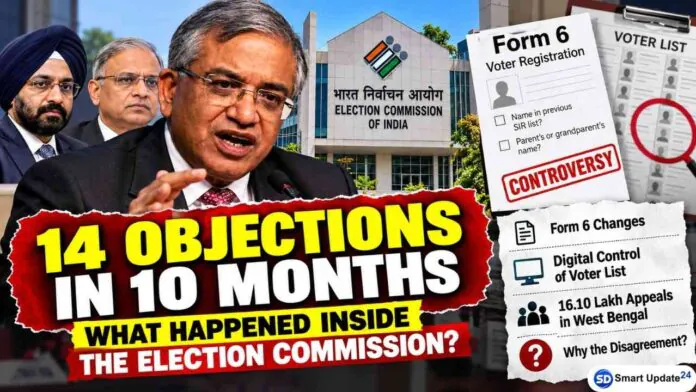
Questions over the functioning of the Election Commission of India have intensified following an investigation by The Indian Express that reported repeated written objections by Election Commissioners Sukhbir Singh Sandhu and Vivek Joshi over decisions concerning voter registration, electoral-roll management and the Commission’s digital systems.
According to the investigation, the two Election Commissioners recorded objections on at least 14 occasions over a period of 10 months. The issues reportedly included changes to Form 6 for new voters, centralisation of control over electoral-roll software, voter deletions and appeals against electoral-roll decisions in West Bengal.
The Election Commission, however, has disputed the interpretation that these objections represented a breakdown in decision-making. In its September 23 press note, the ECI said that internal observations, technical suggestions and differing views are part of the normal deliberative process and maintained that decisions of the full Commission over the past year, including SIR-related decisions, were unanimous.
ECI Clarifies Internal Dissent: What happened with Form 6?
One of the main issues concerns Form 6, the application used by people seeking registration as new voters.
According to The Indian Express investigation, an additional declaration was introduced on the online version of Form 6. Applicants were asked to indicate whether their own name, or the name of a parent or grandparent, appeared in an electoral roll from the previous SIR exercise, or whether none of those names appeared.
The report said that Election Commissioner Sukhbir Singh Sandhu objected to the change, describing it in an August note as unauthorised and illegal and asking that it be removed. The report also said that the additional declaration remained on the online form for some time afterwards.
This has become one of the central questions in the dispute because the issue concerns the information being sought from first-time voters during the registration process.
What does Section 18(2) of the 2023 law say?
The legal provision cited in the debate is Section 18 of the Chief Election Commissioner and Other Election Commissioners (Appointment, Conditions of Service and Term of Office) Act, 2023.
Section 18(2) provides that the Commission’s business should, as far as possible, be conducted unanimously. Where the Chief Election Commissioner and the other Election Commissioners differ on a matter, the law says that the matter is to be decided according to the majority opinion.
That provision is important to understanding the current controversy. It does not mean that every written objection automatically becomes a formal Commission decision. The key factual question is whether a particular matter was formally placed before the full Commission for decision, what positions the members took at that stage, and what decision was ultimately recorded.
The available reports do not establish that every one of the 14 objections constituted a formal vote in which Sandhu and Joshi formed a majority against the CEC. That distinction is important when interpreting the dispute.
ELECTION COMMISSION OF INDIA Official Notification: Download
ECI says internal suggestions are part of the process
According to the Commission, operational questions or suggestions raised during the drafting stage are intended to improve electoral procedures and safeguard voters’ rights.
The ECI further stated that not only the three Election Commissioners, but officers across the Commission are authorised to provide suggestions aimed at improving the electoral system. It described differing observations as part of the process that takes place before a final decision is reached.
This clarification is significant because recent reporting had focused on internal notes and objections reportedly made over a period of around 10 months. The Commission said that looking at selected internal observations without considering the larger body of decisions, approvals and instructions provides only part of the picture.
ECI Clarifies Internal Dissent: Around 40 initiatives and electoral reforms highlighted
The Election Commission said that it has taken numerous decisions and issued instructions in recent months, besides introducing around 40 new initiatives and undertaking several electoral reforms.
These include electoral-roll revision, including the Special Intensive Revision (SIR) being carried out across the country. The Commission said these decisions were the outcome of unanimous decisions of the full Commission over the past year.
The same position was reported by multiple news organisations following the release of the statement. News On AIR also reported that the ECI described its recent decisions, including electoral-roll revision, as unanimous decisions of the full Commission.
What did the Commission say about ECINet?
Another important part of the clarification concerns the Election Commission’s digital platforms, including ECINet, which are used as part of the country’s electoral administration.
The ECI said these platforms operate under strict data-security protocols intended to prevent unauthorised tampering or manipulation. It also said that IT security checks and audit controls are standard cybersecurity measures used across national databases.
The Commission also pointed to the statutory role of Electoral Registration Officers (EROs) and District Election Officers (DEOs). According to the ECI, these authorities exercise their powers relating to voter registration and deletion in accordance with the law.
ECI Clarifies Internal Dissent: SIR and voter-roll revision remain at the centre of the discussion
Electoral-roll revision, particularly the Special Intensive Revision, has been an important part of the recent debate surrounding the Election Commission.
The Commission’s latest statement does not simply address one individual allegation. Instead, it presents its broader position that internal observations and disagreements are part of institutional deliberation, while final decisions are made through the Commission’s established processes.
At the same time, reports have highlighted specific concerns raised by individual Election Commissioners regarding electoral-roll processes and access to digital systems. Those reported concerns and the Commission’s response represent different parts of the ongoing public discussion.
ECI points to recent elections
The Commission also highlighted the scale of its recent work. It said that it had conducted major elections in Bihar, Kerala, Tamil Nadu, Puducherry, Assam and West Bengal, along with other election-related exercises.
According to the ECI, these operations involved extensive administrative and operational machinery, as well as multiple approvals and instructions.
Commission reiterates commitment to constitutional duties
At the end of its statement, the Election Commission reiterated its commitment to carrying out its constitutional responsibilities and maintaining the integrity of the electoral process.
The latest clarification therefore places the ECI’s position on record: internal notes, suggestions and differing observations are part of its deliberative process, while the Commission maintains that its final decisions and electoral reforms have followed established legal and statutory procedures.
