

Editorial Disclaimer: Smart Update24 verifies information through official websites, government notifications, and trusted sources before publication. Our team also conducts independent research and analysis to provide accurate information to readers; however, users are advised to verify important details from the respective official websites for final confirmation.
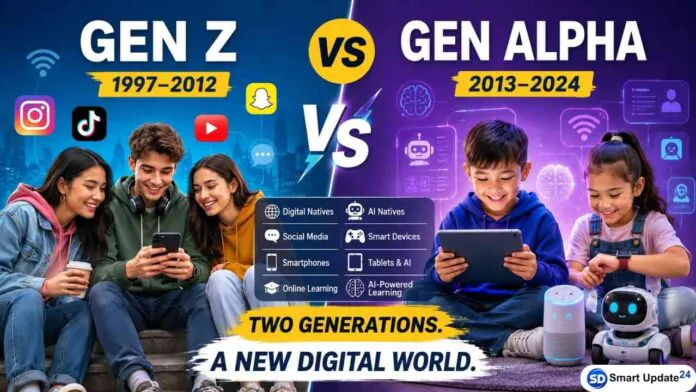
Gen Z vs Gen Alpha: Gen Z—or Generation Zoomers—generally refers to the generation born between 1997 and 2012. They grew up alongside the internet, smartphones, and social media. On the other hand, Gen Alpha—or Generation Alpha—generally refers to the generation born between 2013 and 2024. They have been growing up surrounded by AI, tablets, smart devices, and advanced digital technologies since birth.

If you have ever wondered why teenagers and younger children seem to have very different relationships with technology, the answer may partly lie in the generation they belong to.
Gen Z and Gen Alpha are often described as the first generations to grow up in a highly digital world. But they did not grow up with the same technology. Gen Z experienced the rapid rise of smartphones, social media and online platforms, while Gen Alpha has grown up in an environment where touchscreens, artificial intelligence, smart devices and on-demand digital content are already part of everyday life.

So, what exactly is the difference between Gen Z and Gen Alpha?
What is Gen Z?
Gen Z, sometimes called Generation Z or Zoomers, generally refers to people born from around 1997 to 2012. The exact birth-year boundaries are not universally agreed upon, because generational categories are cultural groupings rather than scientifically fixed classifications. Pew Research Center, for example, places the beginning of Gen Z at 1997.
For many Gen Z members, the internet became an important part of life during childhood or adolescence. They witnessed the transition from traditional mobile phones and desktop computers to smartphones, social media, video-sharing platforms and increasingly connected digital services.
This makes Gen Z a bridge between two worlds. Many older members remember a time before smartphones became dominant, while younger members experienced smartphones and social media as a normal part of growing up.
What is Gen Alpha?
Gen Alpha is the generation that comes after Gen Z. A commonly used definition places its birth years roughly from 2013 onward, although different researchers and organisations use different boundaries.
The youngest generation has been surrounded by digital technology from a very early age. Tablets, smartphones, smart TVs, voice assistants, online learning platforms, gaming ecosystems and AI-powered tools are increasingly familiar parts of their environment.
Unlike Gen Z, Gen Alpha did not necessarily experience the transition into a digital world. For many of them, the digital world was already there when they were born.
Gen Z vs Gen Alpha: The biggest difference
The simplest way to understand the difference is this:
Gen Z grew up during the digital transformation. Gen Alpha is growing up after digital technology has already become deeply embedded in everyday life.
Gen Z watched social media evolve. Gen Alpha has been born into an environment where social platforms, streaming services, mobile apps and smart devices are already established.
Gen Z adapted to smartphones and social media as these technologies became mainstream. Gen Alpha is encountering increasingly advanced forms of technology, including AI-based tools, personalised digital experiences and interactive learning systems, at a much younger age.
Technology and the way they learn
Technology has influenced both generations, but the experience is different.
For Gen Z, online search, YouTube, social media and smartphones became powerful sources of information and entertainment while they were growing up.
For Gen Alpha, digital learning can start much earlier. Children may use educational apps, interactive videos, tablets and AI-supported tools alongside traditional books and classroom teaching.
This does not mean every Gen Alpha child uses technology in the same way. Family circumstances, school environment, location and access to devices can make a major difference.
Also Read: Kerala Officially Renamed Keralam after President’s Assent – But Why?
Social media and communication
Gen Z is closely associated with the rise of social media culture. Platforms such as Instagram, Snapchat, TikTok and YouTube have influenced how many young people communicate, consume entertainment and express themselves.
Gen Alpha is growing up in an even more visual and interactive internet. Short videos, gaming communities, livestreaming and personalised content are likely to play an important role in how this generation interacts with digital media.
However, it is important not to treat an entire generation as having one personality or behaviour. Generational labels can be useful for understanding broad trends, but there is considerable diversity within every generation.
Gen Z vs Gen Alpha at a glance
| Feature | Gen Z | Gen Alpha |
| Commonly used birth range | Around 1997–2012 | Around 2013 onward |
| Relationship with technology | Grew up during rapid digital change | Grew up with digital technology already established |
| Smartphones | Became mainstream during their childhood/teen years | Often present from very early childhood |
| Social media | Experienced its rapid growth | Growing up with mature social platforms and short-form content |
| AI | Encountered AI as it became mainstream | Growing up as AI becomes increasingly integrated into everyday tools |
| Learning environment | Online resources became increasingly important | Interactive and digital learning can begin very early |
| Digital experience | Transition into a connected world | Digital-first environment from an early age |
Does Gen Alpha really understand technology better than Gen Z?
Not necessarily.
Being born into a digital environment does not automatically make someone more technologically skilled. A child’s ability to use technology effectively depends on education, parental guidance, access to devices and the type of technology they use.
Gen Z has also developed considerable digital skills because it experienced the rapid evolution of the internet firsthand.
The difference is therefore less about who is “better” with technology and more about when technology became a normal part of their lives.
Why the difference matters
The gap between Gen Z and Gen Alpha is not simply about age. It also reflects how quickly technology is changing.
Gen Z grew up with the expansion of the internet, smartphones and social media. Gen Alpha is growing up while artificial intelligence, automation, immersive digital experiences and increasingly personalised technology are developing rapidly.
That could influence future education, employment, communication and entertainment.
Schools and parents may also need to think differently about digital literacy. Knowing how to operate a device is only one part of being digitally capable. Understanding online information, privacy, misinformation, AI-generated content and responsible technology use may become equally important.
The bottom line
Gen Z and Gen Alpha are both digital generations, but they entered the digital world at different stages.
Gen Z grew up watching the internet and smartphones transform everyday life. Gen Alpha is growing up in a world where smartphones, smart devices, online platforms and AI are increasingly part of the starting point.
That distinction may seem small, but over time it could shape how the two generations learn, communicate, work and interact with technology.
At the same time, birth-year labels should not be treated as strict rules. Generational boundaries vary between researchers, and people within the same generation can have very different experiences.
For publishers aiming to create useful content around topics like Gen Z, Gen Alpha and technology, Google’s guidance is clear: focus on original, helpful, people-first information rather than writing simply to manipulate search rankings.
