

Editorial Disclaimer: Smart Update24 verifies information through official websites, government notifications, and trusted sources before publication. Our team also conducts independent research and analysis to provide accurate information to readers; however, users are advised to verify important details from the respective official websites for final confirmation.
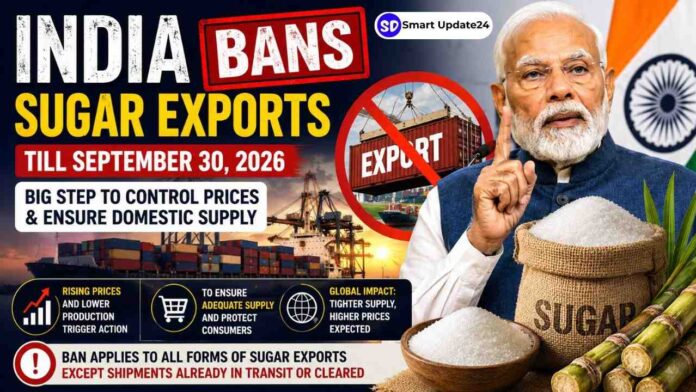
India Bans Sugar Exports: As a significant policy measure aimed at curbing the rising prices of sugar in the domestic market and ensuring adequate supply at the local level, the Government of India has imposed an immediate ban on the export of raw, white, and refined sugar until September 30, 2026.
In a major move aimed at controlling domestic food prices, the Government of India has imposed a ban on the export of raw, white, and refined sugar until September 30, 2026. The decision comes as concerns grow over tightening sugar supplies and rising demand across the country.
According to official notifications and reports, the decision comes as India faces a second consecutive year of lower sugar production compared to consumption, driven by weaker sugarcane yields and regional climate stress.

Earlier, the government had permitted exports of around 1.59 million tonnes of sugar, expecting a production surplus. However, rising domestic demand and tightening supply conditions have forced a complete restriction on exports to prevent inflationary pressure on household consumption.
India Bans Sugar Exports: Why India Has Banned Sugar Exports
The ban applies to all forms of sugar exports, but shipments already in transit or cleared through customs before the notification will be allowed to proceed under specific conditions. Limited exemptions are also expected under certain trade quota arrangements.
India, one of the world’s largest sugar producers and the second-largest exporter after Brazil, plays a key role in global sugar supply chains. The move is expected to tighten international availability and potentially push up global sugar prices as buyers shift toward alternative suppliers like Brazil and Thailand.
The export restriction comes at a time when sugar production is reportedly struggling to keep pace with domestic consumption. Experts believe several factors have contributed to the situation, including:
- Lower sugarcane yields in key producing states
- Climate-related stress on crops
- Concerns over irregular monsoon patterns linked to El Niño conditions
- Rising local demand for sugar and related products
Earlier, India had allowed the export of nearly 1.59 million tonnes of sugar after expecting surplus production. However, changing market conditions and lower-than-expected output forced policymakers to reconsider the decision.
The government now believes that restricting exports is necessary to stabilise prices and avoid shortages in the local market.
India Bans Sugar Exports: What the Ban Includes
The restriction applies to:
- Raw sugar
- White sugar
- Refined sugar exports
However, shipments that had already cleared customs or were already in transit before the official notification may still be allowed under specific conditions. Some limited exemptions under international trade quota arrangements are also expected.
Also Read: Google may set up a major Tech Hub in West Bengal as Ashwini Vaishnaw Proposes
Global Impact of India’s Decision
India is one of the world’s largest sugar producers and also the second-largest sugar exporter after Brazil. Because of this, any major policy change by India has a direct impact on the global sugar market.
Industry experts believe the ban could:
- Reduce sugar availability in international markets
- Push global sugar prices higher
- Increase demand for exports from countries like Brazil and Thailand
- Affect food and beverage industries dependent on imported sugar
Several global buyers are now expected to look for alternative suppliers as Indian exports remain restricted.
Government’s Main Focus
Officials have indicated that the main objective behind the decision is to:
- Protect Indian consumers from rising prices
- Control domestic food inflation
- Ensure stable sugar availability inside the country
- Manage supply risks during uncertain agricultural conditions
The move highlights growing concerns over food security and inflation management as changing climate patterns continue to affect agricultural production across multiple sectors.
Know More: https://www.instagram.com/p/DYUOSVNMWrP/?igsh=MWNzcnh3NW01OWIzbQ%3D%3D
