

Editorial Disclaimer: Smart Update24 verifies information through official websites, government notifications, and trusted sources before publication. Our team also conducts independent research and analysis to provide accurate information to readers; however, users are advised to verify important details from the respective official websites for final confirmation.
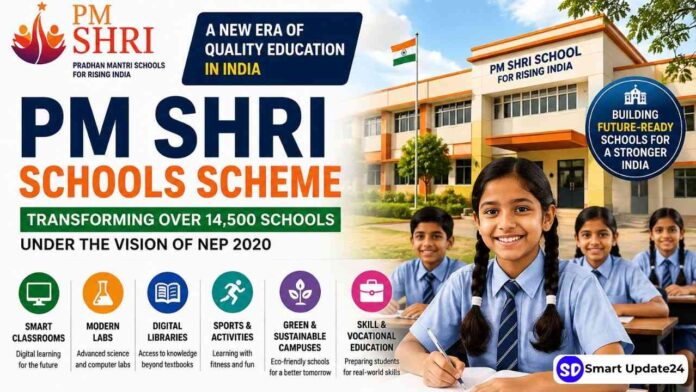
PM SHRI Prakalpa: Today, we will discuss in detail a highly significant initiative of the Government of India: the ‘PM SHRI Yojana’ or ‘PM SHRI SCHOOL SCHEME’. The objective of this scheme is to elevate the standard of school education in India to new heights.
What is the PM SHRI Yojana/PM SHRI Prakalpa?

The full name of PM SHRI is “PM Schools for Rising India.” It is a centrally sponsored scheme through which more than 14,500 schools across the country will be upgraded or modernized. These schools will serve as model schools for the National Education Policy (NEP) 2020.
PM SHRI School is a centrally sponsored scheme by the Government of India. This initiative is intended to develop more than 14500 PM SHRI Schools managed by the Central Government/State/UT Government/local bodies, including KVS and NVS in which every student feels welcomed and cared for, where a safe and stimulating learning environment exists, where a wide range of learning experiences are offered, and where good physical infrastructure and appropriate resources conducive to learning are available to all students.

It will nurture students in a way that they become engaged, productive, and contributing citizens for building an equitable, inclusive, and plural society as envisaged by the National Education Policy 2020.
PM SHRI Prakalpa: What are the objectives of this scheme?
The objectives include: implementing the National Education Policy 2020 by applying all the features of the new policy in these schools; developing modern infrastructure; and transforming ordinary schools into institutions equipped with state-of-the-art facilities. Furthermore, the scheme aims to provide quality education—educating students not merely through rote learning, but through skill-based and practical instruction. It also focuses on creating eco-friendly campuses by establishing “Green Schools” through the use of solar energy, water conservation, and waste management systems.
Who is eligible to apply, and what are the criteria?
It is important to note that individual students do not apply directly to this scheme; rather, the application must be submitted by the school authorities. Regarding the type of schools eligible: Kendriya Vidyalayas (KVS), Navodaya Vidyalayas (NVS), state government schools, or schools operating under local administrative bodies are eligible to apply. The primary prerequisite is that the school must possess a valid UDISE code.
Official Website of PM SHRI: https://pmshri.education.gov.in/
What are the infrastructure requirements?
The school must possess its own permanent (pucca) building. There must be separate toilet facilities for students, as well as adequate arrangements for drinking water.
What benefits will be available? Schools enrolled under the PM SHRI Yojana will receive the following benefits:
Smart Classrooms: The use of digital boards and modern technology in every classroom.
Secondly, these schools feature modern laboratories for Science, Mathematics, and ICT; playgrounds and sports equipment; high-quality sports complexes; and facilities for physical fitness. They also incorporate a modular curriculum, specialized coursework designed for hands-on learning, and a mentorship component—whereby these schools will guide or serve as mentors to other schools in their vicinity.
Required Documents:
The criteria verified during the school selection process include the school’s UDISE (Unified District Information System for Education) data, a No-Objection Certificate (NOC) from the respective Panchayat or Municipality, land deeds or ownership certificates, fire safety and building safety certificates, and a copy of the School Management Committee’s resolution. How does one apply?
The selection process for this project is conducted in three phases and operates based on a “Challenge Method.” The first phase involves the signing of a Memorandum of Understanding (MoU) between the Central Government and the respective States or Union Territories. In the second phase, schools that fulfill the prescribed eligibility criteria are identified. The third phase requires the schools to submit their applications through a dedicated online portal. On this portal, applicants must answer specific questions and upload the necessary supporting documents.
Also Read: CSIR NEIST Recruitment (MTS and Driver) 2026 | Notification, Application Link Here
Selection Process:
Selection Through Challenge Method with -Three Stage Process
Stage -1:
States/UTs would sign an MoU with the Centre, laying down the commitments for supporting these schools in achieving specified quality assurance as PM SHRI schools. A standard MoU is placed at Annexure-A
Only the schools from the above eligible pool of schools would compete based on the challenge method for fulfilling certain criteria. Fulfilment of conditions would be certified by States/UTs/KVS/NVS through physical inspection.
