

Editorial Disclaimer: Smart Update24 verifies information through official websites, government notifications, and trusted sources before publication. Our team also conducts independent research and analysis to provide accurate information to readers; however, users are advised to verify important details from the respective official websites for final confirmation.
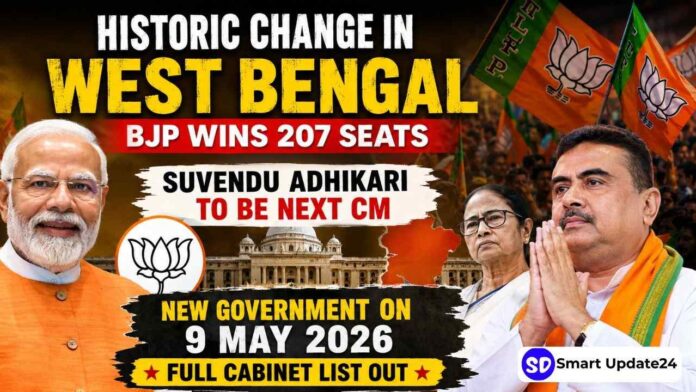
Suvendu Adhikari: West Bengal is standing at the centre of one of the biggest political moments in its modern history. What many people once considered impossible has now become reality. After years of political dominance by the Trinamool Congress (TMC) under Mamata Banerjee, the Bharatiya Janata Party (BJP) is now preparing to form the next government in the state following a massive electoral victory in the 2026 Assembly Elections.
According to the projected results,

BJP secured a stunning 207 MLA seats, clearing the path for government formation in West Bengal. The official swearing-in ceremony is expected to take place on 9 May 2026, marking the beginning of a completely new political chapter for the state.
For months, political discussions across Bengal revolved around one major question: Who would become the next Chief Minister if BJP came to power?

That speculation finally came to an end on 8 May 2026 after senior BJP leader Amit Shah reportedly confirmed that Suvendu Adhikari would become the next Chief Minister of West Bengal. The announcement immediately triggered massive reactions across social media, political circles, and news platforms throughout the state.
The development is being viewed as a landmark victory for the BJP in eastern India, especially in a state where Mamata Banerjee and the All India Trinamool Congress had remained politically dominant for years.
At the same time,
The political atmosphere in Bengal remains tense. Reports suggest that Mamata Banerjee was initially unwilling to accept defeat and had delayed her resignation after the election outcome. However, despite the political drama and uncertainty, BJP is now moving ahead with preparations to officially form the government.
According to the projected cabinet document, Suvendu Adhikari will not only serve as Chief Minister but will also handle several crucial departments, including Home and Hill Affairs, Personnel and Administrative Reforms, Land and Land Reforms, Refugee Relief and Rehabilitation, and Programme Monitoring.
The proposed BJP cabinet also highlights a broad political strategy aimed at balancing regional representation, organizational leadership, industrial growth, tribal representation, and women’s leadership across West Bengal.
Deputy Chief Ministers of West Bengal 2026
The projected cabinet list names two Deputy Chief Ministers:
- Dilip Ghosh
- Agnimitra Paul
Dilip Ghosh is expected to handle Panchayats and Rural Development along with Paschimanchal Unnayan Affairs, while Agnimitra Paul may oversee Industry, Commerce, and Enterprises along with Information Technology and Electronics.
Key Ministers in the Proposed BJP Cabinet
Several prominent BJP leaders have been assigned major ministries in the projected cabinet list:
Who Got Which Responsibility?
- Nishith Pramanik
- North Bengal Development
- Sports and Youth Welfare
- Dilip Ghosh
- Panchayat and Rural Development Department
- Animal Resources Development
- Ashok Kirtania
- Food Department / Food Minister
- Agnimitra Paul
- Women and Child Welfare Department
- Home Affairs (State Minister)
- Sudhiram Tudu
- Tribal Development Department
- Tourism Department
Full List of Major Ministry Allocations
Chief Minister
- Suvendu Adhikari
Departments: Home and Hill Affairs, Personnel and Administrative Reforms, Land and Land Reforms, Refugee Relief and Rehabilitation, Programme Monitoring
Deputy Chief Ministers
- Dilip Ghosh
Departments: Panchayats and Rural Development, Paschimanchal Unnayan Affairs - Agnimitra Paul
Departments: Industry, Commerce and Enterprises, Information Technology and Electronics
BJP’s Reported Governance Roadmap
The cabinet analysis document also outlines a three-phase governance strategy for the new government.
Phase 1
- Administrative cleanup
- Law and order stabilization
- Anti-corruption operations
- Cadre dismantling
Phase 2
- Kolkata modernization
- IT and startup growth
- Port-led industrialization
- Logistics corridors
- Manufacturing revival
Phase 3
- Restoring Kolkata as Eastern India’s premier economic and cultural metropolis
Political observers believe the 2026 West Bengal election could permanently reshape Bengal’s political future. Whether this transition leads to stability and development or intensifies political conflict will become clear in the coming months.
One thing, however, is certain: Bengal politics has entered a completely new era.
