

Editorial Disclaimer: Smart Update24 verifies information through official websites, government notifications, and trusted sources before publication. Our team also conducts independent research and analysis to provide accurate information to readers; however, users are advised to verify important details from the respective official websites for final confirmation.
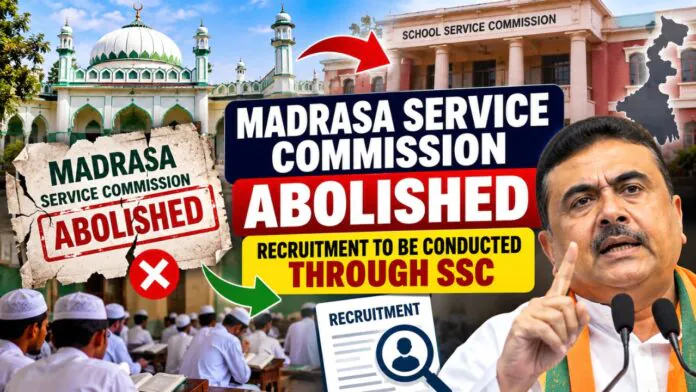
WB Madrasa Service Commission Abolished 2026: In a significant decision concerning teacher recruitment in West Bengal’s madrasa education system, Chief Minister Suvendu Adhikari has said that the Madrasa Service Commission (MSC) has been abolished and merged with the School Service Commission (SSC).

The announcement has triggered considerable attention among madrasa teachers, recruitment aspirants and the wider education sector. According to New CM Suvendu Adhikari, the separate recruitment mechanism of the Madrasa Service Commission would no longer continue and recruitment in madrasas would be conducted through the School Service Commission.
The development could bring a major change to the way teachers are selected for recognised madrasas in the state.

WB Madrasa Service Commission Abolished: What did Suvendu Adhikari announce?
The key announcement is that the separate Madrasa Service Commission recruitment system is being brought under the School Service Commission.
In practical terms, candidates seeking teaching appointments in madrasas will now have to go through the recruitment mechanism of the SSC, rather than a separate Madrasa Service Commission process.
The Chief Minister’s statement, as reported by TV9 Bangla, was that the Madrasa Service Commission had been removed and merged with the School Service Commission. The government reportedly expects the change to make the recruitment process faster and more streamlined.
This is particularly important for candidates who have been waiting for clarity over the future structure of madrasa teacher recruitment.
Why is the decision important?
For years, teacher recruitment in recognised madrasas has had a distinct legal and administrative framework. The Madrasa Service Commission was created specifically for the selection of teachers in madrasas.
Moving the recruitment function into the SSC represents a significant administrative change.
Instead of maintaining two separate recruitment structures, the government now intends to use a common commission for teacher selection. This could potentially simplify the recruitment architecture and provide candidates with a more familiar selection system.
However, the actual impact will depend on the rules, notifications and recruitment procedures that the state government introduces following the announcement.
WB Madrasa Service Commission Abolished: What will happen to madrasa teacher recruitment?
The immediate question for job aspirants is how future recruitment will be conducted.
Based on the Chief Minister’s reported statement, the School Service Commission will handle teacher recruitment for madrasas as well.
That means future recruitment advertisements, eligibility requirements, selection stages and other procedures may be issued through the SSC framework.
Candidates who were preparing for madrasa-specific recruitment will therefore need to closely follow official notifications from the West Bengal government and the School Service Commission before making assumptions about upcoming examinations.
It is important to distinguish between the announcement and the detailed implementation. The exact recruitment rules, subject-wise vacancies, eligibility criteria and examination structure will depend on formal government orders and notifications.
Background of the Madrasa Service Commission
The issue has a long legal history.
The West Bengal Madrasah Service Commission Act, 2008 created the statutory framework for the Madrasa Service Commission. Over the years, different aspects of the recruitment system became the subject of litigation.
In July 2026, the Supreme Court considered a batch of petitions involving teachers and non-teaching staff of madrasas in West Bengal. The judgment discussed the history of the Madrasa Service Commission Act and earlier disputes concerning the recruitment and appointment of madrasa teachers.
The Supreme Court judgment recorded that Sections 8, 10, 11 and 12 of the 2008 Commission Act had previously been challenged and ultimately held those provisions valid and constitutional. The Court also stated that the Commission remained competent to select and nominate teachers to madrasas in accordance with the Act and applicable rules.
That legal background makes the latest state government decision particularly significant.
What does the Supreme Court judgment mean in this context?
The Supreme Court’s July judgment and the state government’s October announcement concern different stages of the recruitment framework.
The Supreme Court judgment dealt with the validity of the existing legal framework and disputes involving appointments and service benefits. The latest announcement concerns the state government’s proposed administrative arrangement for future recruitment, under which the Madrasa Service Commission is being merged with the School Service Commission.
Therefore, candidates should not assume that every aspect of the old recruitment system automatically disappears immediately. The government’s formal notification and subsequent rules will be important in determining how the transition takes place.
WB Madrasa Service Commission Abolished: What should madrasa teacher aspirants do now?
Candidates preparing for teaching jobs in West Bengal’s recognised madrasas should avoid relying only on social media posts or short videos about the announcement.
The most important things to watch for will be:
- The official government notification regarding the merger
- Formal instructions issued by the School Service Commission
- New recruitment advertisements
- Subject-wise vacancies
- Revised eligibility criteria, if any
- Examination and selection pattern
- Treatment of existing recruitment processes
- Rules concerning candidates who have already applied or qualified
- The timeline for the first SSC recruitment cycle covering madrasa posts
Until these details are formally published, candidates should continue preparing according to the applicable qualifications and keep their documents ready.
Will this affect existing teachers?
The announcement primarily concerns the recruitment mechanism. It should not automatically be interpreted as cancelling the existing service of teachers who are already appointed.
The status of serving teachers, ongoing recruitment processes and candidates who have already participated in earlier selection procedures would need to be clarified through the government’s formal orders.
This distinction is important because recruitment reform and changes to existing employment conditions are separate issues.
Also Read: WB Approves 14,454 New Government Jobs 2026 | Recruitment to Be Completed Within 6–8 Months
A major change for future recruitment
If implemented as announced, the merger will create a single recruitment route for school and madrasa teaching posts under the SSC framework.
For job seekers, this could make the recruitment structure easier to understand. At the same time, there could be transitional challenges because the eligibility requirements and recruitment procedures applicable to madrasa posts may require specific provisions.
The government will therefore need to provide clear guidelines so that candidates are not left uncertain about vacancies, examinations or eligibility.
Another development in West Bengal’s madrasa sector
The announcement comes at a time when the state government is also examining the functioning and recognition status of madrasas.
According to the TV9 Bangla report, the government recently issued closure notices to 252 madrasas and show-cause notices to another 100 institutions following a survey. The report said the survey found a large number of institutions without the necessary government approval.
These developments indicate that the government is undertaking wider administrative changes involving the madrasa education system, including institutional recognition and teacher recruitment.
What happens next?
The next major step will be the publication of the government’s formal notification and the detailed recruitment framework.
For thousands of teaching aspirants, the most important information will be when the next recruitment notification is issued, how many vacancies are available and whether the SSC will conduct a separate selection process for madrasa posts or incorporate them into its broader recruitment system.
Until those details are officially clarified, candidates should treat the Chief Minister’s announcement as the key policy development but wait for the formal notification before making decisions about applications or eligibility.
West Bengal Chief Minister Suvendu Adhikari has announced that the Madrasa Service Commission is being abolished and merged with the School Service Commission. According to the reported announcement, future teacher recruitment in madrasas will be conducted through the SSC.
The decision could mark a major change in the state’s madrasa teacher recruitment system. However, the practical details of the transition, including recruitment rules, vacancies, eligibility and the status of ongoing processes, will become clear only after formal government and SSC notifications are issued.
For candidates waiting for madrasa teaching jobs, the message is clear: keep an eye on the official SSC and West Bengal government notifications rather than relying solely on social media claims.
