

Editorial Disclaimer: Smart Update24 verifies information through official websites, government notifications, and trusted sources before publication. Our team also conducts independent research and analysis to provide accurate information to readers; however, users are advised to verify important details from the respective official websites for final confirmation.
West Bengal Proposes Five New Districts in 2026-27 Budget: The Government of West Bengal has proposed the creation of five new districts during its first budget session. The objectives of these proposals are to decentralize administration, improve the quality of public service delivery, and bring the governance system closer to the people.

(Kolkata, Sundarban, Arambagh, Basirhat, Jangipur, new districts, West Bengal, Government of West Bengal)
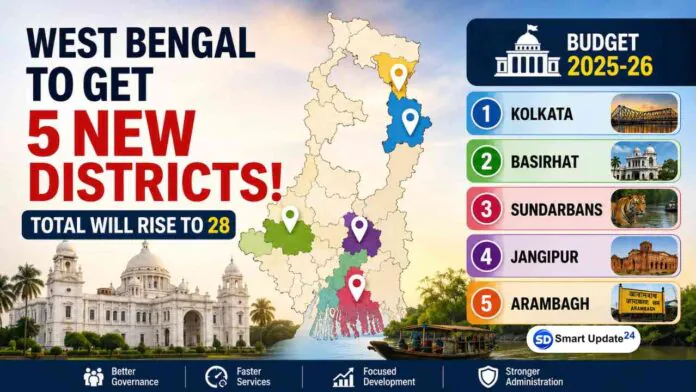
During the 2026-27 state budget session, Finance Minister Chandrima Bhattacharya announced a proposal to create five new districts across the state. If implemented, the move would increase the total number of districts in West Bengal from 23 to 28.

The proposal is aimed at improving governance, bringing administrative services closer to citizens, and ensuring faster delivery of government schemes in densely populated regions.
Which Are the Proposed New Districts?
According to the proposal presented in the budget session, the five new districts are:
- Kolkata
A separate administrative district is proposed for Kolkata. As the state’s capital and largest urban center, Kolkata would function as an independent administrative unit with its own district administration headed by a District Magistrate (DM).
- Basirhat
The proposed Basirhat district would be carved out of the existing North 24 Parganas district. The region shares an important international border and has witnessed rapid population growth over the years, making administrative decentralization a key consideration.
- Sundarbans
The Sundarbans region is proposed to become a separate district by bifurcating parts of South 24 Parganas. Given its unique ecological significance, island geography, and disaster-prone nature, a dedicated district administration could help improve governance and development initiatives in the area.
- Jangipur
Jangipur is proposed to be formed from the present Murshidabad district. The region has emerged as an important administrative and economic zone, and a separate district status could enhance public service delivery and infrastructure planning.
- Arambagh
The proposed Arambagh district would be created from the existing Hooghly district. Supporters of the proposal believe that district-level administration closer to residents could help improve access to government services and accelerate local development.
West Bengal Proposes Five New Districts: Why Is the Government Planning New Districts?
The proposals are aimed at decentralizing administration, improving public service delivery and bringing governance closer to the people.
Creating new districts is often considered an administrative reform rather than merely a geographical change. Larger districts can face challenges in governance due to increasing population, expanding urbanization, and rising demand for public services.
The state government believes that smaller administrative units can offer several benefits:
- Faster implementation of welfare schemes
- Improved law and order management
- Better disaster response and emergency services
- Easier access to government offices for citizens
- Enhanced planning and development at the local level
- More efficient monitoring of infrastructure projects
How Will the Map of West Bengal Change?
If the proposal receives final approval and is implemented, the state’s administrative map will undergo significant changes. New district headquarters, administrative offices, and governance structures may be established in the newly formed districts.
The proposed districts would be carved out from four existing districts:
- North 24 Parganas → Basirhat
- South 24 Parganas → Sundarbans
- Murshidabad → Jangipur
- Hooghly → Arambagh
- Kolkata to function as a separate administrative district
