

Editorial Disclaimer: Smart Update24 verifies information through official websites, government notifications, and trusted sources before publication. Our team also conducts independent research and analysis to provide accurate information to readers; however, users are advised to verify important details from the respective official websites for final confirmation.
WB Orders Closure of 252 Madrasas: BJP leader Suvendu Adhikari criticizes the direction given to the Muslim community, questioning why children are sent to unrecognized (Khariji) madrasas instead of general schools, colleges, or professional training to become doctors or engineers.
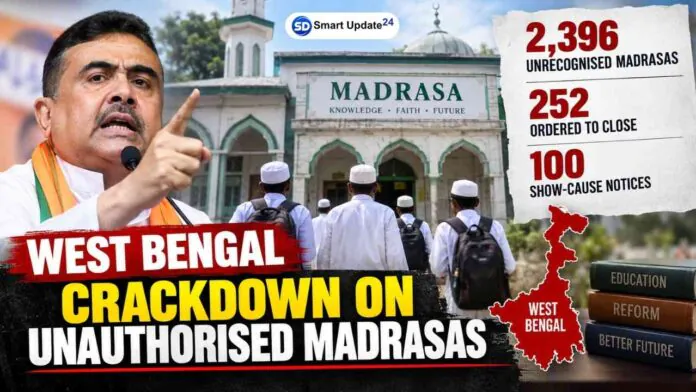
A statewide survey of madrasas in West Bengal has identified 2,396 unrecognised institutions, prompting the government to order the closure of 252 in the first phase. Another 100 madrasas have been served show-cause notices over alleged irregularities and non-compliance. The move has also triggered a political debate over the role of unrecognised and Khariji madrasas in the state’s education system.
West Bengal has begun a major verification drive involving madrasas across the state, with the government moving against institutions that allegedly lack the required approvals, infrastructure or regulatory compliance.

The survey, carried out by the Minority Affairs and Madrasah Education Department, covered Kolkata and 22 districts. The findings have put the spotlight on thousands of institutions operating outside the state’s recognised madrasa framework.
According to the figures presented in the supplied video and accompanying information, 2,396 madrasas were found to be unrecognised, while 2,132 madrasas currently have government recognition.
WB Orders Closure of 252 Madrasas: 252 madrasas ordered to shut down
The first major action has been taken against 252 private, unauthorised madrasas.
The government has issued notices directing these institutions to stop operations. Officials have cited issues including the absence of necessary approvals and deficiencies in basic infrastructure and other regulatory requirements.
The action is being carried out in phases rather than against every unrecognised institution at once.
The survey also looked at infrastructure, student numbers, teaching arrangements, curriculum and management practices before the government decided which institutions would face immediate action.
Another 100 madrasas receive show-cause notices
The government has also issued show-cause notices to around 100 madrasas.
These institutions have been given an opportunity to explain their position and provide the necessary documents or clarification. According to Minority Affairs and Madrasah Education Minister Kshudiram Tudu, further action could follow if the explanations are not considered satisfactory.
The distinction is important. A closure notice and a show-cause notice are not the same thing. The latter gives an institution an opportunity to respond before the authorities decide whether further action is required.
Malda among districts with the highest number of notices
The video report highlights a district-wise distribution of the 252 institutions facing closure action.
The figures highlighted include:
| District | Madrasas facing closure action |
| Malda | 44 |
| North Dinajpur | 38 |
| South 24 Parganas | 32 |
| Murshidabad | 25 |
| Nadia | 25 |
| North 24 Parganas | 13 |
The supplied video specifically shows 32 institutions in South 24 Parganas, rather than South Dinajpur. The remaining institutions among the 252 are spread across other districts.
This concentration in several districts has drawn attention because many of the affected areas are located in border or minority-populated regions.
What are Khariji madrasas?
One of the most discussed aspects of the government action is the status of Khariji madrasas.
In West Bengal’s madrasa landscape, institutions can broadly be divided into recognised and unrecognised categories. Recognised institutions may be government-sponsored or unaided but officially recognised. Unrecognised institutions operate outside that formal recognition structure.
The term Khariji madrasa is generally used for madrasas operating independently of the recognised government madrasa system, often with a stronger focus on religious education.
Several reports have said that a substantial portion of the 252 institutions facing closure action are Khariji madrasas.
However, being a Khariji madrasa should not by itself be treated as proof of wrongdoing. The government’s stated concerns in this exercise relate to issues such as approval status, infrastructure, curriculum and compliance.
Also Read: West Bengal B.Ed College List 2026 | Download PDF of 253 Colleges
WB Orders Closure of 252 Madrasas: Suvendu Adhikari questions the direction of education
The issue has also become political.
BJP leader and West Bengal Chief Minister Suvendu Adhikari has questioned why children should be sent to unrecognised Khariji madrasas instead of mainstream schools, colleges or professional education.
His argument centres on the need for students to receive modern and broader educational opportunities, including pathways towards professions such as medicine and engineering.
The political criticism comes alongside the government’s stated position that madrasas operating legally and with the necessary permissions will continue to function.
The debate, therefore, is not simply about whether madrasas should exist. It is increasingly focused on which institutions are legally recognised, what they teach, what facilities they provide and whether students are receiving adequate modern education.
Government says recognised madrasas can continue
The government has made a distinction between recognised institutions and those operating without the necessary approvals.
Minister Kshudiram Tudu said institutions possessing the required approvals would continue to function. The statewide field-level survey was intended to establish the approval status, infrastructure and management arrangements of madrasas operating in the state.
This means the current action should not be interpreted as a blanket closure of all madrasas in West Bengal.
Instead, the immediate action is directed at institutions that the government says failed to meet prescribed requirements.
Why was the survey conducted?
The survey was launched to build a clearer picture of how many madrasas are operating in West Bengal and under what conditions.
Field-level teams examined institutions across the state. The exercise reportedly considered several factors, including:
- Government approval and recognition
- Basic infrastructure
- Number of teachers and students
- Management practices
- Curriculum
- Administrative compliance
- Other information about the functioning of the institutions
Officials have indicated that institutions found to be compliant can continue, while those failing to meet the required standards could face action.
Government considering tighter regulation
The latest action could be only the beginning of a wider regulatory exercise.
The state government is examining ways to strengthen the regulatory framework for madrasas, including possible changes to existing rules or fresh guidelines.
If implemented, such measures could bring greater scrutiny of unrecognised institutions, particularly those operating without formal approval or outside the recognised education system.
The government’s challenge will be to ensure that enforcement is based on clear legal standards and that institutions are given due opportunity to respond wherever required.
WB Orders Closure of 252 Madrasas: The bigger question: education or regulation?
The madrasa controversy is now moving beyond a simple question of how many institutions are recognised.
At the heart of the debate is the education received by thousands of students. While religious education remains an important part of the identity of many madrasas, the government and political leaders are also stressing access to mainstream academic and professional opportunities.
For families, the practical question is whether students studying in these institutions have adequate access to recognised qualifications, modern subjects and future career opportunities.
At the same time, any regulatory action affecting educational institutions needs to follow established legal procedures and distinguish between genuine violations and institutions that can address deficiencies.
For now, the numbers underline the scale of the issue: 2,396 unrecognised madrasas have been identified, 252 have been ordered to close in the first phase, and around 100 more have been asked to explain alleged irregularities.
The next stage will depend on inspections, responses to show-cause notices and the government’s proposed regulatory measures.
Key Takeaways
- 2,396 unrecognised madrasas identified in the statewide survey.
- 2,132 madrasas reportedly have valid government recognition.
- 252 unauthorised madrasas face closure action in the first phase.
- 100 additional madrasas have received show-cause notices.
- The survey covered Kolkata and 22 districts.
- Malda recorded the highest number in the district-wise figures shown in the video, with 44 institutions.
- The video shows 32 institutions in South 24 Parganas.
- The government says recognised and compliant madrasas can continue operating.
