

Editorial Disclaimer: Smart Update24 verifies information through official websites, government notifications, and trusted sources before publication. Our team also conducts independent research and analysis to provide accurate information to readers; however, users are advised to verify important details from the respective official websites for final confirmation.
SIR Voter List Revision 2026: India’s Special Intensive Revision (SIR) of electoral rolls has sparked a nationwide debate over voter verification, duplicate registrations, and the removal of outdated entries. A figure of approximately 13 crore has become a major point of discussion, with the BJP arguing that these entries relate to categories such as deceased voters, people who have shifted residence, untraceable electors, and duplicate registrations.

But does this mean that 13 crore eligible voters have been permanently removed from the electoral rolls? Not necessarily. Understanding the difference between entries flagged during a revision exercise and final deletions is essential for voters to understand the issue accurately.
SIR Voter List Revision: What Is the Special Intensive Revision (SIR)?
The Special Intensive Revision is an exercise conducted by the Election Commission of India to verify and update electoral rolls. Its purpose is to ensure that voter lists accurately reflect eligible electors and their ordinary places of residence.

The process can help identify deceased voters, people who have permanently moved, duplicate registrations and electors who cannot be traced at their registered addresses. The Election Commission’s 2026 programme has involved large-scale verification across states and Union Territories.
The objective is to maintain accurate electoral rolls while ensuring that eligible Indian citizens are not unfairly excluded.
The 13 Crore Figure: What Does It Include?
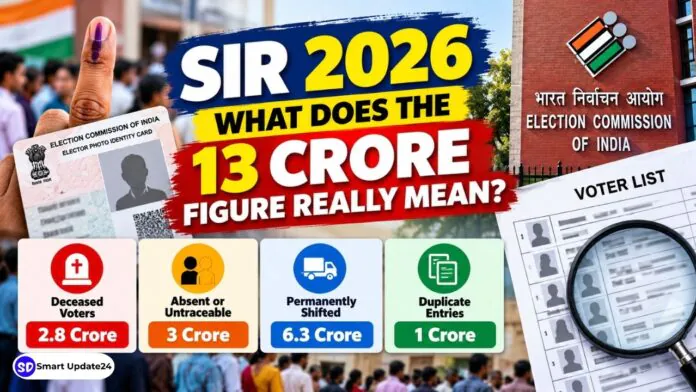
According to figures cited by BJP spokesperson Sudhanshu Trivedi, the approximately 13.1 crore entries discussed in the SIR debate fall into four categories.
- Deceased voters: 2.8 crore
Entries reported in the deceased category.
- Absent or untraceable: 3 crore
Entries associated with electors who could not be traced.
- Permanently shifted: 6.3 crore
Entries identified as belonging to people who had moved.
- Multiple registrations: 1 crore
Entries identified as possible duplicate enrolments.
- Total reported entries: 13.1 crore
Figures cited in the BJP’s explanation of the SIR controversy. They should not be interpreted as a verified count of 13.1 crore eligible voters permanently deleted from final electoral rolls.
Have 13 Crore Voters Been Permanently Deleted?
This is the central question in the ongoing debate.
The BJP has disputed the opposition’s claim that 13 crore voters have simply been deleted, arguing that the figure represents entries across different categories identified during the revision exercise.
These categories are not interchangeable. A record classified as deceased is different from an elector who has moved to another location. Similarly, a person who could not be traced during verification is not automatically the same as a confirmed duplicate entry.
The status of individual names must be understood in the context of the relevant electoral roll, verification process, claims and objections, and the final decisions of the electoral registration authorities.
In an October 13, 2026, court proceeding, the Election Commission also clarified that a name’s absence from a draft SIR roll does not, by itself, establish that the voter has been finally deleted.
Therefore, the headline figure alone does not establish how many eligible voters have been permanently excluded.
SIR Voter List Revision: Why Is SIR Important for Voters?
An accurate electoral roll is essential to a fair election. Outdated records, duplicate registrations and incorrect addresses can create problems for election administration.
At the same time, the verification process must protect the rights of eligible voters. Migrant workers, old citizens, people who have changed residence, and those who face difficulties providing documents may require particular attention.
The challenge is to identify inaccurate entries without wrongly excluding genuine voters. Transparency, accessible correction procedures, and timely resolution of objections are therefore important parts of the process.
Also Read: October Bank Holidays 2026 | Check the Complete List, Banks to Remain Closed for 16 Days
SIR Voter List Revision: What Should You Do If Your Name Is Missing From the Voter List?
Voters should check their registration status rather than relying solely on social media posts or political claims.
- Check your name online: https://voters.eci.gov.in/
Visit the official Election Commission of India website and use the electoral roll search service to check your registration details.
- Keep your documents ready
Keep your voter ID, relevant identity and residence documents, and previous registration details available if verification is required.
- Contact the election authorities
Contact your Booth Level Officer (BLO) or Electoral Registration Officer (ERO) if your details are incorrect or your name cannot be found.
- Submit the appropriate application
Depending on your situation and the applicable SIR procedure, you may need to submit an enumeration form, Form 6 for new registration, or another relevant application.
Official website: Election Commission Voters’ Services Portal. The portal provides voter registration services, electoral roll searches, and application facilities.
Can Eligible Voters Raise Claims and Objections?
Yes. Electoral roll revision procedures provide mechanisms for eligible citizens to seek inclusion or correction and for objections to be considered under the applicable rules.
The appropriate application and deadline depend on the stage of the revision and the circumstances of the voter. Anyone whose name is missing should check the latest official instructions rather than assume that the omission is permanent.
Voters should also retain acknowledgement receipts and other records when submitting an application or responding to a notice.
SIR 2026: What Should Citizens Keep in Mind?
The SIR debate involves two key considerations: maintaining accurate voter lists and protecting every eligible citizen’s right to participate in elections.
The figure of approximately 13 crore cited in the political debate refers to four categories of electoral entries. It should not automatically be presented as the final number of eligible voters removed from the rolls.
Ultimately, the accuracy of the electoral roll depends on proper verification, transparent procedures and effective opportunities for eligible voters to correct their records.
The key message for voters is simple: check your own registration status, follow official Election Commission instructions and act promptly if you find an error.
