

Editorial Disclaimer: Smart Update24 verifies information through official websites, government notifications, and trusted sources before publication. Our team also conducts independent research and analysis to provide accurate information to readers; however, users are advised to verify important details from the respective official websites for final confirmation.
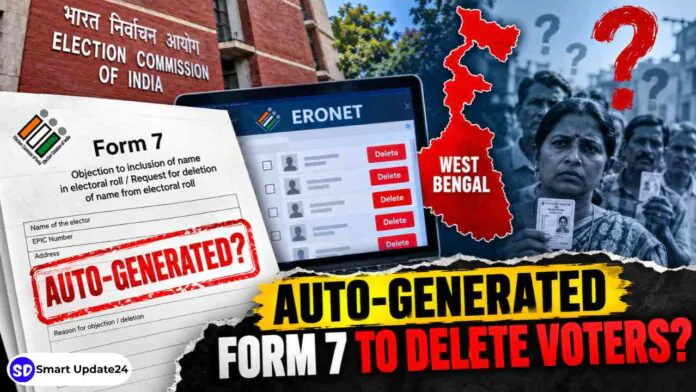
Auto-Generated Form 7 Applications: A fresh controversy has emerged over the process of deleting names from electoral rolls during the Special Intensive Revision (SIR), following reports that Electoral Registration Officers (EROs) submitted auto-generated Form 7 applications bearing their digital signatures. The issue has raised questions about who initiated the objections, what instructions governed the process, and whether all required procedural safeguards were followed.

The controversy has assumed significance because electoral rolls determine who can exercise the right to vote. While the removal of duplicate, deceased, or otherwise ineligible entries is an essential part of maintaining accurate voter lists, the process must also protect eligible electors from wrongful exclusion.
Read More: Election Commission Announces Voter List Revision in 17 States, Including West Bengal

What Is Form 7 and Why Is It Important?
Form 7 is an official Election Commission form used to object to a proposed inclusion in the electoral roll or to request the deletion of an existing entry. It covers specified grounds, including the death of a voter, duplicate registration, permanent shifting of residence, underage registration, and lack of Indian citizenship.
Under the prescribed procedure, an objection or deletion request must be examined by the appropriate election authority. A decision to remove a name should not be treated as automatic merely because an application has been generated or a discrepancy has been identified.
The official Form 7 also contains a declaration warning that knowingly making a false statement is punishable under Section 31 of the Representation of the People Act, 1950. This underlines the importance of accurate information and accountability in the objection process.
The form and its instructions are available through the Election Commission’s official Voters’ Services Portal.
How Did the Auto-Generated Form 7 Controversy Emerge?
According to the reports discussed by Bartaman Patrika and other publications, software used for electoral roll management, known as ERONET, was reportedly involved in generating Form 7 applications during the SIR process in several states.
The reported cases involved voters whose records had been flagged for reasons such as unresolved logical discrepancies or the absence of a mapping to an older electoral roll. In some instances, the applications reportedly carried the digital signatures of EROs or identified election officials in the role of objectors.
This has created a fundamental procedural question: if an officer is responsible for examining an objection and deciding whether a voter’s name should be deleted, can that same officer also appear as the person objecting?
The distinction matters because an objection, an administrative verification, and a final deletion decision are separate stages of the electoral process. Software can help identify records requiring examination, but the legal authority and responsibility for a deletion must remain clear.
The reporting does not, by itself, establish that every auto-generated application was unlawful or that every affected voter was eligible to remain on the roll. Those questions require examination of the individual records, the applicable rules and the instructions under which the applications were processed.
Deletion: Fill Form 7 to get name deleted from the existing electoral roll.
Why Are Election Officials’ Roles Being Questioned?
The controversy centres on the distinction between initiating an objection and adjudicating it.
The Election Commission’s electoral roll framework ordinarily provides for Form 7 objections to be submitted by an eligible objector, subject to the applicable rules and specified exceptions. The ERO examines claims and objections and makes the appropriate decision.
If an ERO appears as the objector on a system-generated application, questions arise over the identity of the person who actually initiated the objection and the legal basis for recording the officer in that role.
The concern is not simply whether a computer generated a form. It is whether the software’s output accurately records the legal and factual basis for the proposed deletion.
A computer-generated document cannot, on its own, establish that a voter is deceased, has permanently shifted residence, is registered twice or is otherwise ineligible. Such findings must be supported by appropriate verification and the prescribed decision-making process.
The Election Commission therefore faces a need to explain the workflow, identify the authority responsible for each stage and clarify how its software is intended to operate during intensive electoral revision.
What Does the Electoral Roll Manual Say?
The Electoral Roll Manual, 2024, is central to the debate because it describes the responsibilities of electoral registration officials and the handling of claims and objections.
As discussed in recent reporting, the manual does not provide a general authorisation for EROs or Assistant Electoral Registration Officers (AEROs) to act as ordinary Form 7 objectors simply because software has generated an application. At the same time, election authorities have statutory responsibilities to correct electoral rolls and remove entries that are found to be ineligible through the applicable process.
These are distinct questions. The authority to correct a roll does not automatically settle whether a particular form-generation procedure complies with the prescribed rules.
The key issues requiring clarification include:
- Whether a written instruction or standard operating procedure authorised the reported use of auto-generated Form 7 applications.
- Whether the applications identified a legally permissible objector or the actual basis for an official-initiated review.
- Whether affected voters received the required notice and an opportunity to respond.
- Whether the relevant objections were recorded and made available for scrutiny in the prescribed manner.
- Whether each deletion was supported by a reasoned decision from the competent authority.
A clear, written explanation would help distinguish legitimate administrative correction from a procedural irregularity.
West Bengal: Questions Over Nearly 16 Lakh Deletion Applications
The Bartaman Patrika report specifically raises a question about applications seeking the deletion of approximately 16 lakh voters’ names in West Bengal. It asks who submitted these applications and under whose instructions the process took place.
This figure must be interpreted carefully. The number cited in the report concerns applications or requests associated with the deletion process. It should not automatically be treated as the confirmed number of voters finally removed from the electoral roll through auto-generated Form 7 applications.
Applications, proposed deletions, approved deletions and names ultimately removed from a published electoral roll are different categories of data. Reliable conclusions require these figures to be separated and reconciled against official records.
The larger concern is whether the election authorities can provide a transparent account of the process, including the number of applications generated automatically, the grounds recorded, the number of decisions taken and the safeguards applied to protect eligible voters.
For West Bengal, where electoral roll revision is a politically sensitive issue, such clarity is particularly important. Transparency can help establish whether the procedure was consistently applied and whether voters had a meaningful opportunity to challenge incorrect entries or proposed deletions.
Similar Concerns in Other States
The controversy is not limited to West Bengal.
Reports have also discussed auto-generated Form 7 applications in Delhi, Uttar Pradesh and Uttarakhand. In Uttarakhand, a report published by Hindustan Times on September 25, 2026, said that approximately 95,000 voters were marked ineligible following logical-discrepancy hearings or non-attendance, with Form 7 applications generated through the electoral management system in the reported cases.
That report described the official explanation that such applications followed cases in which voters had not resolved discrepancies during the hearing process. It also recorded political allegations of irregularities.
These reports illustrate why the underlying procedure deserves scrutiny, but figures from different states should not be combined without checking their definitions, dates, and stages of processing.
A logical discrepancy is a signal that a record requires examination. A mismatch in spelling, age or family details does not, by itself, prove that a voter is ineligible. Similarly, the absence of a match with an older electoral roll is not necessarily conclusive proof that a person should be removed.
Each case must be assessed under the applicable law and the evidence available to the competent election authority.
What Is the Special Intensive Revision (SIR)?
The Special Intensive Revision is an exercise undertaken by election authorities to review and update electoral rolls. Its objectives include identifying eligible electors, correcting inaccurate entries, detecting duplicate registrations and removing entries that no longer meet the legal requirements.
Electoral rolls are not static documents. People die, move between constituencies, register in error or become eligible to vote when they reach the qualifying age. Regular revision is therefore necessary to maintain an accurate and usable voter list.
However, an intensive revision involving large numbers of records also presents administrative challenges. Records may contain spelling differences, incomplete addresses, inconsistent dates of birth or gaps in historical documentation. These issues can arise for innocent reasons, particularly where records have been maintained over many years or transferred between different systems.
The central challenge is to identify genuinely ineligible entries without excluding eligible citizens because their records are incomplete or inconsistent.
A well-designed revision process must combine technology-assisted screening with human verification, accessible procedures for responding to notices and effective remedies for those who believe their names have been wrongly excluded.
Why Due Process Matters in Voter Deletion
The right to participate in elections depends on the accuracy of the electoral roll and the fairness of the procedure used to maintain it.
The Constitution of India provides for elections based on adult suffrage, while electoral registration and revision are governed by legislation including the Representation of the People Act, 1950, and the Registration of Electors Rules, 1960.
Article 326 establishes the constitutional framework for elections to the House of the People and State Legislative Assemblies based on adult suffrage, subject to the constitutional and statutory conditions. The detailed process for registering electors and revising rolls is governed by the relevant laws and rules.
This framework requires election authorities to balance two objectives: preventing ineligible entries and ensuring that eligible voters are not wrongly excluded.
If an application is generated without a clearly identified legal basis, or if a voter does not receive the notice required by the applicable procedure, the affected person may have difficulty understanding or contesting the proposed deletion.
The problem becomes more serious when large numbers of cases are processed through an automated system. Even a small procedural weakness can affect many people when repeated across thousands of records.
For this reason, notice, verification, reasoned decisions, accessible records and effective appeal mechanisms are essential safeguards rather than unnecessary administrative formalities.
Can Software Decide Who Is Eligible to Vote?
Technology can make electoral administration more efficient. It can identify possible duplicate entries, compare records, flag inconsistencies, and help officials prioritise cases for examination.
But identifying a possible problem is not the same as proving that a voter is ineligible.
For example, two records with similar names and dates of birth might belong to the same person, or they might belong to two different people. A person who does not appear in an older roll may have become eligible later, moved from another constituency or have records that were not correctly linked.
An automated system can identify these possibilities, but the outcome must depend on the applicable rules and appropriate verification.
The controversy over auto-generated Form 7 applications therefore raises a broader question about the governance of digital public systems: who is accountable when a software-generated recommendation leads to an adverse decision affecting an individual’s legal rights?
The answer should be clear. The software provider or database cannot replace the legally designated authority. Officials must be able to explain the basis for their decisions, and the system must preserve records showing how each case progressed from identification to final determination.
What Should the Election Commission Clarify?
The Election Commission can help resolve the controversy by publishing a detailed explanation of the procedure used to generate and process the disputed applications.
First, it should clarify whether the reported auto-generation of Form 7 applications was authorised by a written order, circular or standard operating procedure. If such instructions exist, they should be made publicly accessible, subject to applicable legal restrictions.
Second, it should explain whether the software generates only a draft document for administrative review or formally records an objection under an official’s name and digital signature. These functions have different legal implications.
Third, the Commission should provide state-wise data distinguishing applications generated, objections examined, deletions approved and entries actually removed from the electoral roll. Such figures should include the grounds for the action and the relevant reporting period.
Fourth, the authorities should explain how voters were notified and how they could submit evidence, object to an incorrect classification or appeal a decision.
Fifth, cases in which the required procedure may not have been followed should be reviewed. Where an error is established, the authorities should provide an effective and timely remedy, including restoration of an eligible elector’s name through the applicable legal process.
Finally, the Commission should establish clear audit trails for all system-generated applications. Each record should identify the source of the objection, the official who reviewed the case, the evidence considered, the decision taken and the date on which the decision became effective.
These measures would improve accountability while allowing legitimate electoral roll corrections to continue.
What Should Voters Do If Their Names Are Missing?
Voters who discover that their names are missing from the electoral roll should first check the latest published roll and their application status through official Election Commission services.
The appropriate remedy depends on the stage of the revision and the reason for the missing entry. An eligible person seeking fresh enrolment will generally need to use Form 6, while Form 7 is used for specified objections and deletion requests. Form 8 is used for correction of entries and other permitted changes to an existing electoral record.
Voters should consult the current instructions on the Election Commission’s Voters’ Services Portal or contact the relevant Electoral Registration Officer for guidance on the correct application.
Where a deletion has been proposed, voters should read any notice carefully, respond within the applicable period and retain the acknowledgement and supporting documents. Anyone who believes a deletion has been made incorrectly should seek review or appeal through the procedure applicable to the case.
Importantly, the fact that a name appears on an earlier electoral roll does not remove the need to check the current roll. Equally, an unexplained mismatch should not be treated by the voter as proof that their name has been lawfully deleted.
The Need for Transparency and Accountability
The controversy over auto-generated Form 7 applications highlights the importance of clear rules in an increasingly digital electoral administration system.
Accurate voter lists are essential to free and fair elections. Removing duplicate and genuinely ineligible entries protects the integrity of the electoral process. But the credibility of the process also depends on ensuring that eligible voters are not excluded through administrative errors, unclear procedures or insufficient verification.
The issue cannot be resolved simply by arguing that all automated applications are invalid or, conversely, that every software-generated document must be legitimate. The relevant questions concern the legal authority for the process, the reliability of the evidence, the duties of the officials involved, and the safeguards available to affected voters.
A transparent explanation from the Election Commission, supported by the relevant instructions and verifiable data, would help answer these questions. An independent and properly documented review of disputed cases would provide further assurance that the prescribed procedure was followed.
Conclusion
The reports concerning auto-generated Form 7 applications have placed an important aspect of electoral administration under scrutiny. The central issue is not merely whether election software can generate documents, but whether every proposed deletion is supported by a lawful procedure, appropriate verification and accountable decision-making.
For West Bengal and other states involved in intensive electoral revision, the Election Commission must ensure that the search for an accurate voter list does not come at the cost of excluding eligible electors without due process.
A credible electoral system must achieve both objectives: remove ineligible entries and protect every eligible citizen’s opportunity to participate in elections. Clear instructions, transparent records, reasoned decisions, and accessible remedies are essential to maintaining public confidence in that process.
