

Editorial Disclaimer: Smart Update24 verifies information through official websites, government notifications, and trusted sources before publication. Our team also conducts independent research and analysis to provide accurate information to readers; however, users are advised to verify important details from the respective official websites for final confirmation.
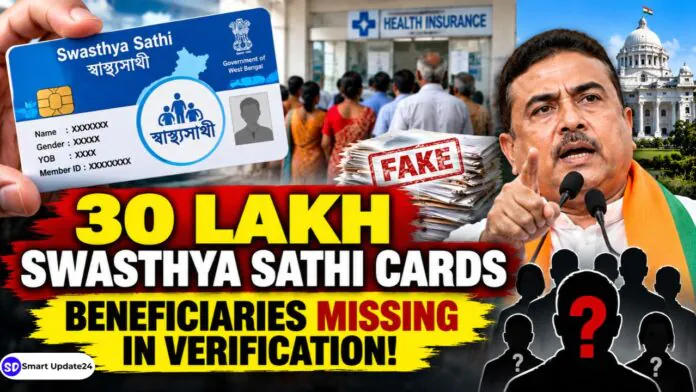
WB Swasthya Sathi Fraud Investigation: A major controversy has emerged over West Bengal’s Swasthya Sathi health insurance scheme after the state government reportedly found serious discrepancies in its beneficiary database. During a verification drive, officials allegedly failed to trace lakhs of people registered under the scheme, raising questions about the accuracy of beneficiary records and the use of public funds.
According to reports published on October 29 and 30, 2026, more than 25 lakh to 30 lakh beneficiaries could not be traced during the verification process. The issue reportedly came to light when the government began checking existing Swasthya Sathi records as part of the process of bringing eligible beneficiaries under Ayushman Bharat and the state’s Mukhyamantri Swasthya Bima Yojana.
The development has triggered fresh concerns about possible irregularities in one of West Bengal’s major healthcare welfare programmes.

Swasthya Sathi Scheme Under Scanner: Over 30 Lakh Beneficiaries Untraceable in West Bengal, Government Reviews Records
WB Swasthya Sathi Fraud Investigation: Massive Verification Drive Raises Questions Over Beneficiary Records and Government Expenditure
A major controversy has emerged in West Bengal over the Swasthya Sathi health insurance scheme, with reports suggesting that more than 30 lakh registered beneficiaries could not be traced during a government verification exercise. The findings have raised serious questions about the accuracy of the scheme’s beneficiary database and the possibility of irregularities in the use of public funds.
The issue came to light when the state government started verifying existing Swasthya Sathi beneficiaries before shifting eligible families to the Centre’s Ayushman Bharat scheme and the state’s newly introduced Mukhyamantri Swasthya Bima Yojana.
According to reports published on October 29 and 30, 2026, officials have reportedly been unable to locate more than 30 lakh beneficiaries at their registered addresses. The findings have prompted the administration to review the existing records and examine whether the discrepancies involve duplicate entries, outdated information or potentially fictitious beneficiaries.
More Than 30 Lakh Beneficiaries Could Not Be Traced
According to a report by The Telegraph, district-level officials encountered difficulties locating more than 30 lakh Swasthya Sathi beneficiaries while conducting verification for their inclusion in alternative health insurance programmes.
A senior government official quoted in the report indicated that the missing beneficiaries were not simply migrant workers who had temporarily moved away. In several cases, officials reportedly could not establish the identity or whereabouts of the registered beneficiaries even after visiting their recorded addresses.
The state is now examining these discrepancies to determine how many records are genuinely invalid and whether any systematic irregularities occurred in maintaining the beneficiary database.
WB Swasthya Sathi Fraud Investigation: Around Rs.14,000 Crore Spent on Swasthya Sathi Since 2017
The financial implications of the issue are significant. Swasthya Sathi was introduced in 2017 as a major healthcare initiative of the West Bengal government, providing cashless health insurance coverage of up to ₹5 lakh per family.
According to The Telegraph, approximately 2.45 crore families were registered under the scheme, and the state government had spent around Rs.14,000 crore since its launch.
The report also indicated that annual expenditure on the scheme had been approximately Rs.2,500 crore over the previous five years.
With more than 30 lakh beneficiaries reportedly remaining untraceable, questions are being raised about the accuracy of the records and the financial implications of maintaining potentially invalid entries.
Could the State Save Thousands of Crores?
The verification exercise has also brought attention to possible savings in government expenditure.
According to officials quoted by The Telegraph, the state government could potentially save between Rs.20,000 crore and Rs.25,000 crore across several welfare schemes if invalid beneficiary records are identified and removed.
However, this estimate relates to multiple government programmes, including Swasthya Sathi, Khadya Sathi and Krishak Bandhu. It should not be interpreted as the confirmed financial loss or savings attributable to Swasthya Sathi alone.
The exact financial impact will depend on the findings of the verification process and the identification of genuinely ineligible or fictitious beneficiaries.
Khadya Sathi and Krishak Bandhu Also Under Scrutiny
The issue is reportedly not limited to the Swasthya Sathi scheme. Government officials have also raised concerns about beneficiary records under other welfare programmes introduced by the previous administration.
Under Khadya Sathi, more than 25 lakh beneficiaries reportedly could not be traced during the verification exercise. The scheme provides subsidised or free foodgrains to eligible households.
Similarly, more than 20 lakh beneficiaries registered under Krishak Bandhu were reportedly difficult to locate when officials attempted to verify their eligibility for inclusion under the Pradhan Mantri Kisan Samman Nidhi scheme.
These developments have prompted the state administration to examine beneficiary databases across multiple departments.
What Happens to Genuine Swasthya Sathi Beneficiaries?
While the government is examining suspected irregularities, the verification process also raises an important question for genuine beneficiaries.
A person not being found at a registered address does not automatically mean that the individual is fictitious or involved in fraud. Changes in residential addresses, migration, incorrect records and other administrative issues can also result in failed verification.
Therefore, the government will need to distinguish between genuine beneficiaries with outdated information and deliberately fabricated records.
A transparent verification process will be important to ensure that eligible families do not lose access to healthcare benefits because of errors in the database.
Also Read: West Bengal TET Protest 2026 | Teachers to Stage Sit-in at Bikash Bhavan from October 28
WB Swasthya Sathi Fraud Investigation: What Happens Next?
The state government’s verification exercise could lead to a major review of welfare scheme databases across West Bengal. Authorities are expected to examine beneficiary identities, registered addresses and relevant records before deciding on further action.
The actual number of fraudulent or duplicate records, if any, will become clearer only after detailed verification and an official audit.
For now, the discovery of more than 30 lakh untraceable Swasthya Sathi beneficiaries has raised serious questions about database management, public expenditure and the monitoring of government welfare programmes.
The key issue is no longer just how many people are registered under the scheme, but how many of those records can be verified and linked to genuine beneficiaries.
