

Editorial Disclaimer: Smart Update24 verifies information through official websites, government notifications, and trusted sources before publication. Our team also conducts independent research and analysis to provide accurate information to readers; however, users are advised to verify important details from the respective official websites for final confirmation.
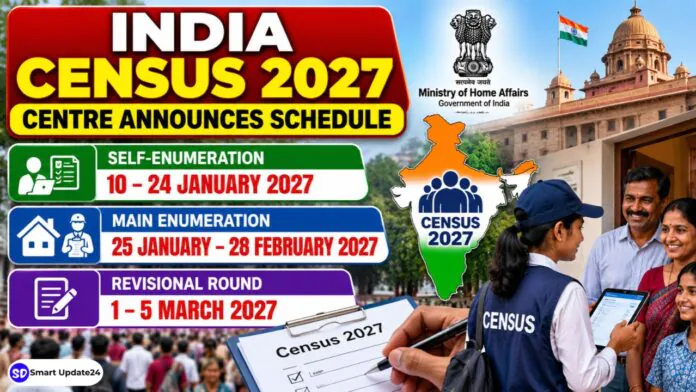
India Census 2027: The Central Government has officially announced the schedule for the next phase of the Census 2027 exercise. According to a notification issued by the Ministry of Home Affairs on October 30, 2026, the population enumeration process will begin on January 25, 2027, and continue until February 28, 2027, across most parts of the country.
The notification has also introduced an important facility for citizens. People will be able to complete their own enumeration through the Self-Enumeration facility between January 10 and January 24, 2027, before the commencement of the house-to-house counting process.
The exercise will be followed by a revisional round from March 1 to March 5, 2027, allowing the census authorities to undertake the prescribed revision process. The reference date for this phase of the Census has been fixed at midnight on March 1, 2027.

The notification was issued by the Office of the Registrar General and Census Commissioner of India under the Ministry of Home Affairs, Government of India.
India Census 2027: Important Dates and Schedule
The government has specified three important stages for the population enumeration process. Citizens should take note of these dates to understand when the self-enumeration facility and the main census exercise will take place.
Census 2027 Schedule
Self-Enumeration: Online facility
10–24 January 2027
Main Population Enumeration
25 January–28 February 2027
Revisional Round
1–5 March 2027
Reference Date
1 March 2027
As specified in the Ministry of Home Affairs notification dated October 30, 2026.
These dates apply to the regions covered by the October 30 notification. Certain states and Union Territories have separate arrangements.
What Is the Self-Enumeration Facility?
One of the important features of Census 2027 is the Self-Enumeration facility. Under this arrangement, citizens will have the opportunity to provide their household and population-related information themselves before census enumerators begin their door-to-door visits.
The self-enumeration window will remain open from January 10 to January 24, 2027.
This facility is expected to make the census process more convenient for households by allowing them to submit the required information in advance. It also represents an important step towards making the country’s population census more digitally accessible.
However, citizens should follow the official instructions issued by the Census authorities regarding the online process, verification and submission of information.
The official Census of India portal provides information and updates about the Census 2027 exercise.
Official website: Census of India Official Portal.
India Census 2027: Which States and Union Territories Are Excluded from This Schedule?
The October 30 notification does not cover all states and Union Territories under the same timetable. Certain regions have been excluded from this particular January-February 2027 schedule.
The following regions are excluded:
- Manipur: The census schedule will be announced separately until further notice.
- Goa: Covered under a separate census schedule.
- Uttar Pradesh: Covered under a separate schedule.
- Punjab: Covered under a separate schedule.
- Uttarakhand: The state has a separate arrangement.
- Ladakh: Excluded from the January-February schedule.
- Himachal Pradesh: Snow-bound non-synchronous areas are excluded.
- Jammu and Kashmir: Snow-bound non-synchronous areas are excluded.
It is important to understand that exclusion from this particular notification does not mean these regions are excluded from Census 2027 altogether. Several of them have separate enumeration schedules or arrangements.
Separate Census Schedule for Election-Bound States
Goa, Uttar Pradesh, Punjab and the non-snow-bound areas of Uttarakhand have a separate timetable because of the upcoming Assembly elections.
According to the Census of India portal, their population enumeration schedule is:
| Census activity | Dates |
| Self-Enumeration | November 16–30, 2026 |
| Door-to-Door Enumeration | December 1, 2026–January 4, 2027 |
| Revisional Round | January 5–9, 2027 |
Therefore, residents of these states should follow their respective census schedules rather than the January 10–February 28 timetable.
What Happens If There Are Errors in Census Information?
Accuracy is an important part of the population census. Household details and individual information must be recorded correctly to ensure reliable population data.
The census process includes a revisional round between March 1 and March 5, 2027, under the latest notification.
If citizens notice any discrepancy in the information collected during the enumeration process, they should follow the official correction and grievance procedures announced by the Census authorities.
The exact procedure, designated offices and documents required for making corrections should be confirmed through official instructions. The October 30 notification specifies the revisional period but does not provide a detailed public grievance procedure.
Why Is Census 2027 Important for India?
The Census is one of the most important administrative exercises undertaken by the Government of India. It provides essential information about the country’s population, households and demographic characteristics.
The data collected through the census is used for several important purposes, including:
- Government planning and public policy formulation.
- Allocation of resources for different states and regions.
- Planning healthcare, education and housing facilities.
- Understanding population growth and migration patterns.
- Development of infrastructure and public welfare schemes.
- Supporting research and demographic studies.
India’s previous population census was conducted in 2011. The next exercise is therefore particularly significant for updating the country’s demographic information.
What Should Citizens Do Before the Census Begins?
Citizens should remain prepared for the upcoming enumeration process. They should keep relevant household and personal information readily available and provide accurate answers to the enumerators.
Those who wish to use the Self-Enumeration facility should wait for the official portal instructions and complete the process within the notified period.
People should also remember that the census is a government exercise and should not share personal information through unofficial websites or suspicious links claiming to offer census registration.
The announcement of the Census 2027 schedule marks an important development in India’s population enumeration exercise. With the Self-Enumeration facility opening on January 10, 2027, and the main door-to-door process beginning on January 25, the government is preparing for another major nationwide census operation.
While most states will follow the January-February schedule, election-bound states and certain snow-bound regions will have separate arrangements.
Citizens should keep track of official announcements from the Ministry of Home Affairs and the Office of the Registrar General and Census Commissioner to avoid missing important information.
For the latest Census 2027 updates, visit the official website: censusindia.gov.in.
