

Editorial Disclaimer: Smart Update24 verifies information through official websites, government notifications, and trusted sources before publication. Our team also conducts independent research and analysis to provide accurate information to readers; however, users are advised to verify important details from the respective official websites for final confirmation.
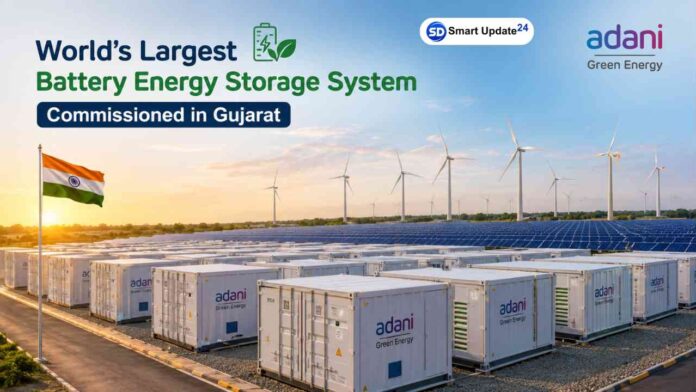
Adani Group Launches India’s Largest Energy Storage System: Adani Green Energy has commissioned a massive 3.37 GWh Battery Energy Storage System (BESS) in Khavda, Gujarat—currently the world’s largest single-site battery storage project outside of China.
The giant facility can store enough renewable energy to power nearly 1 million homes for an entire day.
In India, a major boost to India’s clean energy ambitions, Adani Green Energy Limited (AGEL) has commissioned a massive 3.37 GWh Battery Energy Storage System (BESS) at Khavda in Gujarat. The project is being described as the world’s largest battery energy storage installation at a single location outside China, marking a significant milestone for India’s renewable energy sector.

Khavda is rapidly emerging as one of the world’s largest renewable energy hubs.
Adani Group Launches India’s Largest Energy Storage System: A Landmark Project for India’s Energy Future
The newly commissioned Battery Energy Storage System has a total capacity of 3.37 GWh, with 1.37 GWh already operational since March 2026. Located at the Khavda Renewable Energy Park in Gujarat, the project has been completed within just 10 months, highlighting the rapid pace of development in India’s green energy infrastructure.
The project will help improve grid stability, manage peak power demand, and support round-the-clock clean energy supply from solar and wind projects.
Battery Energy Storage Systems play a critical role in storing electricity generated from renewable sources such as solar and wind power.
Powering Nearly One Million Homes
According to project details, the storage facility can hold enough renewable energy to supply electricity to nearly one million homes for an entire day. This capability is expected to improve energy reliability while reducing dependence on conventional fossil fuel-based power generation.
The project also supports India’s long-term objective of increasing the share of renewable energy in the national power mix and strengthening energy security.
Why the Battery Storage System Matters
Large-scale battery storage has become essential for modern power grids. Renewable sources like solar and wind are intermittent, meaning power generation can fluctuate throughout the day. Energy storage systems help bridge this gap by storing surplus electricity and releasing it when needed.
The Khavda BESS is expected to:
- Improve grid stability and reliability
- Manage peak electricity demand efficiently
- Support a round-the-clock clean energy supply
- Reduce renewable energy curtailment
- Enhance integration of solar and wind power into the grid
Adani Group Launches India’s Largest Energy Storage System: Part of the Khavda Renewable Energy Vision
The battery storage project forms a key component of the larger renewable energy ecosystem being developed at Khavda. Gujarat has emerged as one of India’s leading destinations for renewable energy investments, thanks to its vast land availability and favorable climatic conditions for solar and wind power generation.
Industry experts believe projects of this scale could accelerate India’s transition toward cleaner energy while helping achieve national climate goals.
Strengthening India’s Global Position
The commissioning of one of the world’s largest battery energy storage facilities demonstrates India’s growing capability in deploying advanced renewable energy infrastructure. As the country continues to expand its clean energy capacity, large-scale storage projects will become increasingly important in ensuring a stable and sustainable electricity supply.
With the Khavda Battery Energy Storage System now operational, India has taken another significant step toward building a resilient and future-ready energy network.
