

Editorial Disclaimer: Smart Update24 verifies information through official websites, government notifications, and trusted sources before publication. Our team also conducts independent research and analysis to provide accurate information to readers; however, users are advised to verify important details from the respective official websites for final confirmation.
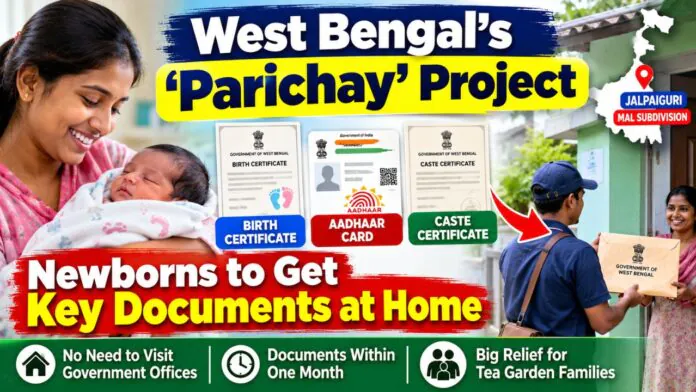
WB Parichay Prakalpa 2026: A new administrative initiative in West Bengal is set to make the process of obtaining essential government documents easier for families, particularly those living in tea garden areas. Under a pilot project called ‘Parichay’, launched in the Mal subdivision of Jalpaiguri district, families will be able to receive important documents for a newborn without having to make repeated visits to different government offices.

The initiative aims to reduce the paperwork and travel involved in obtaining documents such as a birth certificate, Aadhaar card and caste certificate after the birth of a child.
For many families, especially those living in remote tea garden areas, obtaining these documents can be difficult. Travelling to government offices, arranging the required paperwork and standing in queues can take considerable time. The new initiative is intended to bring these services closer to residents.

What is the ‘Parichay’ pilot Prakalpa?
The Parichay pilot Prakalpa has been introduced as an administrative initiative by the Mal subdivision administration in Jalpaiguri district.
The central idea behind the project is simple: instead of asking parents to visit multiple government offices after the birth of their child, the administration will facilitate the process of preparing the child’s essential documents through a coordinated system.
According to the information available about the initiative, the process is particularly focused on helping people in tea garden areas, where access to government services can sometimes involve additional travel and logistical difficulties.
The project is being described as a pilot initiative, meaning that its implementation and functioning can be evaluated before considering wider expansion.
WB Parichay Prakalpa: Birth certificate, Aadhaar and caste certificate
Under the initiative, the administration is seeking to streamline access to three important documents for newborn children.
These include:
- Birth Certificate
- Aadhaar Card
- Caste Certificate, wherever applicable
The birth certificate is one of the most important documents issued after the birth of a child. It is subsequently required for various purposes, including school admission and other official processes.
Similarly, Aadhaar becomes an important identity document as the child grows and accesses different government and institutional services.
For families eligible for a caste certificate, obtaining that document at an early stage can also make future administrative and educational processes easier.
The initiative therefore seeks to bring several documentation-related processes together rather than leaving parents to deal with each department separately.
WB Parichay Prakalpa: Documents may reach the family at home
One of the notable aspects of the initiative is the proposed doorstep delivery of documents.
As per the information provided about the project, the required documents are expected to reach the child’s family within around one month of returning home from the hospital, subject to completion of the necessary formalities and verification.
This could make a significant difference for families who otherwise have to travel to administrative offices to collect documents.
The objective is not simply to issue documents but to make the process more accessible to ordinary residents.
Why tea garden areas are getting special attention
Jalpaiguri has several tea garden areas where a large number of workers and their families live. For residents in such areas, travelling to subdivision or district-level government offices can be time-consuming and expensive.
A parent with a newborn child may have to make more than one trip if a document is not ready or if additional paperwork is required.
The administration’s doorstep approach could therefore reduce both travel and waiting time.
For daily wage earners and tea garden workers, even a single day spent travelling to a government office can mean losing a day’s income. In that context, an initiative that reduces unnecessary visits could have a direct impact on people’s everyday lives.
No more repeated visits to government offices?
The broader objective of the Parichay project is to reduce the need for parents to move from one office to another after the birth of a child.
Traditionally, different documents may involve different departments, forms and verification procedures. For families unfamiliar with government processes, this can become confusing.
A coordinated administrative mechanism can potentially make the experience considerably simpler.
However, it is important to understand that the pilot project does not mean that all documentation requirements or verification procedures have disappeared. The concerned authorities will still need to complete the required formalities before documents can be issued.
A step towards doorstep government services
The Parichay initiative also reflects a broader idea of taking government services directly to citizens.
Instead of expecting citizens to repeatedly visit government offices, technology and coordination between departments can be used to make public services more accessible.
This approach can be particularly useful in rural and geographically dispersed communities.
If the pilot project works successfully in the Mal subdivision, similar models could potentially be considered for other areas where residents face difficulties accessing government services.
Also Read: WB Sarathi Portal 2026 | Class 8 Students to Get Free Bicycles
WB Parichay Prakalpa: What makes the initiative significant?
The importance of the project lies not only in the documents being provided but also in the time and effort that families could save.
A new parent generally has enough responsibilities immediately after the birth of a child. Having to visit multiple offices for documentation can add another layer of stress.
For families in tea garden communities, where transport and distance can make administrative work more difficult, doorstep delivery could provide considerable relief.
The initiative could also encourage more families to complete documentation for their children at an early stage.
What parents should keep in mind
Although the project is designed to simplify the process, parents should still ensure that the information provided during registration is accurate.
Details such as the child’s name, date of birth, place of birth and parents’ information should be carefully checked.
Where caste certification is applicable, the necessary eligibility and verification requirements will also continue to apply.
Parents should therefore follow the instructions provided by the hospital and local administration and keep the necessary supporting documents safe.
A promising pilot for easier public services
The Parichay pilot project in Mal subdivision of Jalpaiguri is an interesting attempt to reduce the administrative burden on families following the birth of a child.
If the system functions effectively, parents could benefit from a more coordinated process for obtaining the birth certificate, Aadhaar and applicable caste certificate, with the documents reaching them at home rather than requiring repeated office visits.
For tea garden communities in particular, this could mean less travelling, fewer queues and less disruption to their daily work.
The real success of the initiative, however, will depend on how smoothly the system operates on the ground and whether the doorstep service can be delivered consistently within the proposed timeframe.
For now, the launch of the pilot project marks a noteworthy step towards making essential government documentation simpler, more accessible and more citizen-friendly.
