

Editorial Disclaimer: Smart Update24 verifies information through official websites, government notifications, and trusted sources before publication. Our team also conducts independent research and analysis to provide accurate information to readers; however, users are advised to verify important details from the respective official websites for final confirmation.
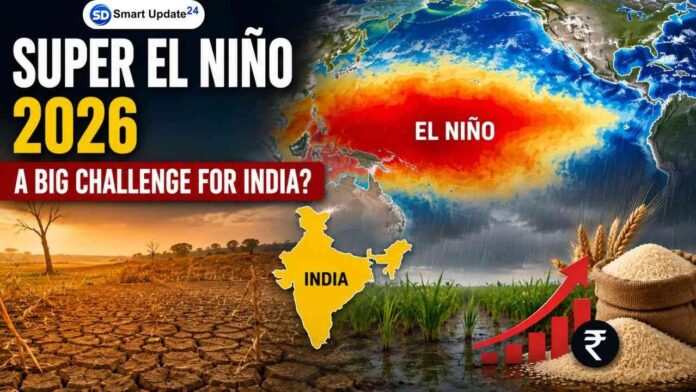
Super El Nino 2026: Another crisis is brewing in the Pacific Ocean. And this crisis is poised to strike India in a devastating form—one unlike anything we have ever witnessed before. Take a look at this specific region of the Pacific Ocean. This particular zone of warm waters has a name. Scientists refer to it as “El Nino.” And what is currently taking shape this year is the rarest and most perilous variant of El Niño—known as “Super El Nino.” >> At this very moment, something is transpiring across the Pacific Ocean that could fundamentally alter the trajectory of global weather patterns. >> Scientists are issuing a stark warning: the next major blow may well come hurtling from the very heart of nature itself. A “Super El Nino”.
A climate pattern forming thousands of kilometers away in the Pacific Ocean is raising fresh concerns among scientists and economists. While global attention has largely focused on rising fuel prices, geopolitical tensions, and inflation, another development is quietly emerging that could affect India’s economy, agriculture, and food security in the months ahead.
Experts are closely watching the possibility of a powerful Super El Niño event, which could influence weather patterns across the world and potentially disrupt India’s crucial monsoon season.

What is ‘Super El Nino’?
There is a strong probability of an El Nino event occurring, and this particular instance is expected to be exceptionally powerful. Scientists are labeling it as dangerous, primarily because the last time such an event occurred was back in 1876. That event was so catastrophic that monsoon rainfall virtually ceased for two consecutive years. Crop failure occurred on a massive scale. 58 million Indians—a figure roughly equivalent to the entire current population of Italy—were plunged into a severe food crisis. Ultimately, between 5 million and 10 million Indians lost their lives; and under the influence of this “Super El Nino,” 3 to 4 percent of the world’s total population was wiped out.
In fact, it was this “Super El Nino” that was the root cause of the devastating famine of 1876. Now, for every Indian watching this video, the most concerning aspect is this: in that very same region of the ocean, those same anomalous conditions are once again taking shape—right at this moment, in May 2026. And the world’s most authoritative meteorological agencies have reached a consensus on a matter regarding which they rarely ever agree. They have all stated the exact same thing: this El Nino could prove to be the most powerful El Nino ever recorded in human history. And the worst part is that this El Nino is poised to strike India at a time when the country is already grappling with a severe energy crisis.
Why India’s Monsoon Matters More Than Many Realize
Every year, India waits for the arrival of monsoon rains. For millions of farmers, these rains are not just a weather event; they are directly linked to income, crop production, and livelihood.
India may be among the world’s largest economies, but agriculture continues to play a major role in supporting employment and rural demand. A large portion of farmland still depends heavily on rainfall rather than irrigation systems.
Good monsoon seasons usually bring:
- Better crop production
- Higher rural income
- Increased consumer spending
- Stronger economic activity
Weak rainfall, on the other hand, can create a chain reaction affecting food prices, industries, and overall economic growth.
Also Read: Nepal Free Sponsored Trips for Indian Influencers | Travel Creators Get New Opportunity
What Exactly Is El Nino?
El Nino is a climate phenomenon that develops when sea surface temperatures in parts of the Pacific Ocean become warmer than usual.
Under normal conditions, ocean winds and temperature patterns help support rainfall systems across several regions, including India. However, during an El Niño event, these weather patterns shift.
When warming becomes significantly stronger, scientists classify it as a Super El Nino. Such events can influence rainfall distribution, increase temperatures, and create weather extremes in multiple countries.
How Could It Affect India?
According to the material provided, concerns are being raised that a stronger El Nino pattern could reduce monsoon performance and affect sectors that depend heavily on rainfall.
Possible impacts may include:
Higher Food Prices
- Lower agricultural output can reduce supply and increase the prices of food items.
Pressure on Farmers
- Farmers relying mainly on rainfall could face difficulties if the rains become weak, delayed, or uneven.
Impact on Rural Economy
- Lower farm income often affects spending on consumer goods, machinery, and local businesses.
Pressure on Growth
- Agriculture and rural demand remain important drivers for broader economic activity in India.
What India Can Do
Experts often point toward long-term solutions rather than emergency responses alone.
Some important measures include:
- Expansion of irrigation networks
- Wider use of drip and sprinkler irrigation systems
- Investment in water conservation
- Stronger agricultural infrastructure
- Diversifying employment opportunities beyond agriculture
Building stronger systems could help reduce dependence on seasonal weather conditions.
A Word of Caution
The provided text contains several claims and historical comparisons regarding future impacts and potential severity. Forecasts around climate events evolve continuously, and weather predictions can change over time. While scientists monitor El Nino conditions closely, the exact impact on India can only become clearer with updated meteorological assessments and official data.
The discussion around Super El Niño highlights an important reality: weather patterns today are increasingly connected to economics, food systems, and everyday life.
Know More: https://oceana.org/blog/what-a-super-el-nino-could-mean-for-our-planet-this-year/
