

Editorial Disclaimer: Smart Update24 verifies information through official websites, government notifications, and trusted sources before publication. Our team also conducts independent research and analysis to provide accurate information to readers; however, users are advised to verify important details from the respective official websites for final confirmation.
Taj Mahal History Controversy: The Taj Mahal is one of the world’s most recognisable monuments, but its history has been at the centre of a long-running controversy in India.

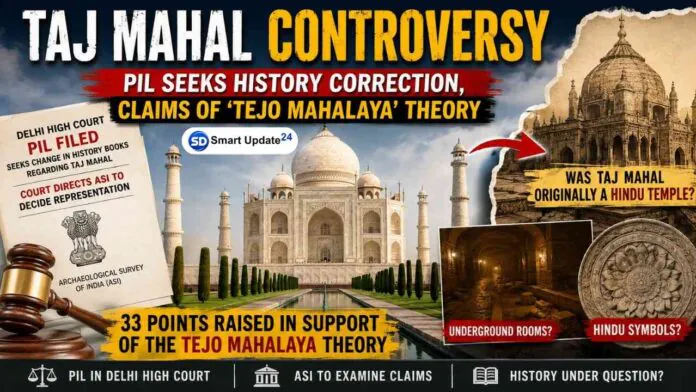
Senior advocate Hari Shankar Jain has repeatedly argued that the monument in Agra was not originally built by Mughal emperor Shah Jahan for Mumtaz Mahal. According to the claim, the structure was originally a Hindu temple known as “Tejo Mahalaya”, dedicated to Lord Shiva, and was constructed centuries before the Mughal period.
A widely circulated statement attributed to Jain claims that people have been made to believe that Shah Jahan built the Taj Mahal as a symbol of love, while the structure was actually an earlier Hindu temple. The claim further attributes its construction to Raja Parmardi Dev around 1155-56 CE, with Jain saying that documentary evidence exists to support the theory. Similar details appear in the petition reported in 2026.

But there is an important distinction between a historical claim and an established historical fact.
The Delhi High Court did not decide that the Taj Mahal was not built by Shah Jahan. Instead, the court directed the Archaeological Survey of India (ASI) to consider and decide on a representation seeking changes to the historical account of the Taj Mahal’s construction.
Taj Mahal History: What exactly is the ‘Tejo Mahalaya’ claim?
The theory is not new. One of its best-known proponents was writer P. N. Oak, whose writings argued that the Taj Mahal had originally been a Hindu temple or palace.
Hari Shankar Jain became involved in the controversy through legal proceedings. In 2015, he and other petitioners approached an Agra court claiming that the Taj Mahal was actually a Shiva temple and sought permission for Hindu devotees to perform religious rituals there. Jain also claimed at the time that Raja Paramardi Dev had built Tejo Mahalaya during the 12th century, after which the property allegedly passed through Rajput rulers before Shah Jahan took control of it.
Supporters of the theory have pointed to features such as the lotus-like design on the dome, certain architectural elements, underground chambers, the layout of the complex and alleged references to an earlier Hindu structure.
An article published by My India My Glory presents 33 arguments in support of the theory. These include claims concerning the size of the complex, underground rooms, fountains, architectural features, alleged Hindu symbols and the presence of other structures around the Taj Mahal. However, the publication itself carries a disclaimer stating that the views expressed are those of the author and that it does not take responsibility for the validity of the information.
What does the established historical record say?
The official historical account is substantially different.
UNESCO describes the Taj Mahal as a vast Mughal mausoleum built in Agra by Emperor Shah Jahan in memory of Mumtaz Mahal. UNESCO records construction as beginning in 1632, with the principal mausoleum completed in 1648 and the wider complex completed in subsequent years. It also notes the importance of historical and Quranic inscriptions in establishing the chronology of the monument.
The Government of India’s Taj Mahal website similarly states that construction of the complex began around 1631 under Shah Jahan, that the principal mausoleum was completed in 1648 and that the surrounding buildings and gardens were completed later. It also describes the project as involving a large team of architects, craftsmen and specialists.
The Ministry of Culture’s current description of the monument also identifies the Taj Mahal as a 17th-century white marble mausoleum commissioned by Shah Jahan in memory of Mumtaz Mahal, with construction between 1631 and 1648.
Therefore, the “Tejo Mahalaya” explanation remains a disputed interpretation rather than the accepted historical account.
Taj Mahal History: What did the Archaeological Survey of India say?
This is one of the most important parts of the controversy.
In 2017, the Archaeological Survey of India told an Agra court that the Taj Mahal was a tomb and rejected the claim that it had originally been a Hindu temple. The Central Government also stated in an affidavit that there was no evidence of a temple having existed at the site before the Taj Mahal.
That position is significant because the ASI is the government agency responsible for protecting and studying India’s centrally protected monuments.
It does not mean that historical research can never change our understanding of a monument. It means that any alternative interpretation needs to be supported by verifiable archaeological, documentary and historical evidence rather than by architectural speculation alone.
Taj Mahal History: The controversy reached the courts again
The legal debate did not end with the earlier cases.
In 2022, the Supreme Court dismissed a petition seeking the opening of certain rooms inside the Taj Mahal in order to investigate the claim that the monument was actually a Hindu temple known as Tejo Mahalaya. The court described the petition as a “publicity interest litigation.”
In November 2023, the Delhi High Court dealt with another PIL seeking changes to historical descriptions of the Taj Mahal and an investigation into its age and the alleged existence of Raja Man Singh’s palace at the site. The court directed the ASI to consider the representation rather than itself declaring the historical claims to be true.
More recently, the issue has returned to the Allahabad High Court.
In July 2026, the court sought responses from the Centre and the ASI on a petition associated with Hari Shankar Jain. The petition challenges lower-court decisions concerning a request to appoint an Advocate Commissioner to inspect, photograph and videograph parts of the Taj Mahal complex. The petitioners claim that the monument was originally the Hindu temple Tejo Mahalaya.
According to reports on the 2026 proceedings, the petitioners have cited 109 archaeological and historical features that they say support their argument. The petition reportedly claims that Tejo Mahalaya was constructed by Raja Paramardi Dev in 1155-56 CE and was later converted into a mausoleum during Shah Jahan’s reign.
However, the High Court seeking a response is a procedural development. It should not be interpreted as a judicial finding that the Taj Mahal was a Hindu temple.
Taj Mahal History: So, is the Taj Mahal really Tejo Mahalaya?
At present, there is no basis for presenting that proposition as an established historical fact.
There is certainly a continuing legal and historical dispute. Hari Shankar Jain and other petitioners have put forward a detailed alternative theory and are seeking examination of evidence through the courts. Their claims deserve to be distinguished from established historical conclusions, particularly when discussing them in news reports or on social media.
At the same time, the official accounts maintained by UNESCO, the Government of India and the ASI identify the Taj Mahal as a Mughal-era mausoleum commissioned by Shah Jahan for Mumtaz Mahal. UNESCO’s chronology places its construction in the 17th century, while the ASI has previously rejected the assertion that the monument was originally a Hindu temple.
The most responsible way to approach the controversy, therefore, is not to declare one side victorious before the evidence has been judicially or academically established.
A debate that needs evidence, not just viral claims
The Taj Mahal debate continues to attract enormous attention because it combines history, religion, architecture and law.
The claim that it was once Tejo Mahalaya, built by Raja Parmardi Dev in the 12th century, is a serious allegation made by specific petitioners and advocates, but it remains contested. Likewise, the fact that courts have entertained petitions or sought responses from government authorities should not be confused with a judicial confirmation of the theory.
For readers encountering viral posts about the Taj Mahal, the key question should therefore be simple: What evidence has actually been established?
Until archaeological investigations, historical research or a competent court establish otherwise, the accepted historical account remains that the Taj Mahal is a 17th-century Mughal mausoleum commissioned by Shah Jahan in memory of Mumtaz Mahal.
The debate may continue, and new evidence can always be examined. But history is ultimately settled by evidence that can be independently verified, not simply by how widely a claim is shared online.
Taj Mahal History: Delhi High Court Seeks ASI’s Decision on Petition Questioning Taj Mahal’s Construction History
The Delhi High Court directed the Archaeological Survey of India (ASI) to consider a representation seeking changes to the historical accounts concerning the construction of the Taj Mahal. The petitioner argued that there is no historical evidence establishing that Raja Man Singh’s palace was demolished and that an entirely new monument was subsequently constructed by Shah Jahan on the same site.
However, the court’s direction should not be interpreted as a finding that the claim is historically correct. The court asked the ASI to examine the representation and take a decision on it. The petitioner’s claims therefore remain claims under dispute, rather than an established judicial conclusion about the origin of the Taj Mahal.
Also Read: Gen Z vs Gen Alpha | What Is the Difference between the Two Digital Generations?
Taj Mahal History: 33 Arguments Cited in Support of the Tejo Mahalaya Theory
A 2017 article published by My India My Glory presents 33 arguments that, according to its author, challenge the conventional account that Shah Jahan commissioned the Taj Mahal as a mausoleum for Mumtaz Mahal. The arguments draw heavily on the writings of P. N. Oak and references to the Badshahnama. The website itself states that the views belong solely to the author and that it does not take responsibility for their validity.
For clarity, the following points are presented as claims made in that article, rather than as independently established historical facts.
1. The unusually large Taj Mahal complex
The article argues that the Taj Mahal occupies an exceptionally extensive area, including structures on both sides of the Yamuna, and questions whether such a large complex would have been necessary for a single mausoleum.
2. Presence of additional graves
It points to several other graves and burial structures within the wider Taj complex and argues that their presence is difficult to reconcile with the idea of a monument created exclusively for Mumtaz Mahal.
3. Other royal and attendant burials
The article draws attention to graves attributed to members of Shah Jahan’s household and attendants and interprets their presence as evidence that the complex may have had a broader purpose.
4. Mumtaz was not Shah Jahan’s only wife
One argument questions why Shah Jahan would have created such an extraordinary monument specifically for Mumtaz when he had other wives.
5. Ancient structures near the Yamuna
The article refers to old structures, temples, bathing areas and other remains near the river and argues that these features suggest the area had a pre-Mughal history.
6. Mumtaz’s burial at Burhanpur
The article highlights Mumtaz Mahal’s initial burial at Burhanpur and questions aspects of the later transfer of her remains to Agra.
7. Interpretation of the Badshahnama
The article questions the wording used in accounts concerning Mumtaz’s remains being brought from Burhanpur to Agra and interprets the chronology as potentially inconsistent.
8. Question over the motivation for constructing the mausoleum
The author argues that Shah Jahan did not construct a major palace specifically for Mumtaz during her lifetime and therefore questions the conventional explanation for commissioning such a monumental tomb after her death.
9. Timing of Mumtaz’s death
The article points out that Mumtaz died relatively early in Shah Jahan’s reign and questions whether the emperor could have accumulated and spent the enormous resources supposedly required for the monument so soon after becoming emperor.
10. Questioning the romantic narrative
The article challenges the popular image of Shah Jahan and Mumtaz as an exceptionally romantic couple and argues that contemporary accounts portray a more complicated royal household.
11. Shah Jahan’s character and reputation
The author uses accounts of Shah Jahan’s political conduct and personality to challenge the traditional image of him as a purely devoted husband who built the Taj Mahal as an expression of personal love.
12. Question over the psychology of grief
The article argues that the conventional story of Shah Jahan immediately turning his grief into the construction of a monumental mausoleum does not fit the author’s interpretation of human behaviour.
13. The argument about Shah Jahan’s personal life
The article goes further by arguing that Shah Jahan’s alleged relationships with other women make the popular romantic explanation for the Taj Mahal questionable.
14. Earlier fountains beneath the present garden
One of the more specific architectural claims concerns fountains reportedly found beneath the existing garden level. The article interprets these as evidence that parts of the garden system existed before Shah Jahan’s reign.
15. Changes to upper-floor rooms
The article claims that some upper rooms show signs of marble and decorative material having been removed and suggests that material may have been reused elsewhere in the complex.
16. Claims about underground chambers
The article refers to historical accounts concerning restricted access to underground areas and argues that the existence of valuable fixtures or decoration there could indicate that the structure had an earlier history.
17. Earthworks and defensive features
The article points to mounds and earthworks around the complex and interprets them as possible remnants of an older defensive arrangement.
18. Mumtaz’s social background
The author questions whether Mumtaz’s birth and social status would, under the author’s interpretation, have made such an enormous mausoleum likely.
19. The alleged Black Taj
The traditional story of a proposed black marble Taj Mahal across the Yamuna is challenged. The article argues that the remains on the opposite bank may instead represent earlier structures rather than the foundations of a second Taj Mahal.
20. Different shades of marble
The article points to differences in the colour and appearance of marble used in different parts of the monument and interprets these variations as evidence that some decorative elements may have been added later.
21. Shah Jahan’s architectural ability
The author questions the extent of Shah Jahan’s personal involvement and architectural expertise and challenges the idea that he personally conceived the Taj Mahal’s design.
22. Absence of an original architectural drawing
One of the article’s major arguments is that no original architectural drawing of the Taj Mahal is presented as surviving in Shah Jahan’s court records. The author argues that this creates a question about the conventional story of the monument’s commissioning.
23. Large surrounding mansions and structures
The article points to substantial buildings surrounding the Taj and argues that their scale and arrangement may indicate that the complex had purposes beyond serving as a simple mausoleum.
24. The alleged ancient cattle house
The article identifies a structure that it interprets as an old royal cowshed and associates it with the theory that the complex once had a Hindu religious function.
25. Red sandstone annexes
The author points to large red sandstone structures around the Taj and argues that these buildings appear excessive if the complex was designed solely as a tomb.
26. The large number of rooms
The article claims that the wider complex contains hundreds of rooms and argues that such extensive accommodation would be unusual for a conventional mausoleum.
27. Relationship with Tajganj
The article examines the relationship between Tajganj and the Taj Mahal complex, including the alignment of roads and gateways, and interprets the layout as evidence of an older palace-temple complex.
28. Pleasure pavilions
The presence of pavilions and recreational architectural features is cited as another reason to question whether the entire complex was originally conceived as a mausoleum.
29. The Shah Jahan imprisonment story
The article challenges the popular story that Shah Jahan spent his final years looking at the Taj Mahal through a small piece of glass from Agra Fort. It argues that this story has been embellished over time.
30. Iron rings on the dome
The article draws attention to iron rings visible around parts of the dome and proposes that they could have been used to support lamps associated with an earlier Hindu religious structure.
31. Shah Jahan and Mumtaz in historical accounts
The author challenges the modern romantic portrayal of the pair and argues that historical descriptions of Shah Jahan and Mumtaz do not necessarily support the popular “monument of love” narrative.
32. Shah Jahan’s wider building programme
The article disputes the portrayal of Shah Jahan’s reign as a period defined primarily by peace, prosperity and architectural achievement. It uses his military campaigns and political history to challenge the conventional interpretation.
33. Alleged sun and cobra imagery
Finally, the article points to what it describes as representations of the sun and cobra inside the dome above Mumtaz Mahal’s cenotaph. The author interprets these motifs as potentially connected with Hindu symbolism, particularly associations with the Sun and Lord Shiva.
Taj Mahal History: What These 33 Points Actually Represent
These 33 arguments form part of the Tejo Mahalaya theory, which claims that the Taj Mahal was originally a Hindu temple or palace and that Shah Jahan later converted or modified the existing structure.
However, the existence of these 33 arguments does not itself establish that the theory is historically proven. The original My India My Glory article explicitly identifies the material as the author’s views and includes a disclaimer concerning its validity.
The arguments should therefore be presented in a news article with careful attribution, using phrases such as “the article claims,” “supporters of the theory argue,” “according to the theory,” or “the petitioner contends.”
This distinction is particularly important because the conventional historical account identifies the Taj Mahal as a 17th-century Mughal mausoleum commissioned by Shah Jahan for Mumtaz Mahal, while the Tejo Mahalaya theory remains disputed.
