

Editorial Disclaimer: Smart Update24 verifies information through official websites, government notifications, and trusted sources before publication. Our team also conducts independent research and analysis to provide accurate information to readers; however, users are advised to verify important details from the respective official websites for final confirmation.
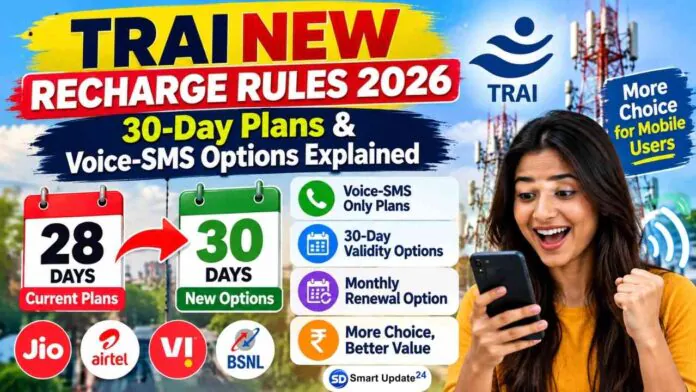
TRAI New Recharge Rules 2026: For millions of prepaid mobile users, the familiar 28-day recharge cycle could soon have more alternatives. The Telecom Regulatory Authority of India (TRAI) has notified the Telecom Consumers Protection (Thirteenth Amendment) Regulations, 2026, introducing a broader framework for Voice and SMS-only Special Tariff Vouchers (STVs).

The new rules were notified on September 22, 2026, and are set to come into force 30 days after publication in the Official Gazette.
The change does not mean that every existing 28-day recharge will automatically become a 30-day plan. Instead, telecom operators will have to make specific Voice-and-SMS-only options available across certain validity periods.

TRAI New Recharge Rules: What has changed under the new TRAI rules?
The latest amendment focuses mainly on giving prepaid users more flexibility over how they recharge their mobile connections.
- Voice and SMS-only plans for 30 days or less
Telecom service providers will have to offer Voice-and-SMS-only STVs corresponding to bundled Voice, SMS and Data STVs with validity periods of 30 days or less.
This means customers who do not need mobile data should have more options to choose a plan that covers only calling and SMS instead of paying for a data component they may not use.
- A monthly renewal option
The regulations also require operators to provide a Voice-and-SMS-only STV that can be renewed on the same date every month.
If that date does not exist in a particular month, the renewal date will be the last day of that month.
This is significant for consumers who prefer a calendar-month style recharge cycle rather than repeatedly tracking a 28-day validity period.
- Shorter-duration options will also be available
The new framework does not stop at 30-day plans.
Where telecom companies offer bundled Voice, SMS and Data STVs with shorter validity periods, corresponding Voice-and-SMS-only options will also have to be offered.
TRAI’s explanatory memorandum specifically says that shorter-duration choices are intended to provide greater flexibility for consumers who need only basic telecom services.
- At least one longer-validity Voice-SMS-only option
The amendment also requires telecom service providers to offer at least one Voice-and-SMS-only STV with a longer validity, corresponding to a longer-validity bundled STV offered by the operator.
So the change is not limited to monthly or short-term plans. The framework covers a range of validity options.
Will mobile users really need only 12 recharges a year?
This is where some headlines can be misleading.
The discussion around the new rules has focused heavily on the fact that many prepaid plans have traditionally used 28-day validity, which can result in more than 12 recharge cycles over a year. Rajya Sabha MP Raghav Chadha has publicly highlighted this issue and described the proposed 30-day options in terms of reducing the need for a 13th recharge.
However, the TRAI regulation itself does not say that every existing 28-day plan must be converted into a 30-day plan.
Instead, the regulation requires operators to provide the specified categories of Voice-and-SMS-only STVs, including a monthly-renewable option. The actual plans, prices and benefits will depend on individual telecom operators.
Therefore, the popular phrase “12 months, 12 recharges” should be understood as a possible outcome for consumers choosing suitable 30-day or monthly-renewable plans, not as a blanket conversion of all prepaid plans.
TRAI New Recharge Rules: Will Voice-SMS-only plans become cheaper?
The new rules require an appropriate reduction in tariff for Voice-and-SMS-only STVs compared with corresponding bundled services that include data.
The idea is that a customer who is not receiving mobile data should not necessarily have to pay the same tariff as someone receiving a bundled data service. TRAI has also clarified that it is not fixing a specific retail price for operators.
So the exact amount customers will save is not yet something that can be stated universally. It will depend on the plans and pricing introduced by individual telecom companies.
Who could benefit from these plans?
The new framework could be particularly relevant for people who primarily use their phones for calling and SMS.
This includes:
- Feature-phone users
- OLD citizens
- Users who rarely need mobile data
- People who primarily use Wi-Fi for internet access
- Consumers looking for shorter-validity recharge options
- Users who want to pay for calling and SMS without a bundled data service
TRAI’s own explanatory memorandum refers to old users, rural consumers and feature-phone users among the groups that may need Voice-and-SMS-only services.
What happens to existing data plans?
Existing bundled plans are not being removed.
TRAI has specifically stated that Voice-and-SMS-only STVs are intended to supplement rather than replace existing Voice, SMS and Data offerings. Consumers who prefer data-inclusive plans can continue using them.
This means the key change is about adding more choices, rather than forcing all users into voice-only plans.
Also Read: NGT Mobile App Launched 2026 | Check Case Status, Hearing Dates and Orders From Your Phone
When will the new rules take effect?
TRAI notified the Telecom Consumers Protection (13th Amendment) Regulations, 2026 on September 22, 2026. The regulation states that it will come into force 30 days after publication in the Official Gazette.
Telecom operators will then need to align their relevant prepaid offerings with the new requirements.
TRAI New Recharge Rules: What should Jio, Airtel, Vi and BSNL users expect?
Customers of Jio, Airtel, Vodafone Idea (Vi) and BSNL should not assume that a particular new recharge price or validity is already available simply because the regulatory framework has changed.
The regulation establishes the requirements for the types of STVs operators must offer. Individual operators will determine their actual tariffs, benefits and plan configurations within that framework.
Therefore, customers should check their operator’s official app, website or authorised recharge channels once the rules take effect.
The bigger change for prepaid users
The most important part of the new TRAI framework is not simply the number 28 or 30. It is the expansion of consumer choice.
Someone who needs mobile data can continue choosing a data-inclusive plan. Someone who only needs calls and SMS can have more dedicated options. And customers who prefer a monthly renewal cycle can get an option designed around the same date each month.
In short, TRAI’s 13th Amendment creates more room for Voice-and-SMS-only prepaid plans, including options of 30 days or less and a monthly-renewable voucher. But it does not automatically turn every 28-day recharge into a 30-day recharge.
TRAI’s official Telecom Consumer Protection regulations page
