

Editorial Disclaimer: Smart Update24 verifies information through official websites, government notifications, and trusted sources before publication. Our team also conducts independent research and analysis to provide accurate information to readers; however, users are advised to verify important details from the respective official websites for final confirmation.
PM SETU Scheme 2026: I was scrolling through Facebook this morning, just as I do every day, when I suddenly came across a post by Jagannath Chattopadhyay—the MLA from Suri, West Bengal, and the state’s Minister for Higher Education. He had shared a few photos with the caption: “The first workshop following West Bengal’s participation in the PM-Setu scheme.”

A question immediately crossed my mind upon seeing the post: What exactly is the PM-Setu scheme? Why is this workshop so significant? If I was unaware of this scheme, it is quite likely that many others are also in the dark about it.
From AI and Robotics training to modern labs and better placements, PM SETU Scheme 2026 aims to upgrade 1,000 ITIs across India. Here’s everything students and job seekers need to know.

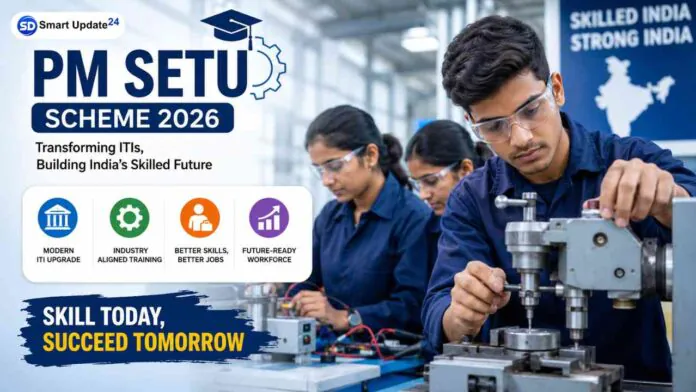
The PM SETU (Pradhan Mantri Skilling and Employability Transformation through Upgraded ITIs) scheme aims to transform India’s Industrial Training Institutes (ITIs) into modern, industry-focused skill development centres.
What is the PM SETU Scheme 2026?
PM SETU stands for Pradhan Mantri Skilling and Employability Transformation through Upgraded ITIs.
The initiative aims to transform government Industrial Training Institutes (ITIs) into modern, industry-aligned skill development centres capable of meeting the demands of a rapidly changing economy.
As industries adopt advanced technologies such as automation, robotics, artificial intelligence, electric vehicles, and smart manufacturing, the need for highly skilled workers is growing rapidly. However, many ITIs still operate with outdated equipment and training systems, creating a significant gap between classroom learning and industry requirements.
PM SETU seeks to close this gap.
Why Was PM SETU Introduced?
India has more than 15,000 ITIs that train millions of students every year. While these institutions have played a crucial role in workforce development, many face challenges related to infrastructure, curriculum relevance, and industry connectivity.
As technology continues to evolve, employers increasingly seek workers with modern technical skills. Unfortunately, many graduates struggle to meet these expectations.
Through PM SETU, the government aims to:
- Align training with industry needs
- Introduce modern technologies into ITI education
- Improve employability among youth
- Create a future-ready skilled workforce
- Support the vision of Viksit Bharat 2047
PM SETU Scheme 2026: Key Features
- Upgrade of 1,000 Government ITIs across India under a Hub-and-Spoke Model.
- Development of 200 Hub ITIs and 800 Spoke ITIs with shared modern infrastructure.
- Establishment of Special Purpose Vehicles (SPVs) with industry participation for better management and governance.
- Introduction of state-of-the-art laboratories, advanced machinery, and digital learning systems.
- Launch of new-age courses in emerging technologies and modernization of existing trades.
- Promotion of blended learning, short-term courses, executive programs, and Training of Trainers (ToT).
- Creation of incubation centres and production units to encourage innovation and sustainability.
- Strong industry involvement in curriculum design, training standards, apprenticeships, and placements.
- Strengthening of five National Skill Training Institutes (NSTIs) as Centres of Excellence.
- Total investment of approximately ₹60,000 crore over five years.
PM SETU Scheme 2026: Benefits
For Students and Job Seekers
- Access to industry-relevant and globally competitive skills.
- Training on modern equipment and advanced technologies.
- Improved placement and employment opportunities.
- Apprenticeship and on-the-job training support.
- Career counselling and life-skills development.
For Industries
- Availability of a skilled workforce aligned with industry needs.
- Reduced skill gaps in emerging sectors.
- Better productivity through job-ready recruits.
For ITIs and Training Institutions
- Modern infrastructure and upgraded facilities.
- Improved governance and industry partnerships.
- Access to digital learning and advanced training resources.
For States and Union Territories
- Stronger skill development ecosystem.
- Enhanced industrial competitiveness.
- Better employment generation and economic growth opportunities.
For India
- Creation of a future-ready workforce.
- Support for emerging sectors such as AI, Robotics, EV Technology, Renewable Energy, and Industry 4.0.
- Contribution towards the vision of Viksit Bharat 2047 through large-scale skill development and employability enhancement.
Implementation Strategy
The scheme follows a phased implementation approach with clear monitoring mechanisms. Phased implementation over 5 years
- Centralized portal for scheme monitoring
- State-level implementation committees
- Regular third-party evaluations
- Feedback mechanism from all stakeholders
Key Objectives of the PM SETU Scheme
The scheme focuses on several long-term goals:
- Modernising government ITIs across the country
- Strengthening industry-led training models
- Enhancing job readiness among students
- Improving employment outcomes for ITI graduates
- Creating Centres of Excellence through National Skill Training Institutes (NSTIs)
The overall objective is to ensure that technical education keeps pace with industrial transformation.
1,000 Government ITIs Set for Major Upgrade
One of the most significant features of PM SETU is the planned transformation of 1,000 government ITIs nationwide.
These institutions will be divided into:
- 200 Hub ITIs
- 800 Spoke ITIs
This network-based approach is expected to improve resource sharing and training quality across regions.
Understanding the Hub-and-Spoke Model
Under the PM SETU framework, selected ITIs will be developed as advanced Hub institutions.
These Hub ITIs will feature:
- State-of-the-art laboratories
- Advanced machinery and equipment
- Digital learning facilities
- Placement support systems
- Innovation and entrepreneurship centres
Multiple nearby Spoke ITIs will be linked to each Hub, enabling students in smaller institutions to access modern facilities and specialised training.
This model aims to bring high-quality technical education to a larger number of students without duplicating resources.
Official Website: https://pm-setu.skillindiadigital.gov.in/
New-Age Technologies Coming to ITIs
The future workplace will demand new skills, and PM SETU intends to prepare students accordingly.
Potential focus areas include:
- Artificial Intelligence and Automation
Students may gain exposure to AI-driven industrial systems and automated processes.
- Advanced Manufacturing
Training will align with modern manufacturing technologies used in global industries.
- Robotics
Hands-on learning opportunities in robotic systems and automation technologies.
- Electric Vehicle Technology
With India’s EV sector growing rapidly, specialised training in electric mobility is expected to become increasingly important.
- Renewable Energy
Courses related to solar, wind, and sustainable energy technologies may be expanded.
- Industry 4.0 Skills
Students will be introduced to smart factories, digital manufacturing, and interconnected production systems.
- Smart Maintenance Systems
Training in predictive maintenance and technology-driven industrial servicing.
Also Read: PM-AJAY Portal and AJAY Mobile App Launched: Features, Benefits, Objectives and How It Works
Benefits for ITI Students
The scheme is designed to directly improve opportunities for students.
- Better Training Infrastructure
Students will receive training using modern equipment and updated technologies that reflect current industry practices.
- Improved Job Prospects
Closer collaboration with employers could significantly increase placement opportunities.
- Apprenticeship Opportunities
Students may gain practical workplace experience while completing their training.
- Career Guidance Support
Career counselling and employment assistance services are expected to become stronger under the programme.
- Life Skills Development
Communication skills, teamwork, workplace behaviour, and professional readiness will also receive greater emphasis.
Greater Industry Participation
One of the most transformative aspects of PM SETU is the enhanced role of industry partners.
Rather than designing training programmes independently, institutions will work closely with employers.
Industry participation may include:
- Curriculum development
- Training quality assessment
- Apprenticeship opportunities
- Internship programmes
- Recruitment support
This collaboration can help ensure that students graduate with skills that employers actually need.
Five NSTIs to Become Centres of Excellence
The government also plans to strengthen five National Skill Training Institutes (NSTIs) and develop them into Centres of Excellence.
These institutes are located in:
- Bhubaneswar
- Chennai
- Hyderabad
- Ludhiana
- Kanpur
They are expected to play a major role in advanced training, instructor development, and skill innovation.
PM SETU Budget and Funding
The scheme is backed by an estimated investment of approximately ₹60,000 crore over five years.
Funding is expected to come from multiple sources, including:
- Central Government
- State Governments
- Industry partners
- International financial institutions such as the Asian Development Bank (ADB)
- World Bank-supported initiatives
The scale of investment highlights the government’s commitment to strengthening India’s skill development ecosystem.
Why PM SETU Matters for West Bengal
West Bengal has a large network of government ITIs and thousands of students enrol in technical trades every year.
The state’s participation in PM SETU and the organisation of its first workshop indicate that efforts toward ITI modernisation are already underway.
If implemented successfully, students across West Bengal could benefit from:
- Modern training infrastructure
- Industry-relevant courses
- Better placement opportunities
- Enhanced apprenticeship programmes
- Greater exposure to emerging technologies
This could significantly improve employment prospects for technical graduates in the state.
A Major Step Toward India’s Skilled Future
PM SETU is much more than an infrastructure upgrade programme. It represents a comprehensive effort to modernise India’s technical education system and make it relevant for the jobs of tomorrow.
What started as a simple question after seeing a social media post led to the discovery of one of India’s most ambitious skill development initiatives.
As industries continue to evolve, the success of PM SETU may determine how effectively India prepares its young workforce for the future. If implemented as envisioned, the scheme could become the bridge that connects education, technology, and employment in a rapidly changing economy.
- PM SETU Scheme Official Portal : PM SETU Official Portal
- Skill India Digital Portal : Skill India Digital
- Directorate General of Training (DGT) :Directorate General of Training (DGT)
- Ministry of Skill Development & Entrepreneurship (MSDE): MSDE Official Website
- Craftsmen Training Scheme (CTS) / ITI Information: CTS & ITI Information
