

Editorial Disclaimer: Smart Update24 verifies information through official websites, government notifications, and trusted sources before publication. Our team also conducts independent research and analysis to provide accurate information to readers; however, users are advised to verify important details from the respective official websites for final confirmation.
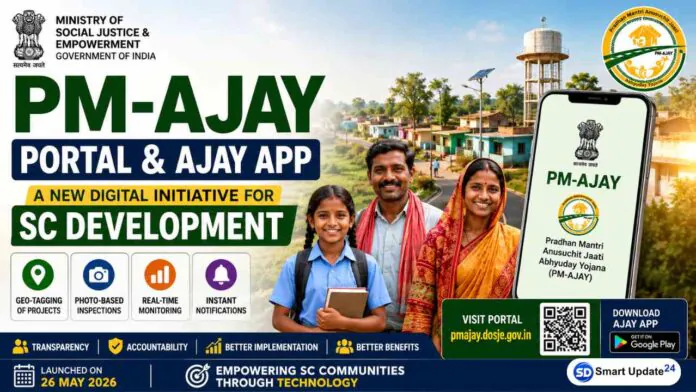
PM-AJAY Portal and AJAY Mobile App: The Government of India has taken a significant step toward strengthening the implementation of welfare schemes for Scheduled Castes (SCs) by launching the PM-AJAY Portal and AJAY Mobile App. The initiative was launched on 26 May 2026 by the Ministry of Social Justice and Empowerment with the objective of bringing transparency, accountability, and real-time monitoring to welfare programs across the country.

The new digital platform is expected to transform how government schemes are implemented and monitored, ensuring that benefits reach the intended beneficiaries more efficiently.
Related Article: OBC NCL Certificate Online Application Starts in West Bengal for Central OBC Non-Creamy Layer through the OSCAR portal

What is PM-AJAY?
PM-AJAY (Pradhan Mantri Anusuchit Jaati Abhyuday Yojana) is a flagship scheme of the Government of India aimed at the socio-economic development of the Scheduled Castes.
The scheme is implemented by the Department of Social Justice and Empowerment and focuses on improving living standards, education, employment opportunities, infrastructure, and overall social welfare for SC communities.
The scheme consists of multiple components designed to address various aspects of development and empowerment.
Why Were PM-AJAY Portal and AJAY Mobile App Introduced?
Traditionally, many government welfare schemes relied heavily on paper-based processes and manual reporting systems. This often led to delays, a lack of transparency, difficulties in monitoring progress, and inefficient utilization of funds.
To address these challenges, the Government introduced the PM-AJAY Portal and AJAY Mobile App, creating a complete digital ecosystem for planning, implementation, monitoring, reporting, and fund management.
The initiative aims to:
- Shift from paper-based workflows to end-to-end digital processing
- Enable real-time monitoring of projects
- Improve transparency and accountability
- Strengthen field-level implementation
- Ensure efficient utilization of government funds
- Improve coordination among central, state, and district authorities
Key Features of the PM-AJAY Portal
1. Real-Time Monitoring
The portal allows authorities to monitor the progress of projects and welfare schemes in real time. This helps identify delays and take corrective actions quickly.
2. Transparent Governance
All project-related information is digitally recorded and accessible through the system, reducing the chances of irregularities and increasing accountability.
3. Milestone-Based Fund Flow
Funds are released based on the completion of predefined milestones. This ensures that projects are progressing as planned before additional financial support is provided.
4. National, State, and District Dashboards
Dedicated dashboards are available for officials at different administrative levels, allowing them to track project performance and implementation status efficiently.
5. Monitoring of 50 Socio-Economic Indicators
The portal tracks approximately 50 indicators related to the socio-economic development of Scheduled Castes.
6. Coverage Across 10 Development Sectors
The system monitors progress across multiple development sectors, including:
- Education
- Healthcare
- Sanitation
- Drinking Water
- Housing
- Employment
- Skill Development
- Social Welfare
- Infrastructure Development
- Economic Empowerment
7. Automated Tracking of Village Development Plans
The portal automatically tracks the implementation of village-level development initiatives and measures their impact on the targeted communities.
What is the AJAY Mobile App?
The AJAY Mobile App serves as the field-level implementation and monitoring tool of the PM-AJAY scheme.
The app enables government officials and implementing agencies to capture and upload project-related information directly from the field.
It significantly improves monitoring, verification, and reporting processes.
Major Features of AJAY Mobile App
Geo-Tagging of Projects
The app records the exact geographical location of project activities.
Benefits include:
- Improved transparency
- Easy verification of project locations
- Prevention of false reporting
Photo-Based Inspection and Uploads
Officials can upload photographs directly from project sites, enabling visual verification of work completed.
Real-Time Reporting
Field-level updates can be submitted instantly through the app, reducing reporting delays.
Dashboard-Based Monitoring
Officials can access project dashboards and monitor progress from anywhere.
Notifications and Alerts
The app sends important updates, reminders, and notifications to users.
Unified Login System
A single login system allows authorized users to access the platform efficiently.
Role-Based Access Control
Access to information is provided according to the user’s official role and responsibilities.
For example:
- Ministry officials can view national-level data.
- State officials can monitor state-level projects.
- District officials can oversee local implementation.
Who Can Use the AJAY Mobile App?
The app is designed primarily for:
- Ministry Officials
- State Government Authorities
- District Administration
- Implementing Agencies
- Inspection Officers
- Hostel Administrators
- Field Functionaries
These users play a crucial role in implementing and monitoring PM-AJAY projects across the country.
Components of PM-AJAY Scheme
1. Adarsh Gram Component
This component focuses on developing SC-majority villages into model villages.
Development activities include:
- Better roads
- Improved sanitation
- Healthcare facilities
- Educational infrastructure
- Drinking water supply
- Community development services
2. Grants-in-Aid Component
Financial assistance is provided to organizations and institutions working for the welfare and empowerment of Scheduled Castes.
The component also supports:
- Skill development
- Employment generation
- Entrepreneurship promotion
- Capacity building
3. Hostel Component
The hostel component provides accommodation facilities for Scheduled Caste students.
This initiative aims to:
- Reduce educational dropouts
- Improve access to higher education
- Support students from remote and disadvantaged areas
- Enhance educational continuity
Benefits for the Public
Although the portal and app are primarily administrative tools, they ultimately benefit the public, especially Scheduled Caste communities.
Improved Service Delivery
Government benefits can reach beneficiaries more quickly and efficiently.
Greater Transparency
Digital monitoring reduces the possibility of fund misuse and irregularities.
Better Development Outcomes
Continuous tracking ensures that development projects are completed on time.
Increased Accountability
Every stage of project implementation can be monitored and verified.
Enhanced Welfare Support
The system strengthens education, healthcare, skill development, housing, and employment-related services for SC communities.
How to Use PM-AJAY Portal and AJAY Mobile App
PM-AJAY Portal
Visit the official portal: https://pmajay.dosje.gov.in/
Authorized users can log in and access project information, dashboards, reports, and monitoring tools.
AJAY Mobile App
The mobile application can be downloaded through the QR code provided by the Ministry or via authorized access channels.
Users can:
- Log in using official credentials.
- Access assigned projects.
- Upload geo-tagged photos.
- Submit inspection reports.
- Monitor project progress.
- Receive notifications and alerts.
Significance of the Initiative
The PM-AJAY Portal and AJAY Mobile App represent a major step toward digital governance and data-driven welfare administration.
The initiative:
- Ensures transparent and accountable governance
- Enables real-time monitoring of welfare schemes
- Strengthens coordination between central, state, and district authorities
- Reduces dependence on manual processes
- Improves project implementation efficiency
- Enhances beneficiary-focused service delivery
By leveraging technology, the Government aims to ensure that welfare schemes for Scheduled Castes are implemented more effectively and that development benefits reach the intended beneficiaries in a timely and transparent manner.
