

Editorial Disclaimer: Smart Update24 verifies information through official websites, government notifications, and trusted sources before publication. Our team also conducts independent research and analysis to provide accurate information to readers; however, users are advised to verify important details from the respective official websites for final confirmation.
Biography of Dharmendra Pradhan: Dharmendra Pradhan Resigns Following Weeks of Student Protests

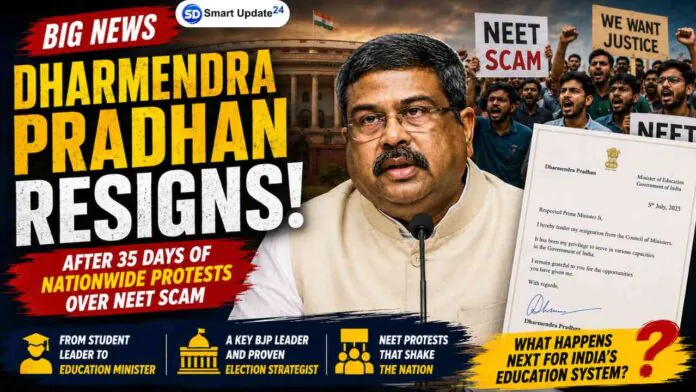
After more than a month of nationwide student demonstrations, growing public anger over alleged examination irregularities, and mounting political pressure, Union Education Minister Dharmendra Pradhan has resigned from his post.
His resignation comes after weeks of protests led by students, youth organisations, and civil society groups demanding accountability over issues surrounding competitive examinations, including NEET. The development marks one of the most significant political moments in recent years concerning India’s education sector.

While political reactions continue to emerge, the resignation has once again brought national attention to questions of transparency, examination reforms, and government accountability.
Biography of Dharmendra Pradhan: Why Did Dharmendra Pradhan Resign?
According to reports and public statements circulating after his resignation, pressure had been building for several weeks following allegations related to examination management and paper leak controversies.
Student organisations across different parts of the country organised protests demanding:
- Greater transparency in national examinations
- Strong action against paper leak networks
- Improved accountability within examination agencies
- Ministerial responsibility for alleged administrative failures
As public protests intensified, the resignation was widely viewed as a political response to the growing pressure.
The government is expected to announce further measures to reform the examination system in the coming weeks.
Who Is Dharmendra Pradhan?
Dharmendra Pradhan is one of the Bharatiya Janata Party’s most experienced organisational leaders and has held several key positions in both the party and the Union government.
Born on 26 June 1969 in Talcher, Odisha, he comes from a political family. His father, Dr. Debendra Pradhan, served as a Union Minister of State during the Atal Bihari Vajpayee government.
However, Dharmendra Pradhan built his own political identity through student politics before rising to national prominence.
Biography of Dharmendra Pradhan: From Student Activist to National Leader
Pradhan completed his Master’s degree in Anthropology from Utkal University.
His political career began with the Akhil Bharatiya Vidyarthi Parishad (ABVP), where he actively participated in student movements and organisational work.
He later became the National President of the Bharatiya Janata Yuva Morcha (BJYM), the BJP’s youth wing, strengthening his position within the party.
Photographs from his early political life often show him leading demonstrations and participating in street protests, highlighting his roots in student activism.
Rise in Electoral Politics
Dharmendra Pradhan’s political career progressed steadily over the next two decades.
His major milestones include:
- Entered the Odisha Legislative Assembly in 2000
- Elected as a Member of Parliament to the Lok Sabha in 2004
- Later served in the Rajya Sabha
- Held several important organisational responsibilities within the BJP
Over time, he emerged as one of the party’s most trusted strategists and campaign managers.
Key Ministries Held by Dharmendra Pradhan
Before becoming Education Minister, Pradhan handled several major Union ministries, including:
- Ministry of Petroleum and Natural Gas
- Ministry of Steel
- Ministry of Skill Development and Entrepreneurship
In July 2021, he was appointed Union Education Minister, taking charge of one of the country’s most important ministries responsible for school education, higher education, and national entrance examinations.
Biography of Dharmendra Pradhan: Declared Assets
According to his election affidavit filed during the 2024 Lok Sabha elections, Dharmendra Pradhan and his family declared total assets of approximately Rs.6.92 crore.
The affidavit also listed liabilities of nearly Rs.1.30 crore.
His investments reportedly included:
- Bank deposits
- Public Provident Fund (PPF)
- Mutual funds
- Insurance policies
A Key Organiser for the BJP
Within the BJP, Dharmendra Pradhan has long been regarded as an influential organisational leader.
Party workers often credit him with playing important strategic roles during election campaigns in several states.
His organisational experience and ability to manage large political campaigns made him one of the BJP’s prominent national leaders over the past decade.
What Does His Resignation Mean?
The resignation is likely to have implications beyond a simple cabinet reshuffle.
Political observers believe it raises broader questions regarding:
- Accountability in public examinations
- Reform of national testing agencies
- Protection of students’ interests
- Public trust in competitive examinations
The coming months may determine whether the resignation leads to structural reforms in India’s examination system or remains a symbolic political decision.
Students at the Centre of the National Debate
The recent controversy has once again highlighted the importance of maintaining credibility in India’s examination process.
Millions of students compete every year in national entrance examinations, making fairness, transparency, and timely administration critical for public confidence.
Regardless of political perspectives, the developments have intensified discussions on improving examination security and strengthening institutional accountability.
Dharmendra Pradhan’s political journey is one of steady organisational growth, beginning as a student activist and rising to become one of the BJP’s senior cabinet ministers.
His resignation marks a significant moment in India’s education landscape and reflects the growing importance of public accountability in the administration of national examinations.
Whether this development becomes a turning point for examination reforms or simply another chapter in Indian politics will depend on the government’s next steps and the reforms introduced in the education system.
Know More: Click Here
