

Editorial Disclaimer: Smart Update24 verifies information through official websites, government notifications, and trusted sources before publication. Our team also conducts independent research and analysis to provide accurate information to readers; however, users are advised to verify important details from the respective official websites for final confirmation.
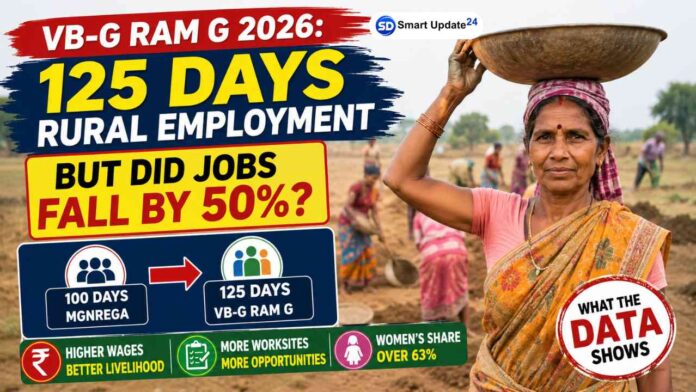
VB-G RAM G Scheme 2026: Startling statistics have emerged following a major shift in rural employment. Effective July 1, 2026, the VBG Ram-G Act replaced the Mahatma Gandhi National Rural Employment Guarantee Scheme. The new legislation mandates a legal guarantee of 125 days of work per year, up from the previous 100 days. However, government figures indicate that employment dropped by nearly half in July—the very first month of the new system.

A total of 7.67 crore person-days of work were generated, whereas the figure stood at 15.33 crore under the old scheme in July 2025. The number of households securing employment also fell by approximately 51 percent. Moreover, both these figures represent the lowest levels recorded for the month of July over the past five years. Factors such as the new Act’s financial structure, the additional burden on states, and the provision to suspend work during the peak agricultural season are collectively altering the landscape of rural employment.
India’s rural employment system has entered a new phase. From July 1, 2026, the Viksit Bharat–Guarantee for Rozgar and Ajeevika Mission (Gramin), or VB-G RAM G, replaced MGNREGA and increased the statutory employment guarantee from 100 days to 125 days for eligible rural households.

A social media post now drawing attention claims that despite the increase in guaranteed workdays, rural employment fell by nearly 50% during the first month of the new system. The claim has raised questions among rural workers and job-card holders about whether the new programme is actually generating more employment on the ground.
However, the available official data presents a more nuanced picture.
VB-G RAM G Scheme: From 100 days to 125 days of guaranteed employment
The biggest change under the new law is the increase in the employment guarantee from 100 days under MGNREGA to 125 days in a financial year.
The VB-G RAM G Act came into force nationwide on July 1, 2026. The government says the new framework is designed not only to provide wage employment but also to create durable rural assets, improve water security, strengthen infrastructure and support climate-resilient development.
Existing job cards were also allowed to continue during the transition, helping prevent an interruption in rural employment programmes.
Why is there a debate over employment falling?
The social media graphic highlights an apparent contradiction: the guarantee has increased to 125 days, but employment generation may have declined during the initial phase of implementation.
The first month of any major government programme can be affected by several factors, including the transition from the old system, registration and verification, administrative arrangements, work approvals and the creation of new worksites.
Therefore, comparing one month with another does not necessarily show the full impact of the new law.
More importantly, the government’s own data does not support a simple conclusion that employment has fallen by 50% nationwide.
VB-G RAM G Scheme: Government data tells a different story
According to the Ministry of Rural Development, by July 22, 2026, more than 99.5% of workers who demanded employment had been offered work under VB-G RAM G.
The government reported that 5.20 crore person-days had been generated across 8.46 lakh worksites since the scheme came into operation on July 1.
This is an important figure because it indicates that the new programme was already generating a substantial volume of employment within its first few weeks.
The government has also introduced an online Management Information System for real-time monitoring of implementation and employment generation.
Women account for a major share of the work
Another notable development has been women’s participation.
Data reviewed during the initial weeks of the new programme showed that women accounted for more than 63% of the 4.62 crore person-days generated between July 1 and July 20.
That suggests the programme continues to be an important source of livelihood support for women in rural households.
VB-G RAM G Scheme: What has changed under VB-G RAM G?
The new framework is not simply a change in the number of employment days.
The government has linked the programme more closely with rural infrastructure, water security, climate resilience and productive assets. The funding structure has also changed, with general states expected to share costs with the Centre under the new framework.
The national average notified wage under the new programme has also increased, with the average reported at Rs.327.40 per day, while no notified wage rate is below ₹300 per day.
For West Bengal, the revised rural wage has been reported at Rs.300 per day.
Official Notification: Download PDF
So, did rural employment really fall by 50%?
At present, it would be premature to say that rural employment under VB-G RAM G has fallen by 50% across India.
The viral/social media claim appears to be based on an early comparison, but the official figures available so far show that millions of person-days have already been generated and that almost all workers who demanded employment had been offered work by July 22.
A meaningful assessment will require a longer period of data and comparable figures from the previous employment programme.
The first few weeks are also not enough to judge whether the new 125-day guarantee will translate into more actual working days for rural households throughout the financial year.
What rural workers should know
For rural households, the key point is that the new law provides a 125-day statutory employment guarantee for eligible households whose adult members volunteer for unskilled manual work.
The government has also stated that workers can demand employment and that unemployment allowance provisions continue under the new framework when work is not provided as required.
Therefore, job-card holders should not assume that the new programme means fewer employment opportunities simply because some early data comparisons may show fluctuations.
The bigger question is implementation
The real test of VB-G RAM G will be what happens over the next several months.
The increase from 100 to 125 days looks significant on paper. But its impact will ultimately depend on whether rural households can actually obtain the promised work when they need it, whether wages are paid on time, how many person-days are generated, and whether the programme reaches the people who depend on it most.
For now, the first-month figures show a mixed picture rather than a straightforward collapse in rural employment. The coming months will provide a much clearer indication of whether the new 125-day guarantee delivers the improvement that rural workers have been promised.
