

Editorial Disclaimer: Smart Update24 verifies information through official websites, government notifications, and trusted sources before publication. Our team also conducts independent research and analysis to provide accurate information to readers; however, users are advised to verify important details from the respective official websites for final confirmation.
Women Scheme State-Wise Comparison 2026: Women-focused cash assistance schemes have become an important part of welfare policy across several Indian states. Monthly transfers are designed to put money directly into women’s hands, helping households manage everyday expenses while strengthening women’s financial independence.

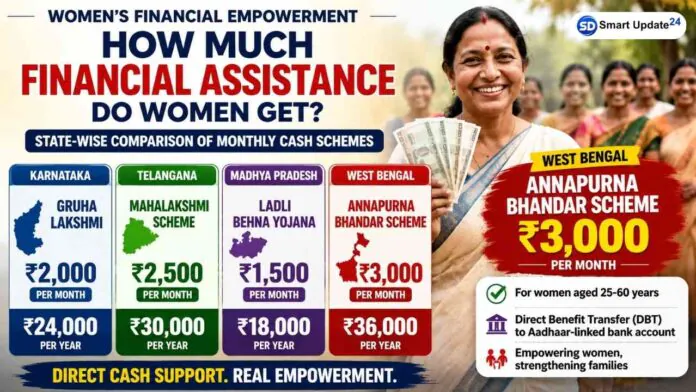
A recent social media post by the BJP’s West Bengal unit has highlighted this comparison, presenting West Bengal’s new Annapurna Yojana alongside women-centric financial assistance programmes in other states. The graphic focuses on one question that is increasingly attracting attention: how much direct financial support do women receive under different state government schemes?
West Bengal’s current figure stands out because eligible women under the Annapurna Yojana are entitled to Rs.3,000 per month through Direct Benefit Transfer (DBT).

Women Scheme State-Wise Comparison: West Bengal’s Rs.3,000 monthly assistance
The West Bengal government introduced the Annapurna Yojana in 2026 as a women-focused social welfare scheme.
Under the official notification, eligible women between 25 and 60 years of age can receive 3,000 every month. The money is transferred directly to the beneficiary’s Aadhaar-linked bank account through DBT. Women holding permanent government employment or receiving certain government salaries or pensions, as well as income-tax payers, are excluded under the notified conditions.
The scheme was rolled out in June 2026. In the first phase, more than 28 lakh verified women beneficiaries received Rs.3,000 each.
The scale of the programme has subsequently expanded significantly. Recent reports say around 1.45 crore eligible women are covered under the scheme, with the government continuing the DBT process for beneficiaries.
That means a woman receiving the full monthly amount would get Rs.36,000 in a year.
How does West Bengal compare with other states?
The social media graphic compares West Bengal with several other states that have introduced direct or recurring financial support for women.
Karnataka: Gruha Lakshmi
Karnataka’s Gruha Lakshmi scheme provides 2,000 per month to eligible women who are recognised as the head of the household. Official Karnataka material describes the monthly assistance as 2,000.
At the full rate, that works out to 24,000 a year.
Official Website: https://wcd.karnataka.gov.in/26/gruhalakshmi-scheme/en
Telangana: Mahalakshmi
Telangana’s Mahalakshmi Scheme includes a provision for 2,500 monthly financial assistance for eligible women who are heads of families.
The scheme also includes other benefits, including subsidised LPG cylinders and free bus travel for women. The Telangana government’s own portal lists the 2,500 monthly assistance as one of the key components of Mahalakshmi.
If received for a full year, the cash component alone comes to 30,000.
Official Website: https://mahabubnagar.telangana.gov.in/scheme/maha-lakshmi-scheme/
Madhya Pradesh: Ladli Behna
Madhya Pradesh has one of the country’s most prominent women-focused cash-transfer programmes, the Mukhyamantri Ladli Behna Yojana.
The monthly assistance was increased to 1,500 from November 2025. In July 2026, more than 1.25 crore women were reported to be receiving the regular monthly payment of 1,500.
There can also be additional one-time festival payments. For example, a 250 Raksha Bandhan amount was transferred along with the regular instalment in August 2026. That additional amount should not, however, be treated as the scheme’s regular monthly payment.
The regular annual assistance at 1,500 per month is 18,000.
Official Website: https://cmladlibahna.mp.gov.in/
Women Scheme State-Wise Comparison 2026: West Bengal’s Rs.3,000 figure is higher on a monthly cash value
Looking strictly at the regular monthly cash assistance, the comparison is straightforward:
| State | Women-focused scheme | Regular monthly cash assistance |
| West Bengal | Annapurna Yojana | Rs.3,000 |
| Telangana | Mahalakshmi | Rs.2,500 |
| Karnataka | Gruha Lakshmi | Rs.2,000 |
| Madhya Pradesh | Ladli Behna | Rs.1,500 |
This comparison considers the regular monthly cash component only. Other benefits attached to individual schemes, such as free bus travel, LPG subsidies or occasional festival payments, are separate and therefore should not be added directly to the monthly figures.
Also Read: WB Ayushman Bharat Card Benefits 2026 | From August 16, 0 3.4 Crore People to Get Health Coverage
Why these schemes matter
The growing popularity of women-focused cash-transfer programmes reflects a broader shift in state welfare policy.
Instead of providing assistance only through household-level benefits, governments are increasingly transferring money directly into women’s bank accounts. The idea is that putting financial resources in the hands of women can give them greater control over household spending and improve their economic security.
For governments, these programmes also represent a major financial commitment because the cost rises rapidly as the number of beneficiaries increases.
West Bengal’s 3,000 monthly assistance, for example, translates into 36,000 a year for a woman receiving the full benefit. With the number of beneficiaries now running into crores, the overall fiscal commitment becomes substantial.
A political debate is also emerging
The comparison has a clear political dimension in West Bengal.
The BJP’s West Bengal unit has used the comparison to highlight the newly introduced 3,000 assistance and present it as a major women-focused intervention. At the same time, welfare schemes involving direct cash transfers have become an important part of electoral and policy debates across India.
However, comparing schemes only by the headline monthly amount does not tell the complete story. Eligibility rules, number of beneficiaries, additional benefits, payment regularity and the overall financial burden on each state government are equally important.
For women beneficiaries, the most important question ultimately remains whether the promised assistance reaches eligible recipients regularly, directly and without unnecessary administrative hurdles.
India is witnessing increasing competition among states to design and expand women-centric welfare programmes. From Karnataka’s Gruha Lakshmi and Telangana’s Mahalakshmi to Madhya Pradesh’s Ladli Behna and West Bengal’s Annapurna Yojana, direct financial assistance has become a major feature of state welfare policy.
For now, West Bengal’s 3,000 monthly Annapurna Yojana places it above the regular monthly cash amounts of the three other programmes compared here. But the real impact of any such scheme will depend not just on the amount announced, but on how effectively and consistently the money reaches the women it is intended to support.
