

Editorial Disclaimer: Smart Update24 verifies information through official websites, government notifications, and trusted sources before publication. Our team also conducts independent research and analysis to provide accurate information to readers; however, users are advised to verify important details from the respective official websites for final confirmation.
WB Ayushman Bharat Card Benefits 2026: Ayushman Bharat Card Announcement | 3.4 crore people to receive Ayushman Bharat card benefits starting August 16, Health Minister announces.

West Bengal is set to begin the rollout of the Ayushman Bharat Pradhan Mantri Jan Arogya Yojana (AB-PMJAY) from August 16, bringing a major change to the state’s public healthcare system.
According to reports ahead of the launch, around 3.4 crore people in West Bengal have enrolled for Ayushman Bharat, while around 80 lakh people have also signed up for the state’s Mukhya Mantri Swasthya Bima Yojana.

The development is significant because West Bengal had remained outside the full implementation of Ayushman Bharat for several years. The state formally moved towards implementation in 2026 after signing an agreement with the National Health Authority. The scheme is expected to provide health assurance of up to Rs.5 lakh to eligible families.
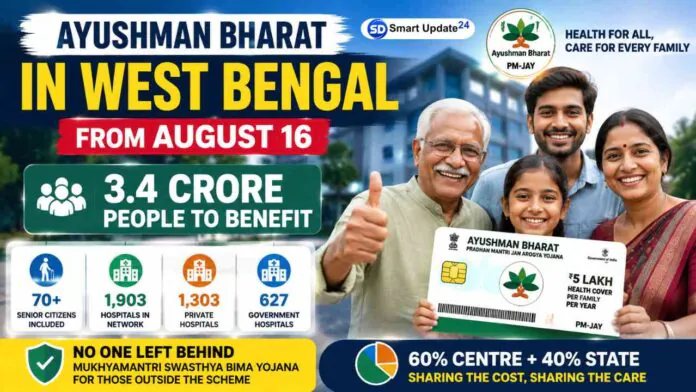
WB Ayushman Bharat Card Benefits effective in the state from August 16
-
3.4 crore people will receive benefits
-
Everyone aged 70+ will be covered under this Ayushman Bharat scheme
-
1,903 hospitals are registered on the list
-
1,303 private hospitals will provide this benefit
-
627 government hospitals are enlisted
-
If left out, the Chief Minister’s Health Insurance Scheme will be available
-
In Ayushman Bharat, Centre will provide 60% + State will provide 40% funding
Ayushman Bharat to start in Bengal from August 16
The rollout scheduled for August 16 will bring eligible West Bengal residents under the central health assurance programme.
The latest reports indicate that the state-specific health insurance scheme will continue to play an important role alongside Ayushman Bharat. Around 80 lakh people have reportedly enrolled under the state scheme, providing an alternative layer of health coverage for people who may not fall under the central programme.
This dual approach is expected to expand healthcare protection for a much larger section of the state’s population.
Around 3.4 crore people enrolled
One of the biggest highlights of the rollout is the reported enrolment of approximately 3.4 crore people for Ayushman Bharat in West Bengal.
The figure is important because it shows the potential scale of the scheme once it becomes operational across the state. Earlier reports had estimated that the central scheme would cover around 1.43 crore families, including eligible poor families, old people and frontline workers.
WB Ayushman Bharat Card Benefits: Special focus on people aged 70 and above
Under the expanded Ayushman Bharat coverage, people aged 70 years and above are eligible for health coverage irrespective of their economic status, subject to the applicable scheme rules.
For old people, this can be particularly important because hospitalisation and treatment costs can become a major financial burden for families.
More hospitals to provide treatment
The information shared in the accompanying graphic mentions a large network of government and private hospitals for providing treatment under the scheme.
It lists 1,903 hospitals in the registered network, including 1,303 private hospitals and 627 government hospitals.
There is, however, a numerical mismatch in those figures: 1,303 private hospitals plus 627 government hospitals equals 1,930, not 1,903. Therefore, readers should wait for the final official hospital list or dashboard figures before treating the exact total as confirmed.
The expansion of the hospital network remains one of the most important aspects of the rollout because beneficiaries need access to empanelled hospitals to use the scheme.
What happens to people left outside Ayushman Bharat?
The state’s existing health insurance arrangement is expected to remain important for people who do not come under Ayushman Bharat.
Reports have indicated that the Mukhya Mantri Swasthya Bima Yojana will provide coverage to eligible people who are outside the central scheme. Around 80 lakh people have reportedly enrolled under the state programme ahead of the launch.
This means beneficiaries will need to check which scheme they are eligible for rather than assuming that every resident will automatically receive an Ayushman Bharat card.
WB Ayushman Bharat Card Benefits: Centre and state to share the cost
The information provided with the announcement states that the financial burden of Ayushman Bharat in West Bengal will be shared between the Centre and the state.
The stated arrangement is 60% contribution from the Centre and 40% from the state.
The 2026-27 West Bengal Budget has also made a specific provision for Ayushman Bharat, allocating Rs.3,100 crore to the scheme under the Health and Family Welfare sector.
What beneficiaries should remember
People who believe they are eligible should check their Ayushman Bharat eligibility and card status through the official channels rather than relying only on social media posts.
Beneficiaries should also verify whether the hospital where they plan to receive treatment is actually empanelled under the scheme and whether the particular treatment or procedure is covered.
The rollout is expected to make a significant difference to healthcare access in West Bengal, particularly for eligible low-income families and old citizens.
Key points at a glance
- Scheme: Ayushman Bharat PM-JAY
- West Bengal rollout: August 16, 2026
- Reported enrolment: Around 3.4 crore people
- Old Citizens: 70+ category included under applicable rules
- Health cover: Up to Rs.5 lakh for eligible beneficiaries
- State scheme: Mukhya Mantri Swasthya Bima Yojana
- Reported state-scheme enrolment: Around 80 lakh
- Funding mentioned: Centre 60%, State 40%
- 2026-27 budget allocation for Ayushman Bharat: ₹3,100 crore
For West Bengal, the August 16 rollout marks an important expansion of publicly supported health insurance. With millions of people expected to come under the programme, the availability of empanelled hospitals, smooth card verification and clear information about eligibility will be crucial for beneficiaries.
