

Editorial Disclaimer: Smart Update24 verifies information through official websites, government notifications, and trusted sources before publication. Our team also conducts independent research and analysis to provide accurate information to readers; however, users are advised to verify important details from the respective official websites for final confirmation.
NMC Publishes New Gazette 2026: We all know that the National Medical Commission is the main authority that controls and monitors medical education in India. From giving permission to new medical colleges, approving MBBS seats, checking hospital infrastructure, maintaining faculty standards, and setting rules for medical education, almost everything in the Indian medical education system runs according to NMC guidelines and regulations.

Every medical college in India, whether government or private, must follow the rules set by the National Medical Commission. From the number of beds a hospital must have to the number of teachers required, the type of laboratories that should exist, how classrooms should be built, and even how students receive clinical training, all these things are decided according to NMC norms.
Dear reader, now, you may ask one question!

NMC publishes notices almost every day, so why is this particular notice becoming important today?
The answer is simple for NMC Publishes New Gazette.
This is not just a normal update or small circular. The National Medical Commission has officially published an Amendment Notification through a Gazette Notification, which means the changes mentioned inside it can directly affect medical colleges, medical education systems, permissions, regulations, and future compliance rules across India.
The official notification was published as:
Because this is an amendment notification issued through the Gazette system, it carries legal and administrative importance.
Why Gazette Notifications Are Important
In India, when any major authority publishes a Gazette Notification, it usually means the government or regulatory body is officially making changes, adding new rules, modifying old regulations, or clarifying existing policies.
This is why medical colleges, hospital management authorities, MBBS aspirants, faculty members, and healthcare institutions closely watch such updates from NMC.
Even small wording changes inside amendment notifications can later impact:
- Medical college approval process
- Increase or reduction of MBBS seats
- Faculty requirements
- Infrastructure guidelines
- Hospital attachment rules
- Internship structure
- Student intake capacity
- Recognition status of colleges
- Compliance inspections
That is why this latest amendment notification has started drawing attention in the medical education sector.
How NMC Controls Medical Colleges in India
India’s entire modern medical education system mainly works under the supervision of the National Medical Commission.
Some major responsibilities of NMC include:
- Approving new medical colleges
- Granting permission for MBBS admission
- Regulating postgraduate medical education
- Monitoring teaching hospitals
- Conducting inspections
- Defining the teacher-student ratio
- Setting infrastructure standards
- Maintaining the quality of medical education
Without NMC approval, no medical college in India can legally operate MBBS courses.
Even if a college has land, buildings, and hospital facilities, it still requires NMC permission and periodic assessment to continue admissions.
What Has Changed in the New NMC Amendment Notification 2026?
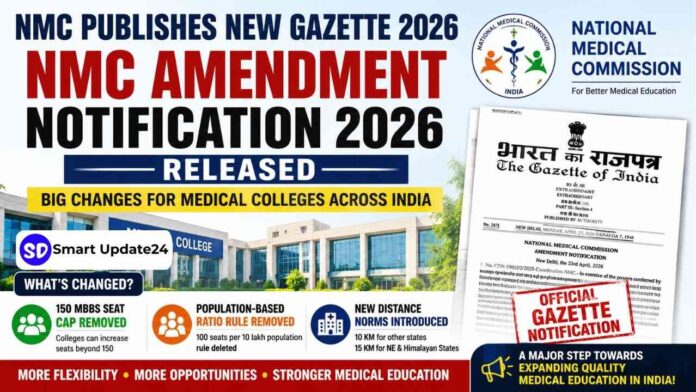
According to the official Gazette Notification, NMC has made three major amendments under the UG-MSR 2023 Regulations.
1. NMC Removes 150 MBBS Seat Limit Rule
Earlier, under UG-MSR 2023, medical colleges seeking seat increases were not allowed to exceed a total intake of 150 MBBS students from the academic year 2024-25.
Now, NMC has officially deleted this restriction.
This means medical colleges may now get more flexibility for increasing MBBS seats beyond the earlier 150-seat limitation, depending on infrastructure, faculty, hospital facilities, and NMC approval.
This change can become very important for:
- Private medical colleges
- Government medical colleges
- Upcoming medical institutions
- States planning to increase MBBS capacity
Experts believe this amendment may help India increase the number of MBBS seats in future years.
2. Population-Based MBBS Seat Restriction Removed
Earlier rules also mentioned that states and Union Territories should maintain a ratio of 100 MBBS seats per 10 lakh population.
Now this condition has also been officially removed by NMC.
This is considered a very major policy-level change.
Why?
Earlier, some states faced limitations in opening new medical colleges or increasing seats due to population ratio restrictions. After removal of this condition, more flexibility may come for opening medical institutions even in states where the seat-population ratio was already high.
This amendment may help:
- Expansion of medical education
- Faster approval of new colleges
- Increase in MBBS seats
- Growth of healthcare infrastructure
3. New Distance Rule Between Medical College and Hospital
One more important change has been introduced regarding the distance between the medical college campus and the attached teaching hospital.
Earlier rule:
- Travel time between the college and hospital should not exceed 30 minutes.
Now, NMC has replaced this rule with a fixed distance system.
New Rule:
- Maximum distance between college and hospital: 10 KM
- For North Eastern and Himalayan states: 15 KM
This amendment may create better clarity during inspections and approval processes because travel time often depended on traffic conditions and local situations.
Now the rule has become more measurable and straightforward.
Why Students and Parents Should Also Understand These Notices
Usually students ignore Gazette notifications because they look technical or legal. But in reality, these notices can directly impact future medical admissions and the recognition status of colleges.
If new rules are introduced regarding infrastructure, hospital beds, faculty shortage, or student intake, colleges may have to quickly upgrade facilities to remain compliant.
In some situations, colleges failing to follow updated rules can face:
- Seat reduction
- Admission restrictions
- Warning notices
- Renewal problems
- Recognition-related issues
That is why students planning for MBBS admission should also stay updated about major NMC regulatory changes.
Big Impact on Future Medical Education
India’s healthcare and medical education sector is expanding very fast. Every year, new medical colleges are opening across different states. Along with expansion, the government and NMC are also trying to maintain education quality and proper clinical training standards.
This is the main reason why amendment notifications become important.
Many times these amendments are introduced to modernize regulations, remove old system problems, improve medical training quality, or bring stricter monitoring systems.
The latest NMC amendment notification, published on 23rd April 2026, may become one of those important regulatory updates that medical institutions across India will now need to study carefully.
Final Words for NMC Publishes New Gazette
The National Medical Commission is not just another government office. It is the backbone of India’s medical education regulatory system. Every medical college, every MBBS seat, every teaching hospital, and every approval process is connected with NMC regulations.
That is why whenever an official Gazette Amendment Notification is published by NMC, it automatically becomes an important subject for the medical education sector.
In the coming days, medical colleges, healthcare education experts, and administrative authorities are expected to closely analyze this amendment notification to understand what practical changes may come into effect across India’s medical education system.
