

Editorial Disclaimer: Smart Update24 verifies information through official websites, government notifications, and trusted sources before publication. Our team also conducts independent research and analysis to provide accurate information to readers; however, users are advised to verify important details from the respective official websites for final confirmation.
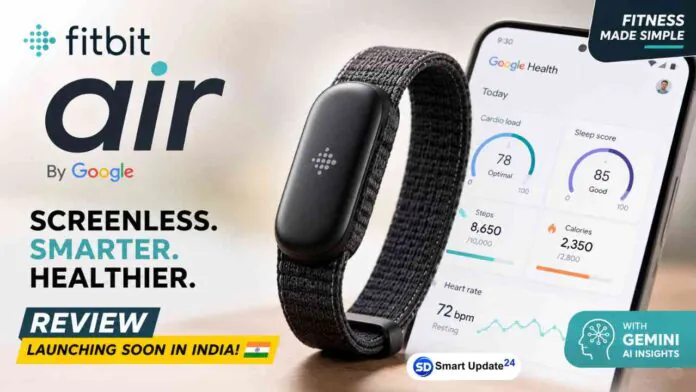
Fitbit Air Review: The fitness wearable market is crowded with smartwatches, fitness bands, and recovery trackers. From the Apple Watch and Garmin devices to subscription-based platforms like Whoop, consumers have more choices than ever. Yet Google is taking a different approach with the upcoming Fitbit Air, a screenless fitness tracker designed to focus on health, recovery, and simplicity rather than notifications and distractions.

Expected to launch in India soon, Fitbit Air aims to bridge the gap between traditional fitness trackers and advanced health-monitoring devices. With a lightweight design, continuous health tracking, AI-powered insights, and an affordable price point of around $100, Google is positioning Fitbit Air as a wearable for everyday users rather than hardcore athletes.
Fitbit Air Review: Quick Specifications
| Feature | Fitbit Air |
|---|---|
| Product Type | Screenless Fitness Tracker |
| Display | None |
| Design | Detachable tracker module (“Pebble”) |
| Band Options | Fabric Band, Silicone Band |
| Heart Rate Monitoring | Continuous |
| Sleep Tracking | Automatic |
| Nap Detection | Yes |
| Activity Tracking | Steps, Cardio Load, Distance, Calories |
| GPS | Phone-connected GPS |
| Workout Tracking | Via Smartphone App |
| AI Features | Gemini Health Companion |
| App Ecosystem | Google Health App |
| Notifications | No |
| Third-Party Apps | No |
| Expected Price | Around $100 |
| Target Users | Casual Fitness Enthusiasts |
| Subscription Required | No (Premium features optional) |
Minimalist Design Focused on Comfort
Unlike conventional smartwatches, the Fitbit Air does not feature a display. Instead, it uses a compact sensor module that fits into either a fabric or silicone wristband. The result is an extremely lightweight device that users can wear throughout the day without constantly checking notifications or interacting with a screen.

The tracker’s small size makes it particularly comfortable during workouts. Whether lifting weights, running, or cycling, the device stays out of the way and rarely interferes with movement. For users who find smartwatches bulky or distracting, Fitbit Air offers a refreshing alternative.
Read More: Realme P4R 5G Launch Soon in India: 7000mAh Battery, Dimensity 7400, 144Hz Display Expected
However, the fabric strap may not appeal to everyone. During intense workouts, it can absorb sweat and take time to dry. The silicone band option is likely to be a better choice for users who engage in frequent high-intensity training.
Health Tracking Takes Center Stage
At its core, Fitbit Air is designed to track health metrics continuously and unobtrusively. Heart rate monitoring is among its strongest features. Real-world testing suggests that the device delivers readings that are reasonably close to premium wearables, making it suitable for daily health monitoring and workout tracking.
The tracker records:
- Continuous heart rate
- Resting heart rate
- Cardio load
- Calories burned
- Activity duration
- Distance traveled
- Time spent in heart-rate zones
For most users, these metrics provide a clear picture of overall health and activity levels without overwhelming them with excessive data.
Design and Build Quality
The Fitbit Air follows a minimalist philosophy. Instead of a smartwatch-style screen, it consists of a small sensor module that snaps into a fabric or silicone band.
Pros
- Extremely lightweight
- Comfortable for all-day wear
- No screen distractions
- Doesn’t interfere during gym workouts
- Easy to forget you’re wearing it
Cons
- Fabric strap uses Velcro
- Pebble can occasionally shift during activity
- Fabric absorbs sweat
- Not as premium-feeling as higher-end wearables
The lightweight design is one of Fitbit Air’s biggest strengths. During weight training, the tracker stays out of the way and doesn’t clash with wrist straps or gym equipment.
Health Tracking Features
Heart Rate Monitoring
Heart rate tracking appears to be one of Fitbit Air’s strongest features.
In real-world testing, average heart rate readings were reportedly only 3-5 BPM lower than those recorded by an Apple Watch Ultra, which is considered one of the most accurate wrist-based heart rate monitors available.
For everyday health tracking, this level of accuracy should be more than sufficient.
What it tracks:
- Resting Heart Rate
- Active Heart Rate
- Cardio Load
- Heart Rate Zones
- Workout Intensity
Sleep Tracking
Sleep tracking is arguably Fitbit Air’s standout feature.
Features:
- Automatic sleep detection
- Automatic nap detection
- Sleep score
- Deep sleep analysis
- Sleep trends
Unlike many smartwatches, users don’t need to manually activate sleep mode.
The tracker automatically identifies:
- Night sleep
- Afternoon naps
- Sleep duration
- Sleep quality
For users focused on recovery and wellness, this could become one of the device’s biggest selling points.
Activity Tracking
Fitbit Air tracks:
- Steps
- Distance
- Calories Burned
- Workout Duration
- Cardio Load
- Heart Rate Zones
For walking, jogging, and daily movement, performance appears solid.
However, limitations become evident for advanced users.
Workout Tracking
Strength Training
Fitbit Air primarily treats weightlifting as a heart-rate-based activity.
Missing features include:
- Rep counting
- Weight logging
- Exercise recognition
- Set tracking
Compared to an Apple Watch paired with gym apps, the Fitbit Air offers much less workout-specific data.
Running and Cycling
For casual runners and cyclists, Fitbit Air provides:
- Distance
- Duration
- Heart Rate
- Cardio Load
However, advanced metrics are missing.
Not Available
- Average Speed
- Maximum Speed
- Elevation Gain
- Training Load Analysis
- VO2 Max-style metrics
- Power Data
- Advanced Running Dynamics
This makes the Fitbit Air less attractive to serious endurance athletes.
Google Health App
The Google Health App is one of Fitbit Air’s strongest assets.
Dashboard Includes
Fitness
- Steps
- Calories
- Cardio Load
- Running Score
Sleep
- Sleep Score
- Sleep Stages
- Recovery Data
Health
- Nutrition Tracking
- Calorie Intake
- Carbohydrates
- Additional Health Metrics
The interface is clean, intuitive, and beginner-friendly.
Gemini AI Health Companion
One of Fitbit Air’s most interesting features is the integration of Gemini AI.
Premium subscribers can access:
AI-Powered Insights
- Health summaries
- Recovery suggestions
- Activity analysis
- Personalized recommendations
- Trend explanations
Instead of manually interpreting graphs and numbers, users receive conversational health guidance powered by Google’s AI.
This could become a major differentiator from traditional fitness bands.
Fitbit Air vs Whoop
Similarities
- Screenless design
- Focus on recovery
- Continuous monitoring
- Sleep tracking emphasis
Fitbit Air Advantages
- Lower upfront cost
- No mandatory subscription
- Better value for casual users
- Simpler experience
- Google ecosystem integration
Whoop Advantages
- More advanced recovery analytics
- Strain tracking
- Training readiness
- Athlete-focused insights
- Professional sports adoption
Verdict
Whoop remains the better choice for serious athletes.
Fitbit Air is the better choice for everyday consumers.
Fitbit Air vs Apple Watch
| Feature | Fitbit Air | Apple Watch |
|---|---|---|
| Screen | No | Yes |
| Notifications | No | Yes |
| Apps | No | Thousands |
| Sleep Tracking | Excellent | Good |
| Health Simplicity | Excellent | Moderate |
| Workout Metrics | Basic | Advanced |
| Battery Focus | Better | Lower |
| Price | Much Lower | Higher |
Fitbit Air vs Garmin
| Feature | Fitbit Air | Garmin |
|---|---|---|
| Casual Use | Excellent | Good |
| Serious Sports | Limited | Excellent |
| Running Metrics | Basic | Advanced |
| Cycling Metrics | Basic | Industry Leading |
| Training Analytics | Minimal | Extensive |
Garmin remains the superior option for competitive athletes.
Pros
What We Like
- Extremely lightweight design
- Comfortable for 24/7 wear
- Excellent sleep tracking
- Automatic nap detection
- Accurate heart rate monitoring
- Clean Google Health App
- Gemini AI integration
- Affordable pricing
- No screen distractions
- No mandatory subscription
Cons
Areas for Improvement
- Limited workout metrics
- No onboard GPS
- Requires a smartphone for workout control
- No screen for quick information
- No third-party apps
- Fabric strap retains sweat
- Weak athlete-focused features
- Limited cycling and running analytics
Excellent Sleep Monitoring
Sleep tracking is where Fitbit Air truly shines. The device automatically detects sleep without requiring users to activate a dedicated sleep mode. It can also recognize naps, a feature often missing from many competing devices.
Users receive insights into:
- Sleep duration
- Sleep quality
- Deep sleep stages
- Recovery patterns
- Sleep scores
The automatic nature of the system makes it convenient for people who simply want to wear the tracker and let it collect data in the background.
The Limits of Performance Tracking
While Fitbit Air performs well as a health tracker, its limitations become apparent when viewed as a serious sports-performance device.
Advanced athletes often rely on detailed training metrics such as:
- Average speed
- Maximum speed
- Elevation gain
- Training load analysis
- Recovery readiness
- Performance trends
These features are commonly available on Garmin devices, premium Apple Watches, and dedicated cycling computers. Fitbit Air focuses primarily on heart-rate-based tracking and lacks many advanced sports metrics.
Strength training enthusiasts may also find the tracker restrictive. It cannot count repetitions, log workout sets, or track weights lifted. Because there is no display and no support for third-party workout applications, users must rely on their smartphones for workout management.
For casual fitness enthusiasts, these limitations may not matter. For competitive athletes, however, they are significant drawbacks.
Google Health App: The Real Strength
One of Fitbit Air’s biggest advantages is the Google Health App. The software provides a clean and intuitive interface that organizes health data in an easy-to-understand format.
Users can view:
- Daily activity statistics
- Cardio load
- Running performance scores
- Sleep analytics
- Nutrition tracking
- Health trends
The app avoids overwhelming users with technical information while still offering enough detail to help improve overall wellness.
Gemini AI Brings Personalized Health Insights
Google is also integrating Gemini AI into the Fitbit ecosystem. Through the Gemini Health Companion, users can receive personalized insights based on their health data.
Rather than simply displaying charts and graphs, the AI can explain trends, answer health-related questions, and provide recommendations based on activity, sleep, and recovery patterns.
This feature has the potential to make health tracking more accessible, especially for users who struggle to interpret raw fitness data.
Fitbit Air vs Whoop
Comparisons with Whoop are inevitable because both devices embrace a screenless design and focus heavily on health monitoring.
Whoop remains the stronger option for serious athletes due to its advanced recovery analysis, strain tracking, and performance-focused ecosystem. However, Whoop requires an ongoing subscription, which significantly increases long-term ownership costs.
Fitbit Air, on the other hand, offers a more affordable entry point and may appeal to users who want health insights without committing to monthly fees.
Who Should Buy the Fitbit Air?
Fitbit Air is ideal for:
- Health-conscious individuals
- Beginners entering the fitness-tracking world
- Users focused on sleep improvement
- People who dislike smartwatch distractions
- Budget-conscious consumers
- Casual exercisers seeking simple health insights
Who Should Look Elsewhere?
The device may not satisfy:
- Competitive runners
- Cyclists
- Triathletes
- Data-driven athletes
- Advanced strength trainers
- Users seeking smartwatch functionality
Final Verdict Fitbit Air Review
Fitbit Air represents a bold shift in wearable technology. Rather than competing directly with feature-packed smartwatches, Google has created a device that prioritizes health, simplicity, and long-term wellness.
Its excellent sleep tracking, reliable heart-rate monitoring, lightweight design, and AI-powered health insights make it one of the most interesting fitness wearables expected to launch this year. While it lacks the advanced performance metrics demanded by serious athletes, it succeeds in delivering the fundamentals at an attractive price.
For everyday users looking to improve their health without being distracted by another screen, Fitbit Air could become one of the best-value fitness trackers on the market.
