

Editorial Disclaimer: Smart Update24 verifies information through official websites, government notifications, and trusted sources before publication. Our team also conducts independent research and analysis to provide accurate information to readers; however, users are advised to verify important details from the respective official websites for final confirmation.
UPI Charges Above Rs.2,000: India’s Unified Payments Interface, or UPI, is set to enter a new phase from October 15, 2026, with a Merchant Discount Rate (MDR) applying to certain high-value merchant transactions.

The issue has triggered questions among users and businesses about whether the new charge is a tax, whether customers will have to pay it, and where the money will actually go.
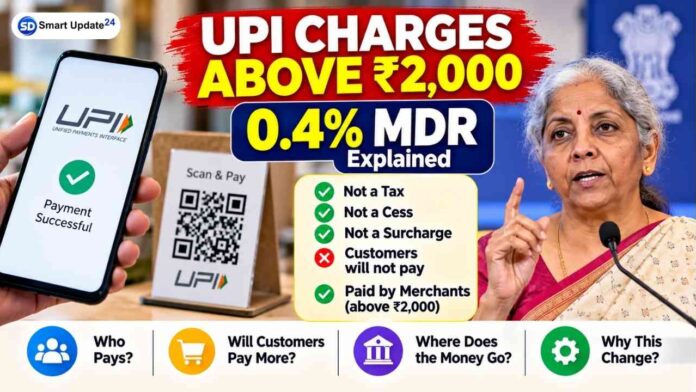
In a recent statement, Finance Minister Nirmala Sitharaman said the MDR should not be confused with a government tax, cess or surcharge. She said the amount would not go into the Consolidated Fund of India and would instead remain within the payments ecosystem.

Merchant Discount Rate: What is changing in UPI payments?
Under the new framework, a 0.4% MDR will apply to specified Person-to-Merchant (P2M) UPI transactions above Rs.2,000.
The framework is scheduled to take effect from October 15, 2026. Payments between individuals, or P2P transactions, will continue to remain free. Merchant payments up to Rs.2,000 will also remain outside the MDR framework.
For transactions of RS.75,000 or more, the MDR will be capped at Rs.300 per transaction.
Merchant Discount Rate: Simple examples
| UPI merchant payment | MDR under the new framework |
| Rs.1,000 | Rs.0 |
| Rs.2,000 | Rs.0 |
| Rs.3,000 | Rs.12 |
| Rs.10,000 | Rs.40 |
| Rs.50,000 | Rs.200 |
| Rs.75,000 | Rs.300 |
| Rs.1,00,000 | Rs.300 cap |
The actual applicability depends on the merchant category and the applicable UPI rules.
Will customers have to pay the 0.4% charge?
No, the announced MDR is not supposed to be passed on to the customer.
The charge is designed as a merchant-side payment ecosystem fee. The government has stated that customers will not be required to pay MDR when making UPI payments.
This means that if an eligible customer makes a Rs.10,000 UPI payment to a merchant, the customer is still expected to pay Rs.10,000. The applicable MDR would be accounted for within the merchant payment ecosystem.
Is the UPI MDR a tax?
The Finance Minister has specifically said that it is not a tax, cess or surcharge.
The stated reason is that the MDR is a payment-related charge distributed among participants in the payment ecosystem rather than a government tax collected into the Consolidated Fund of India.
The Ministry of Finance has similarly described the MDR as a charge within the payment ecosystem, with the amount shared among relevant participants such as banks, payment service providers and UPI application providers.
Merchant Discount Rate (MDR) 0.4% Explained: Download PDF
Merchant Discount Rate: Where will the MDR money go?
According to the government’s framework, the 0.4% MDR will be distributed among participants involved in processing UPI merchant payments.
These include parts of the payments chain such as:
- Banks
- Payment service providers
- UPI application providers
- Other eligible participants in the payment ecosystem
The stated purpose is to help support the infrastructure, technology, security and continued development of the UPI ecosystem.
So, the charge is different from a tax collected by the government for general expenditure.
Small merchants will continue to get protection
One of the important parts of the new framework concerns small merchants.
According to the Ministry of Finance, small merchants receiving up to Rs.1 lakh per month through UPI QR codes under the Person-to-Person-Merchant (P2PM) category will continue to receive zero MDR.
This provision is intended to cover small businesses such as street vendors, neighbourhood shops and similar small merchants.
Therefore, simply making a payment above Rs.2,000 does not automatically mean that every merchant will have to pay 0.4%. The merchant’s category and eligibility also matter.
Some sectors will have different rates
The new framework also provides different treatment for certain sectors.
For specified essential and thin-margin sectors such as railways, telecommunications, insurance, fuel and agricultural inputs, transactions above Rs.2,000 will attract a flat MDR of Rs.5 per transaction, according to the government’s framework.
Capital-market related payments, including certain payments involving mutual funds, securities, stockbrokers and dealers, have a separate 0.02% MDR, capped at Rs.300 per transaction.
Merchant Discount Rate: What about normal UPI transfers between people?
There is no change to ordinary person-to-person UPI transfers under this framework.
If you send money to a friend, family member or another individual, the transaction remains free irrespective of the amount.
This distinction is important because the new MDR is aimed at specified merchant payments, not ordinary transfers between individuals.
Also Read: NGT Mobile App Launched 2026 | Check Case Status, Hearing Dates and Orders From Your Phone
Why has the MDR been introduced?
The government and NPCI have presented the change as a way of creating a sustainable financial structure for the UPI payment ecosystem.
UPI has grown to a very large scale. NPCI’s statistics show that UPI processed more than 24.5 billion transactions in August 2026, with a transaction value of about Rs.29.82 lakh crore.
The new framework therefore changes the earlier zero-MDR structure for specified higher-value merchant transactions while keeping P2P payments and many small-value merchant transactions free.
What merchants should know
For businesses accepting UPI payments, the most important points are:
- The new framework starts from October 15, 2026.
- The standard MDR for specified P2M transactions above Rs.2,000 is 0.4%.
- The charge is capped at Rs.300 per transaction for transactions of ₹75,000 and above.
- P2P UPI transfers remain free.
- Merchant payments up to Rs.2,000 remain free.
- Eligible small P2PM merchants receiving up to Rs.1 lakh per month through UPI QR codes can continue with zero MDR.
- The MDR is intended to be borne within the merchant payment ecosystem rather than directly by the customer.
The key takeaway
The new UPI MDR should not be described simply as a “UPI tax”.
The announced framework introduces a 0.4% merchant discount rate for specified merchant UPI payments above Rs.2,000, while keeping person-to-person payments free and protecting many small merchants from MDR.
The Finance Minister’s recent remarks also make clear that the government is distinguishing this payment-system charge from a tax, cess or surcharge. The money is intended to circulate among eligible participants in the payment ecosystem rather than being collected as government revenue.
For consumers, the central point is straightforward: the announced MDR is not supposed to become a separate charge on the UPI payment made by the customer.
