

Editorial Disclaimer: Smart Update24 verifies information through official websites, government notifications, and trusted sources before publication. Our team also conducts independent research and analysis to provide accurate information to readers; however, users are advised to verify important details from the respective official websites for final confirmation.
PM Modi Said Restart Work From Home: Our Prime Minister Narendra Modi announced on Sunday, the revival of Covid-era work practices such as work-from-home, online conferences, and virtual meetings, saying the ongoing global crisis and rising fuel prices required collective public participation and responsible consumption.

Addressing at a public gathering in Hyderabad on Sunday, the Prime Minister said the country must focus on responsible consumption, fuel savings, and reducing unnecessary expenses to protect India’s economy during a period of global uncertainty. Modi also said international conflicts, particularly the prolonged hostilities in West Asia, had disrupted global supply chains and put pressure on oil prices and India’s foreign exchange reserves.
His remarks come at a time when crude oil prices and international supply chain disruptions continue to affect economies worldwide.

Restart Work From Home: PM Modi Highlights Impact of Global Conflicts
During the Corona period, we developed many systems of work from home, online meetings and video conferences, and we even became accustomed to them. Today, the demands of the times are such that if we restart these systems, it will be in the national interest,” the Prime Minister said.
Modi referred to ongoing international conflicts, especially tensions in West Asia, which he said have disrupted global trade routes and increased pressure on fuel prices.
According to the Prime Minister, rising petrol and diesel prices are directly affecting India’s foreign exchange reserves because the country imports a large portion of its energy requirements from abroad.
He stressed that public participation and behavioural changes are now necessary to reduce economic pressure.
“Restart Work From Home Systems,”: Said by PM Modi
Recalling the systems developed during the Covid-19 pandemic, Modi said India had already successfully adapted to remote work and digital communication methods.
He stated that:
- Work-from-home systems
- Online conferences
- Video meetings
- Digital communication platforms
should once again be prioritised wherever possible.
The Prime Minister said these steps would help reduce daily fuel consumption, traffic congestion, and transportation costs while also supporting national economic interests.
PM Modi Said Restart Work From Home: Focus on Saving Foreign Exchange
One of the central themes of Modi’s speech was the importance of conserving foreign exchange reserves.
He urged citizens to avoid unnecessary fuel usage and adopt more cost-conscious habits during the ongoing global energy crisis.
According to him, reducing petrol and diesel consumption can help India manage import expenses more effectively during periods of international instability.
PM Modi Also Urges Responsible Spending
Apart from work-from-home culture, Modi encouraged people to rethink certain lifestyle and spending habits.
He appealed to citizens to:
- Reduce unnecessary gold purchases
- Avoid excessive fuel consumption
- Minimise dependence on imported foreign products
- Prefer digital meetings over unnecessary travel
- Reduce avoidable foreign trips
The Prime Minister also mentioned that farmers should work toward reducing excessive chemical fertiliser usage where possible.
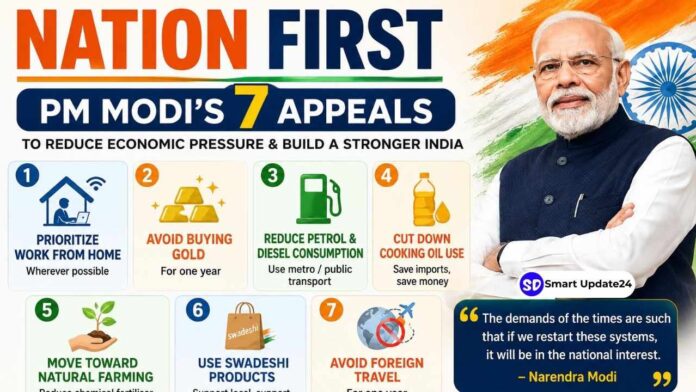
PM Modi’s ‘Nation First’ Appeal: 7 Major Appeals to Citizens to Reduce Economic Pressure and Strengthen India
The graphic lists seven major appeals made in the interest of the nation.
1. Prioritize Work From Home Wherever Possible
The Prime Minister has encouraged companies and employees to bring back work-from-home systems wherever practical.
According to him, reducing daily commuting can help:
- Save fuel
- Reduce traffic congestion
- Lower transportation costs
- Ease pressure on fuel imports
The appeal also supports greater use of:
- Online meetings
- Video conferences
- Digital work systems
2. Avoid Buying Gold for One Year
Modi has also urged citizens to reduce unnecessary gold purchases temporarily.
India imports a large quantity of gold every year, which impacts foreign exchange reserves. Reducing gold imports can help lower financial pressure on the economy during difficult global conditions.
3. Reduce Petrol and Diesel Consumption
The Prime Minister encouraged people to:
- Use metro services
- Prefer public transport
- Reduce unnecessary vehicle usage
With global crude oil prices remaining unstable, lowering petrol and diesel consumption has become an important economic concern for India.
4. Cut Down the Use of Cooking Oil
The appeal also focuses on reducing excessive edible oil consumption.
India imports a significant amount of cooking oil from foreign countries. Lower dependence on imported edible oil can help reduce import costs and strengthen economic stability.
5. Move Toward Natural Farming
Farmers have been encouraged to reduce dependence on chemical fertilisers and gradually adopt natural farming methods wherever possible.
The government has repeatedly promoted:
- Organic farming
- Sustainable agriculture
- Reduced chemical usage
as part of long-term agricultural reforms.
6. Use More Swadeshi Products
Another major appeal focuses on reducing dependence on foreign-branded products and promoting Swadeshi goods.
The message encourages citizens to support:
- Indian manufacturers
- Domestic brands
- Local businesses
- Made-in-India products
This aligns with the government’s larger “Atmanirbhar Bharat” vision.
7. Avoid Foreign Travel for One Year
The Prime Minister also suggested reducing unnecessary foreign travel temporarily.
According to economic experts, reducing international spending can help conserve foreign exchange reserves during periods of global instability and rising import costs.
Also Read: West Bengal New CM 2026 : New CM, Advisor & Secretary Appointment Update
The COVID-19 pandemic completely changed the work culture in India between 2020 and 2022. Millions of employees worked remotely during lockdown periods, and companies rapidly shifted toward virtual communication platforms.
Although most offices later returned to physical operations, rising fuel prices and economic uncertainty are once again bringing discussions around hybrid work and remote work back into focus.
Experts believe that wider adoption of:
- Hybrid office systems
- Virtual conferences
- Remote collaboration
could significantly reduce urban traffic, fuel demand, and operational costs for companies.
Rising Fuel Prices Becoming a Major Concern
Global crude oil volatility has remained one of the biggest economic concerns for many countries over the last few years. Ongoing geopolitical tensions and disruptions in international trade routes have increased transportation and import costs worldwide.
India, being one of the world’s largest energy-importing nations, remains highly sensitive to global oil market fluctuations.
This is why the Prime Minister’s comments are being viewed as both an economic message and a public participation appeal.
Digital India Push Gets Renewed Attention
Modi’s statement has also renewed attention on India’s digital infrastructure and remote-working capabilities.
During the pandemic years, India saw rapid growth in:
- Video conferencing platforms
- Digital payment systems
- Online education
- Remote office technology
The Prime Minister’s latest remarks indicate that digital work culture may continue playing an important role in India’s economic and administrative strategies in the coming years.
**Do you think ‘Work From Home’ will truly be effective in reducing oil demand and protecting the environment? Share your thoughts in the comments.
