

Editorial Disclaimer: Smart Update24 verifies information through official websites, government notifications, and trusted sources before publication. Our team also conducts independent research and analysis to provide accurate information to readers; however, users are advised to verify important details from the respective official websites for final confirmation.
WB New Old Pension Scheme 2026: Is the New Pension Scheme (NPS) set to replace the old pension system for state government employees in West Bengal, just as it did for central government employees? A hint to this effect came on Friday from S. Raman, Chairman of the Pension Fund Regulatory and Development Authority (PFRDA).

Speaking at an event in the city, Raman said, “The NPS was first introduced in 2004, replacing the old pension system, exclusively for central government.
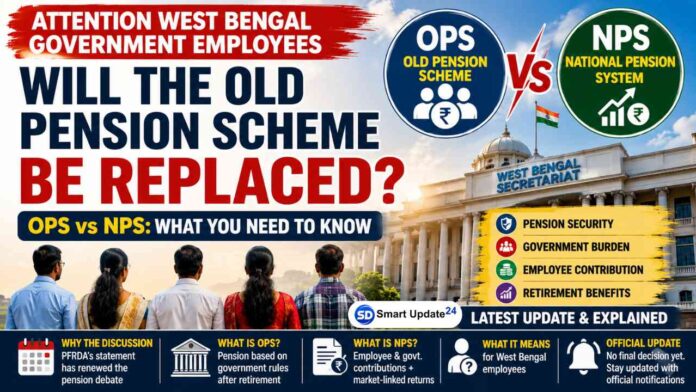
A fresh debate over the Old Pension Scheme (OPS) and National Pension System (NPS) has once again drawn attention among government employees in West Bengal. A recent newspaper report has highlighted comments and indications linked to the Pension Fund Regulatory and Development Authority (PFRDA), raising questions about whether the state could move towards an NPS-based pension framework in the future.

However, there is an important point to remember: there is no confirmed announcement in the material provided that West Bengal has decided to replace its existing pension system with NPS. The discussion is about a possible future direction and the wider pension debate.
WB New Pension Scheme: Why is NPS being discussed in West Bengal?
The issue has gained attention following remarks attributed to PFRDA Chairperson Sivasubramanian Ramann. The PFRDA is the statutory regulator responsible for regulating and developing India’s pension sector and the NPS.
Ramann has previously argued that the traditional Old Pension Scheme can create a significant long-term financial burden for state governments. In an interview with The Indian Express, he said states are free to offer OPS, but argued that they should continue contributions to a funded pension account under NPS.
The newspaper report shown in the supplied image connects this wider debate with West Bengal and raises the possibility of an NPS-style system being considered in the state.
What is the Old Pension Scheme?
Under the traditional pension arrangement, government employees receive a pension after retirement according to the applicable government rules.
The key attraction of the old system is that the employee does not have to build a market-linked retirement corpus in the same way as under NPS. The government bears the pension liability according to the applicable rules.
For many government employees, this makes OPS attractive because the retirement income is viewed as more predictable.
WB New Pension Scheme: How does NPS work?
NPS follows a different model.
Under the NPS framework for state government employees, the employee contributes 10% of salary plus Dearness Allowance every month, while the government makes an equal contribution. The money is credited to the employee’s Tier-I pension account and invested through the NPS framework.
The eventual retirement benefit therefore depends on the accumulated pension corpus and the applicable withdrawal/annuity rules.
This is fundamentally different from the traditional pension model, where the pension is determined under government pension rules rather than primarily by an accumulated market-linked corpus.
OPS vs NPS: What is the basic difference?
| Feature | Old Pension Scheme | NPS |
| Pension structure | Defined-benefit style | Defined-contribution based |
| Employee contribution | Generally no comparable mandatory pension contribution under the old model | Employee contributes to NPS |
| Government contribution | Government bears pension liability | Government contributes alongside employee |
| Retirement benefit | Based on applicable pension rules | Depends on accumulated corpus and applicable rules |
| Investment element | Not directly linked to employee’s pension corpus | Contributions are invested |
| Market-linked element | No direct corpus-based market exposure for the pension | Investment performance affects corpus |
Why are government employees concerned?
The biggest concern is retirement security.
Employees who support OPS generally prefer the certainty of a pension determined under government rules. They argue that retirement income should not depend heavily on investment performance.
NPS supporters, on the other hand, point to the long-term financial burden created by unfunded pension liabilities and argue that a funded retirement system can provide greater fiscal sustainability.
PFRDA Chairperson Ramann has described the traditional OPS model as financially difficult to sustain for states and stressed the importance of a funded pension account.
What does this mean for West Bengal employees?
At present, employees should not interpret the newspaper report as confirmation that West Bengal has officially introduced NPS for all state government employees.
The West Bengal Finance Department’s current budget documents continue to contain provisions for pension expenditure as well as specific NPS-related government contributions for certain categories, showing that pension arrangements in the state involve multiple components.
Therefore, any major change affecting state government employees would need to be backed by a formal notification, government order or other official decision.
WB New Pension Scheme: Could the pension system change in the future?
That remains a matter of policy.
The broader national pension landscape is changing. The Central Government introduced the Unified Pension Scheme (UPS) as an option under NPS for eligible Central Government employees from April 1, 2025. Meanwhile, PFRDA continues to work on reforms to the pension system.
PFRDA has also recently expanded the number of pension funds operating under NPS, indicating that the pension sector continues to evolve.
But these developments do not automatically mean that West Bengal will adopt NPS or abolish its existing pension arrangements.
Also Read: Annapurna Yojona New Portal Login 2026 | Application Link, Status Check and 3,000 Monthly Assistance
The debate over OPS is far from over
The demand for restoration of the Old Pension Scheme has remained an important issue among sections of government employees in several states.
At the same time, governments face the challenge of managing future pension liabilities. This is why the debate is not simply about choosing between “old” and “new” pension systems. It is also about how governments can provide adequate retirement security while maintaining long-term financial sustainability.
For West Bengal employees, the key question will ultimately be what the state government officially decides.
What employees should watch for
If any major change is proposed, employees should look for:
- Official notification from the West Bengal Government
- Finance Department order
- Changes to pension rules
- Details of employee contribution
- Government contribution
- Retirement benefit formula
- Treatment of existing employees
- Treatment of employees appointed after a particular date
- Options for existing NPS subscribers, if applicable
- Any transition or migration provisions
