

Editorial Disclaimer: Smart Update24 verifies information through official websites, government notifications, and trusted sources before publication. Our team also conducts independent research and analysis to provide accurate information to readers; however, users are advised to verify important details from the respective official websites for final confirmation.
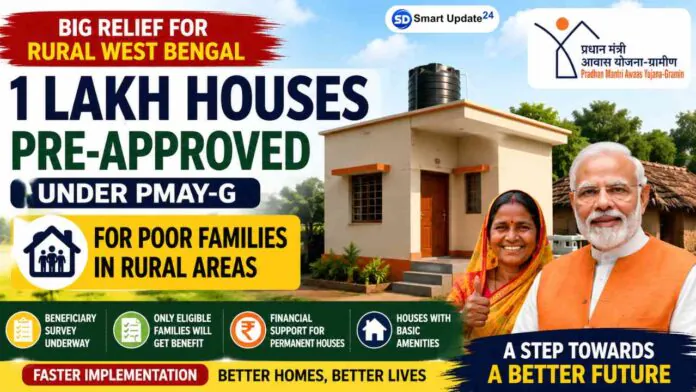
WB PMAY-G Apply 2026: The Central Government has already approved the construction of 1 lakh houses for poor families in rural areas of West Bengal under the ‘Pradhan Mantri Awas Yojana-Gramin’ (PMAY-G); this step has been taken even before the completion of the ongoing survey to select beneficiaries, with the aim of providing housing assistance to eligible families expeditiously.
In a major boost to rural housing in West Bengal, the Central Government has granted advance approval for the construction of one lakh houses under the Pradhan Mantri Awaas Yojana–Gramin (PMAY-G). The decision has been taken even before the ongoing beneficiary survey is completed, with the aim of speeding up the implementation of the scheme for eligible rural families.
WB PMAY-G Apply: One Lakh Houses Approved in Advance
According to the information shared, the Centre has pre-approved 1,00,000 rural houses under PMAY-G for West Bengal. This advance allocation is intended to ensure that construction work can begin without unnecessary administrative delays after the beneficiary survey is completed.

Officials believe that approving the houses in advance will help eligible families receive housing assistance more quickly.
Beneficiary Survey Still in Progress
Although the allocation has been approved, the government has clarified that the beneficiary survey and verification process are still ongoing.
The final list of beneficiaries will be prepared only after officials complete the verification exercise. This is intended to ensure that only genuinely eligible rural households receive assistance under the scheme.
Why the Centre Took This Step
Normally, approvals are issued after the beneficiary list is finalized. However, in this case, the Centre has opted for advance approval to avoid delays in releasing funds and starting construction.
The decision is expected to help authorities begin implementation immediately after the survey is completed, reducing the waiting period for deserving families.
What Is PMAY-G?
The Pradhan Mantri Awaas Yojana–Gramin (PMAY-G) is a flagship rural housing scheme of the Government of India.
Under the scheme, eligible rural households receive financial assistance to construct permanent (pucca) houses equipped with basic amenities. The programme is designed to improve the living conditions of economically weaker families living in rural areas.
Who Will Get the Benefit?
The government has made it clear that the advance approval does not mean automatic inclusion in the scheme.
Only those families who are found eligible during the ongoing survey and verification process will be included in the final beneficiary list and receive assistance under PMAY-G.
How to Apply for WB PMAY-G (Pradhan Mantri Awaas Yojana-Gramin): Step-by-step process
The PMAY-G scheme is not an open online application scheme where anyone can directly submit a form. Beneficiaries are identified through government surveys, Gram Sabha verification, and approval by the local authorities.
You can access the official PMAY-G portal here:
PMAY-G Official Website: https://pmayg.dord.gov.in/netiayHome/Home.aspx
Step 1: Check Your Eligibility
You may be considered if you:
- Live in a rural area.
- Do not own a pucca (permanent) house.
- Live in a kutcha or dilapidated house.
- Meet the eligibility criteria determined by the government survey and Gram Sabha verification.
Step 2: Participate in the Beneficiary Survey
Eligible households are identified through the official housing survey conducted by the Rural Development Department. If the survey team visits your village, ensure your family’s details are correctly recorded.
Step 3: Contact Your Gram Panchayat
If your name has not been included, visit your:
- Gram Panchayat Office
- Panchayat Secretary
- Block Development Office (BDO)
Request that your case be verified and included in the eligible beneficiary list if you meet the scheme criteria.
Step 4: Verification by Gram Sabha
Your application or survey details will be verified by the Gram Sabha and local authorities. Only eligible households are recommended for approval.
Step 5: Approval and Sanction
Once approved, your details are entered into the PMAY-G system, and financial assistance is released in installments directly to your linked bank account through DBT (Direct Benefit Transfer).
WB PMAY-G Apply: Documents Generally Required
Keep these documents ready:
- Aadhaar Card
- Mobile Number
- Bank Account linked with Aadhaar
- Job Card (if applicable)
- Ration Card
- Residence Proof
- Recent Photograph
- Land ownership or possession details (where applicable)
The exact document requirements may vary depending on your State Government’s implementation.
How to Check If Your Name Is in the PMAY-G List
- Visit the PMAY-G Official Portal.
- Go to Stakeholders → IAY/PMAY-G Beneficiary or use the Search Beneficiary service.
- Enter your Registration Number (or search using available details if applicable).
- View your beneficiary status and sanction details.
Expected Impact
The approval of one lakh houses is expected to significantly strengthen rural housing infrastructure in West Bengal. Once the verification process is complete, eligible beneficiaries could receive assistance much faster than usual because the allocation has already been sanctioned.
For thousands of families waiting for permanent housing, this decision could accelerate access to government support and improve living conditions across rural districts.
The Centre’s decision to pre-approve one lakh PMAY-G houses reflects an effort to speed up rural housing implementation in West Bengal. While the final beneficiaries will be selected only after the ongoing verification process, the advance approval is expected to ensure that eligible families do not face unnecessary delays in receiving housing assistance.
