

Editorial Disclaimer: Smart Update24 verifies information through official websites, government notifications, and trusted sources before publication. Our team also conducts independent research and analysis to provide accurate information to readers; however, users are advised to verify important details from the respective official websites for final confirmation.
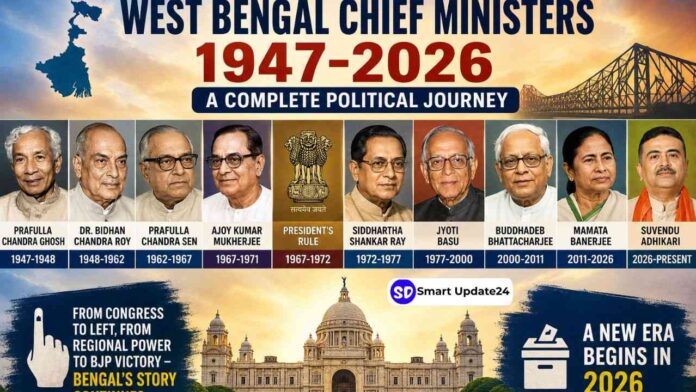
History of West Bengal Chief Ministers (1947-2026): Since India’s independence, West Bengal has witnessed a long and dramatic political journey—one that spans from the Congress party to the Bharatiya Janata Party. From legendary physicians and freedom fighters to Leftist leaders and influential figures in regional politics, the state’s political leadership has undergone numerous transformations over the past several decades. On May 9, 2026, Suvendu Adhikari was sworn in as the ninth Chief Minister of West Bengal; this marked a historic transition, as he became the first leader from the Bharatiya Janata Party (BJP) to assume the state’s highest political office.

This article presents a comprehensive list of West Bengal’s Chief Ministers from 1947 to 2026, alongside the periods during which the state was under President’s Rule. This list clearly illustrates the shifting dynamics of political power in Bengal—tracing the trajectory from the dominance of the Congress and the era of Left Front rule, through the rise of regional politics, and culminating in the BJP’s victory in the 2026 Legislative Assembly elections.
Dr. Prafulla Chandra Ghosh Became Bengal’s First Chief Minister
West Bengal’s first Chief Minister after independence was Dr. Prafulla Chandra Ghosh, who served from August 15, 1947, to January 22, 1948. His tenure came during one of the most difficult phases in Bengal’s history, immediately after Partition.

He was succeeded by the iconic Dr. Bidhan Chandra Roy, one of the most respected political figures in Bengal. Serving from January 23, 1948, to July 1, 1962, Dr. Roy played a massive role in shaping modern West Bengal. Cities like Durgapur, Bidhannagar, and Kalyani are often associated with his development vision.
List of West Bengal Chief Ministers and President’s Rule (1947–2026)
| Period | Chief Minister / Rule |
|---|---|
| 15 August 1947 – 22 January 1948 | Prafulla Chandra Ghosh |
| 23 January 1948 – 1 July 1962 | Dr. Bidhan Chandra Roy |
| 2 July 1962 – 15 March 1967 | Prafulla Chandra Sen |
| 15 March 1967 – 2 November 1967 | Ajoy Kumar Mukherjee |
| 2 November 1967 – 20 February 1968 | President’s Rule |
| 25 February 1969 – 16 March 1970 | Ajoy Kumar Mukherjee |
| 19 March 1970 – 2 April 1971 | President’s Rule |
| 2 April 1971 – 28 June 1971 | Ajoy Kumar Mukherjee |
| 29 June 1971 – 19 March 1972 | President’s Rule |
| 20 March 1972 – 21 June 1977 | Siddhartha Shankar Ray |
| 21 June 1977 – 6 November 2000 | Jyoti Basu |
| 6 November 2000 – 13 May 2011 | Buddhadeb Bhattacharjee |
| 20 May 2011 – 4 May 2026 | Mamata Banerjee |
| 9 May 2026 – Present | Suvendu Adhikari |
History of West Bengal Chief Ministers: Political Instability Marked the 1960s and 1970s
After Dr. Roy’s death, Prafulla Chandra Sen took charge in 1962. Bengal then entered a politically unstable phase with frequent changes in government.
Ajoy Kumar Mukherjee served multiple times as Chief Minister between 1967 and 1971, interrupted by several periods of President’s Rule. The late 1960s and early 1970s were marked by political unrest, food movements, and growing ideological battles.
Siddhartha Shankar Ray became Chief Minister in 1972 and remained in office until 1977. His tenure is still debated in political discussions because of the Emergency period and the handling of Naxalite movements.
The Left Front Era Changed Bengal Politics
In 1977, Jyoti Basu came to power and began one of the longest-serving elected communist governments in the world. He remained Chief Minister until 2000 and became one of the most influential Left leaders in Indian politics.
After him, Buddhadeb Bhattacharjee led the state from 2000 to 2011. His government focused more on industrialization and IT growth, but land acquisition controversies later weakened the Left Front’s political hold.
Also Read: Suvendu Adhikari to Take Oath as West Bengal CM on May 9 After BJP Landslide Victory
Mamata Banerjee Ended 34 Years of Left Rule
The 2011 Assembly election became a historic turning point when Mamata Banerjee defeated the Left Front and ended 34 years of communist rule in Bengal.
She remained Chief Minister from May 20, 2011, to May 4, 2026, becoming one of the longest-serving leaders in the state’s recent history. During her tenure, schemes related to social welfare, women’s empowerment, rural roads, and student support gained national attention.
At the same time, her government frequently faced criticism from opposition parties over law and order, political violence, corruption allegations, and unemployment issues.
History of West Bengal Chief Ministers: Suvendu Adhikari Begins a New Political Chapter in 2026
According to the graphic, Suvendu Adhikari took office as Chief Minister on May 9, 2026, after the BJP secured a decisive victory in the West Bengal Assembly election.
His rise marks a major political shift in Bengal. Once a key Trinamool Congress leader, Adhikari later joined the BJP and emerged as one of Mamata Banerjee’s strongest political challengers.
Supporters see his appointment as the beginning of a new administrative and political direction for the state, while opponents remain cautious about how the new government will handle Bengal’s complex economic and social challenges.
